Chattahoochee County, a district of about 1,000 students on the Alabama border, cut its chronic absenteeism rate from 13.2% to 5.3% between 2019 and 2025. Chickamauga City, about 1,300 students in northwest Georgia, held steady at 4.8%. Clay County, 182 students in the rural southwest, dropped from 7.4% to 4.9%.
These are three of the 12 Georgia school districts that have returned to their pre-pandemic attendance levels.
Out of 194.
Three years after chronic absenteeism peaked statewide at 24.4% in 2021-22, Georgia has clawed back barely a third of the ground it lost. The rate sat at 20.4% in 2024-25, meaning one in five students missed 10% or more of the school year. That is 377,482 children. Before COVID, it was 245,747.
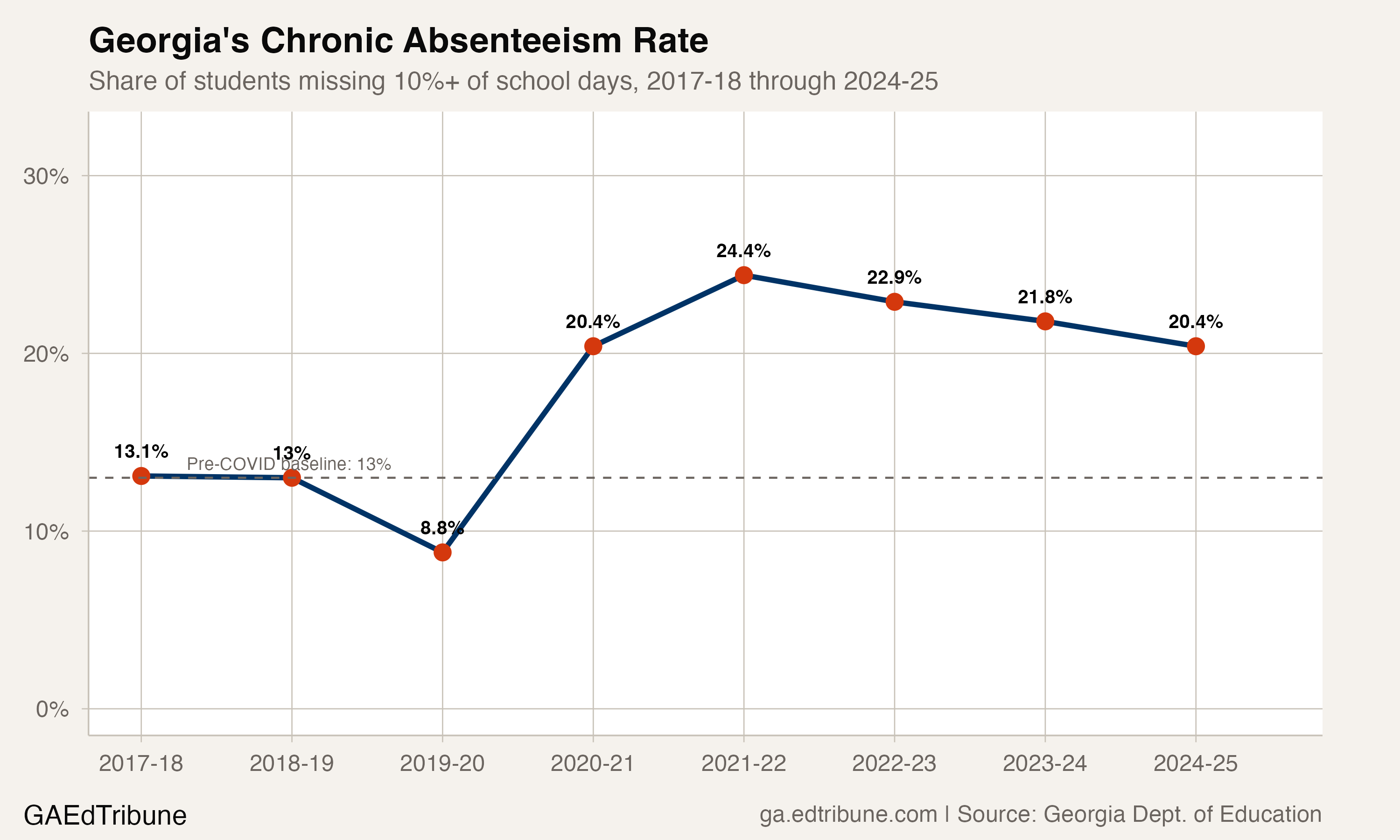
131,735 more students missing school
The raw numbers sharpen the picture. Georgia has 131,735 more chronically absent students than it did in 2018-19, despite total enrollment falling by about 40,000 over that period. The state has recovered 35.1% of the gap between its 2022 peak and its 2019 baseline. At the current pace of 1.3 percentage points of improvement per year, Georgia would not return to its pre-pandemic rate until 2031, six years from now.
State Superintendent Richard Woods joined the national 50% Challenge, committing to halve chronic absence within five years. That pledge targets a rate of roughly 10%, well below even the 2019 baseline.
"Put simply, students cannot learn when they are not in school. When absences add up, it limits their opportunities and puts their futures at risk." — Richard Woods, State Superintendent, August 2025
The gap between that ambition and the trajectory is stark. Reaching a 10% rate from Georgia's 2024-25 rate of 20.4% would require roughly eight more years at the current pace of improvement.
The middle has hollowed out
Before COVID, more than half of Georgia students (51.9%) fell into the "good attendance" category: five or fewer days missed per year. By 2024-25, that share had dropped to 38.8%. The loss did not flow equally to the extremes. The at-risk middle category, students missing six to 15 days, swelled from 36.0% to 41.5%. Severe absence (more than 15 days) went from 12.1% to 19.7%.
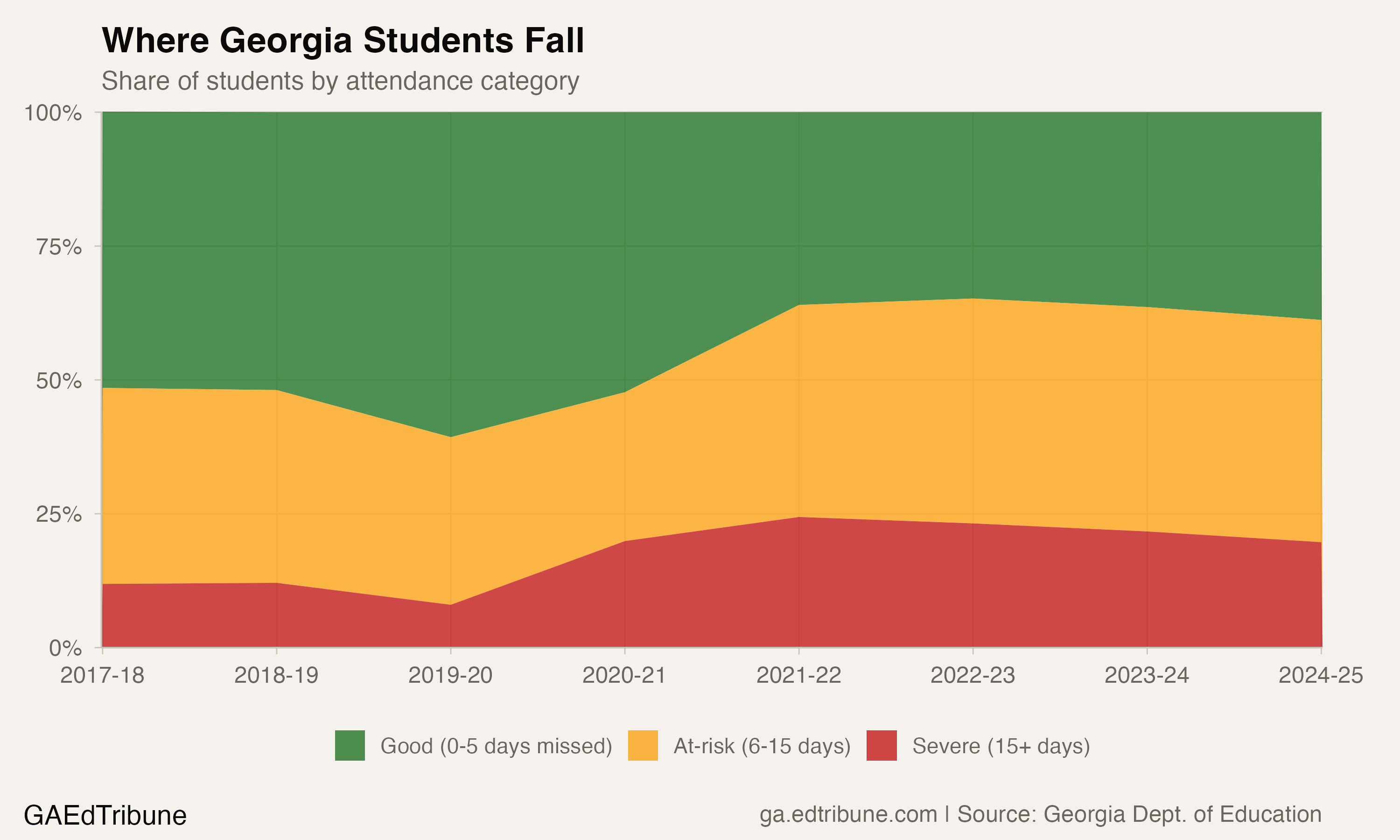
The at-risk band now contains the largest share of students, a structural shift from the pre-pandemic distribution. In 2018-19, the good-attendance group was 15.9 points larger than the at-risk group. By 2024-25, the at-risk group was 2.7 points larger. Georgia did not just lose students from the "good" category to "chronically absent." It lost the middle. The typical student now misses more school than before, even if many of them have not yet crossed the 10% threshold that defines chronic absence.
Where the recovery failed
The 12 districts that managed to recover are overwhelmingly small and rural. Chattahoochee County has Fort Benning anchoring its community. Clay County has 182 students. Chickamauga City has about 1,300. The median enrollment among recovered districts is about 1,400 students.
Superintendent Kimothy Hadley, who arrived at Chattahoochee County after a stint in Sumter County, said the district's turnaround came from layering interventions. "We implemented attendance recovery programs, daily tracking to identify data errors, and incentives like block parties and pizza parties," Hadley said. Daily tracking mattered as much for catching administrative mistakes as for flagging students at risk -- inaccurate records had been inflating the district's numbers. Hadley said the close-knit community around Fort Benning helped, but the work was deliberate: "Student engagement drives achievement, and it is affected by daily attendance."
No district in metro Atlanta has recovered. Among the 10 largest systems in the state, every one is worse off than in 2019.
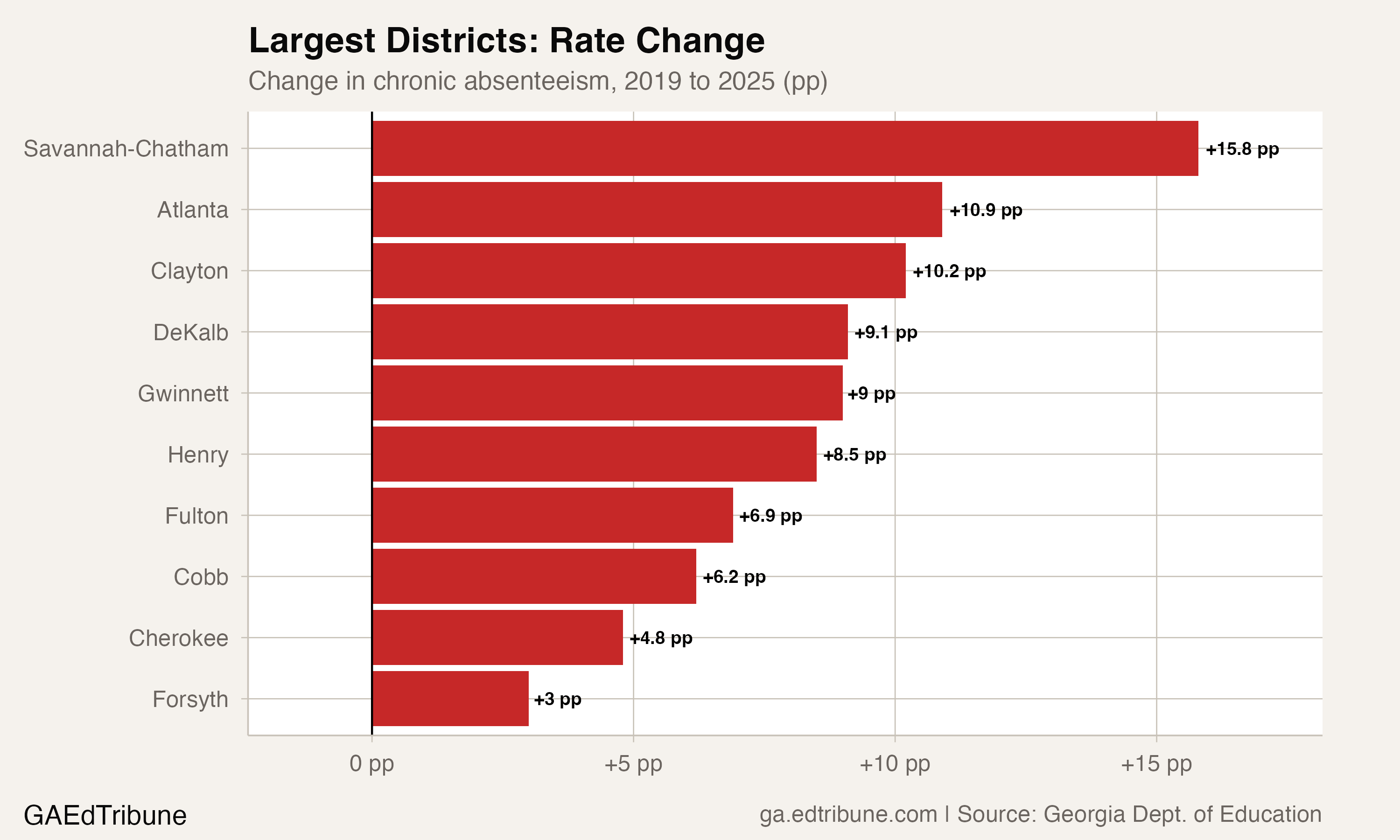
Savannah-Chatham County saw the largest deterioration: its chronic rate jumped from 8.5% to 24.3%, a 15.8 percentage-point increase that nearly tripled its pre-pandemic level. Atlanta Public Schools went from 21.0% to 31.9%. Even Forsyth County, the best performer among the big 10, still worsened by 3.0 points.
The median district is 5.8 percentage points worse than before the pandemic. Forty districts worsened by 10 or more points.
The racial gap that did not recover
Before COVID, the gap between Black and white chronic absenteeism rates in Georgia was 2.9 percentage points: 15.0% versus 12.1% in 2018-19. By 2024-25, that gap had more than doubled to 7.5 points, with Black students at 24.4% and white students at 16.9%.
Both groups improved from their 2022 peaks. White students recovered faster, dropping 4.7 points from their peak of 21.6%. Black students dropped 3.9 points from 28.3%. The unequal pace of recovery means the gap is wider now than it was during the 2021-22 peak chronic year, when it stood at 6.7 points.
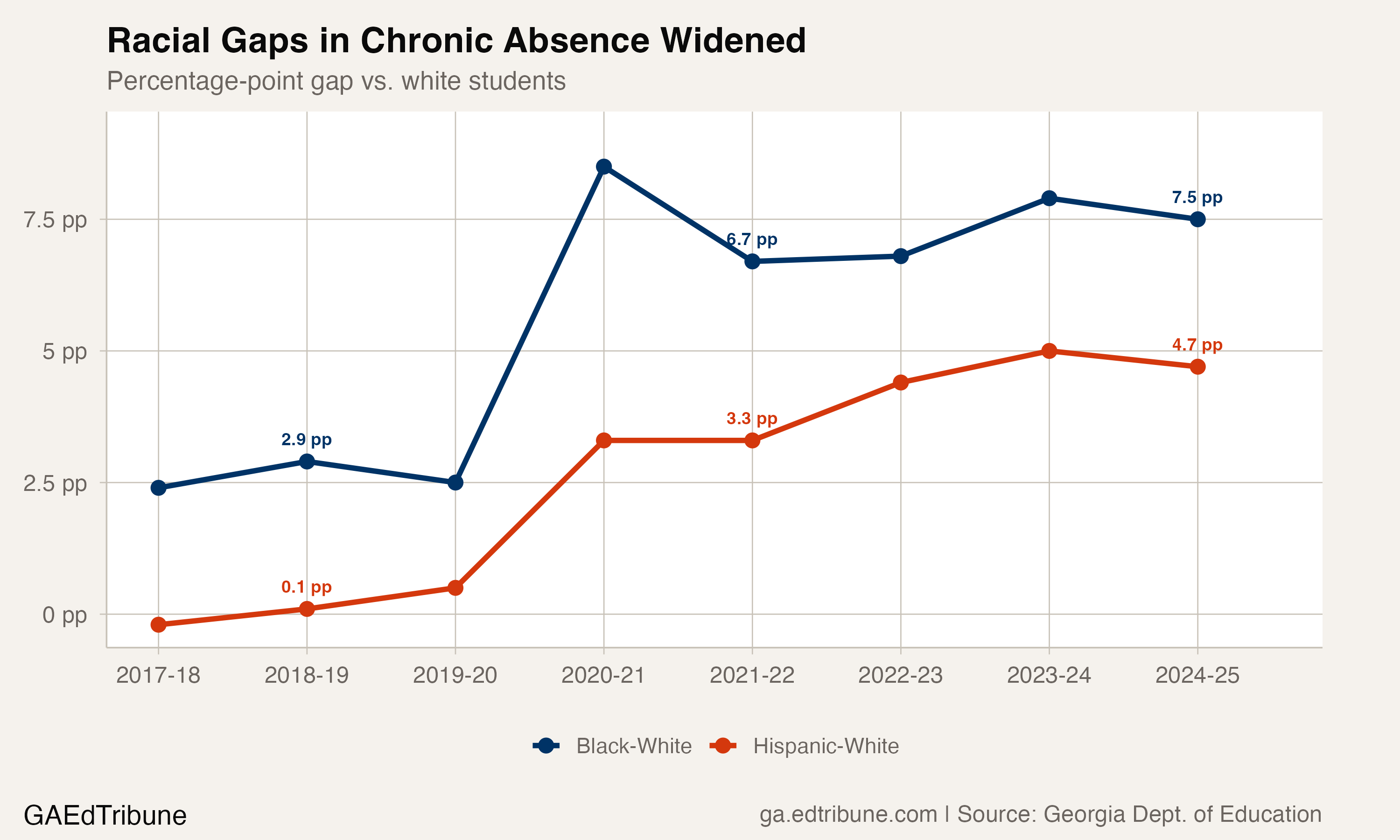
The Hispanic-white gap tells a parallel story. In 2018-19, it barely existed: 0.1 percentage points. By 2024-25 it had expanded to 4.7 points. Hispanic students are chronically absent at a rate of 21.6%, compared to 16.9% for white students.
Black students represent 37.0% of Georgia's enrollment but an outsized share of chronic absence. The poverty gap compounds this: economically disadvantaged students have a chronic rate of 23.5%, compared to 12.1% for their peers, an 11.4 percentage-point divide. Since Black students are overrepresented among economically disadvantaged students in Georgia, these gaps reinforce each other.
What sits behind the numbers
The most commonly cited explanation is cultural: the pandemic made missing school more acceptable. A Georgia Public Policy Foundation analysis argued that missing school had become far more socially acceptable than it was five years earlier. That framing carries some weight. The 2019-20 school year, when buildings closed and instruction went virtual, registered an artificially low 8.8% chronic rate. The norms around school attendance fractured and have not fully reset.
But a cultural-shift explanation struggles to account for the racial and economic concentration of the problem. If permissiveness were the primary driver, the increase would be more evenly distributed. The data suggest structural barriers. Georgia ranks 49th nationally for mental health care access, according to Mental Health America. The state's school counselor ratio is one per 450 students, nearly double the recommended 1:250, and 151 of Georgia's 159 counties face a shortage of mental health providers. Children wait six to eight months for adolescent behavioral health specialist appointments.
Transportation is another barrier, particularly in rural Georgia, where bus driver shortages have persisted since the pandemic. The at-risk band (six to 15 days missed) is the largest attendance category now, and transportation disruptions can easily push a student from occasional misses into chronic territory.
Hadley, whose Chattahoochee County is one of the few success stories, said the challenges are similar regardless of district size. "The main constraint is securing the resources to address attendance issues and implement targeted interventions," he said. For a district of 1,000 students, a dedicated attendance recovery program is a significant budget line. For a district of 50,000, it is a question of scale.
A legislative response, untested
Governor Kemp signed SB 123 in April 2025, the state's first update to compulsory attendance law in 18 years. The bill prohibits schools from expelling students solely for absences, requires districts with chronic rates above 10% to form attendance review teams, and mandates schools above 15% to do the same.
"For far too long, absenteeism has affected our communities and inhibited Georgia students" from reaching their potential. — Sen. John F. Kennedy, R-Macon, Senate Press Office
When Kennedy introduced the bill, the Senate press office noted that the number of chronically absent students in Georgia had doubled between 2019 and 2023 and that 21.7% of students, roughly 360,000, missed 10% or more of school days in 2024.
The law took effect July 1, 2025. Each county's student attendance committee must adopt a written attendance protocol by June 2026. The 2024-25 data analyzed here captures the last school year before SB 123's provisions began operating. Whether the law's intervention-first framework produces measurable improvement will not be visible in the data until the 2025-26 school year.
What the next year will show
Every large district, every metro system, every community with more than a few thousand students is worse off than six years ago. The improvement has been real -- 4.0 percentage points off the peak. But the pace has stalled: a 1.5-point drop in 2022-23, then 1.1, then 1.4. No acceleration. The annual improvement would have to double for Georgia to return to its pre-pandemic rate before the end of the decade.
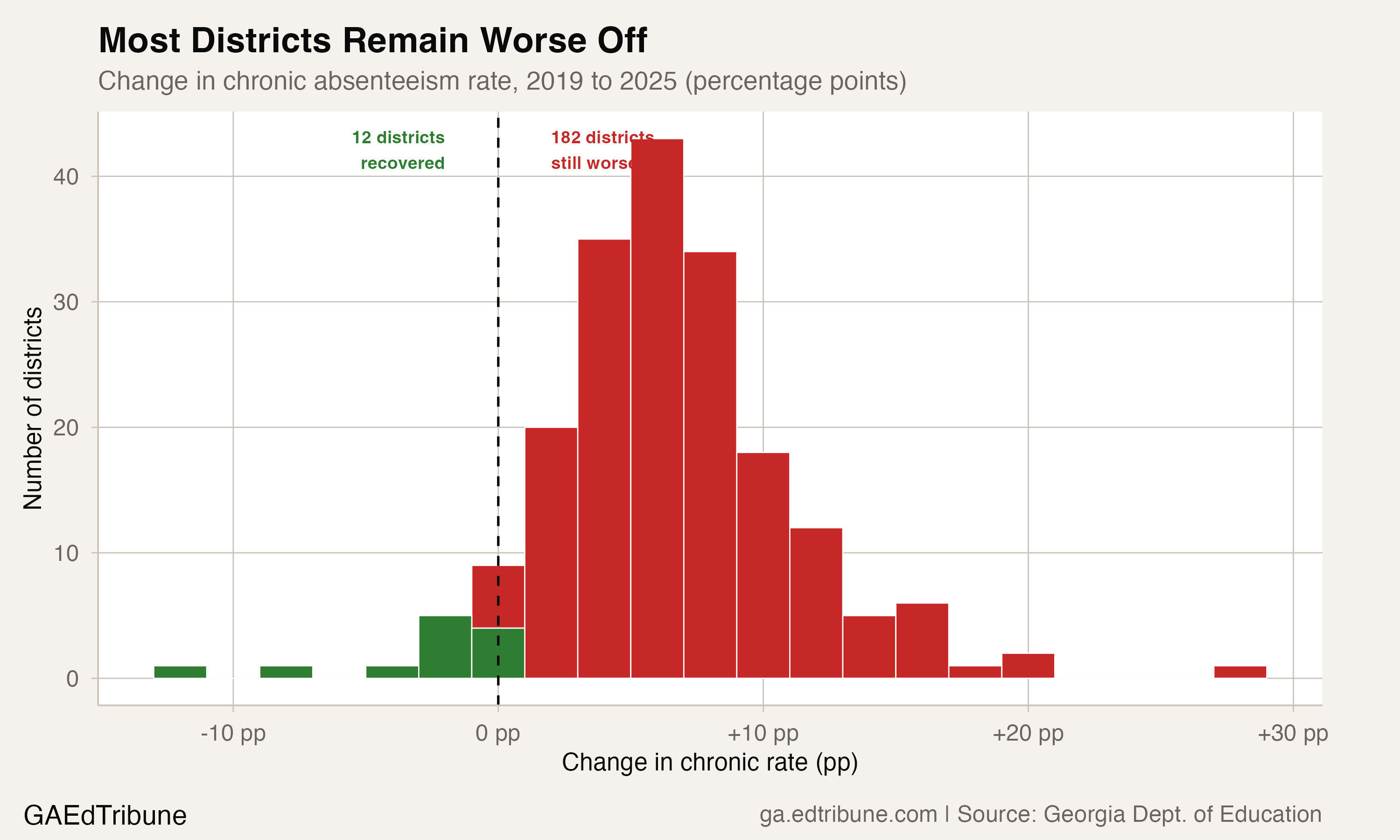
The 12 recovered districts are real. So is the math: 182 districts are still worse off than they were before anyone had heard of remote learning. For 377,482 students, three years of gradual improvement has not been fast enough.
Detailed code that reproduces the analysis and figures in this article is available exclusively to EdTribune subscribers.
Discussion
Sign in to join the discussion.
Loading comments...