Correction (August 17, 2026): An earlier version calculated the share of chronically absent Black students from the six selected race rows rather than Georgia's published all-students total. The corrected share is 44.2%, not 44.3%, and the Black-student disproportionality ratio is 1.19, not 1.20. The underlying attendance rates and Black-white gap are unchanged.
In the 2018-19 school year, Black students in Georgia missed school at a rate of 15.0%. White students, 12.1%. The difference, 2.9 percentage points, was small enough that a reasonable person might have looked at it and concluded that chronic absenteeism in Georgia was, if not equitable, at least not dramatically unequal.
Six years later, the gap has ballooned to 7.5 percentage points: 24.4% of Black students chronically absent versus 16.9% of white students. Both groups got worse. But Black students got worse faster, recovered slower, and are now missing school at a rate far above where they stood a decade ago. The pandemic did not create this disparity. It detonated it.
51,000 students on the wrong side of the line
The arithmetic is blunt. If Black students in Georgia were chronically absent at the same rate as white students, roughly 51,300 fewer Black students would miss 18 or more school days per year. That is the size of a mid-sized Georgia school district, the approximate enrollment of Fulton County's traditional schools, vanishing into absence.
Black students make up 37.0% of Georgia's enrollment but account for 44.2% of all chronically absent students. White students make up 33.0% of enrollment and 27.3% of the chronically absent. The disproportionality ratio for Black students is 1.19: for every percentage point of enrollment, they carry 1.2 percentage points of chronic absence.
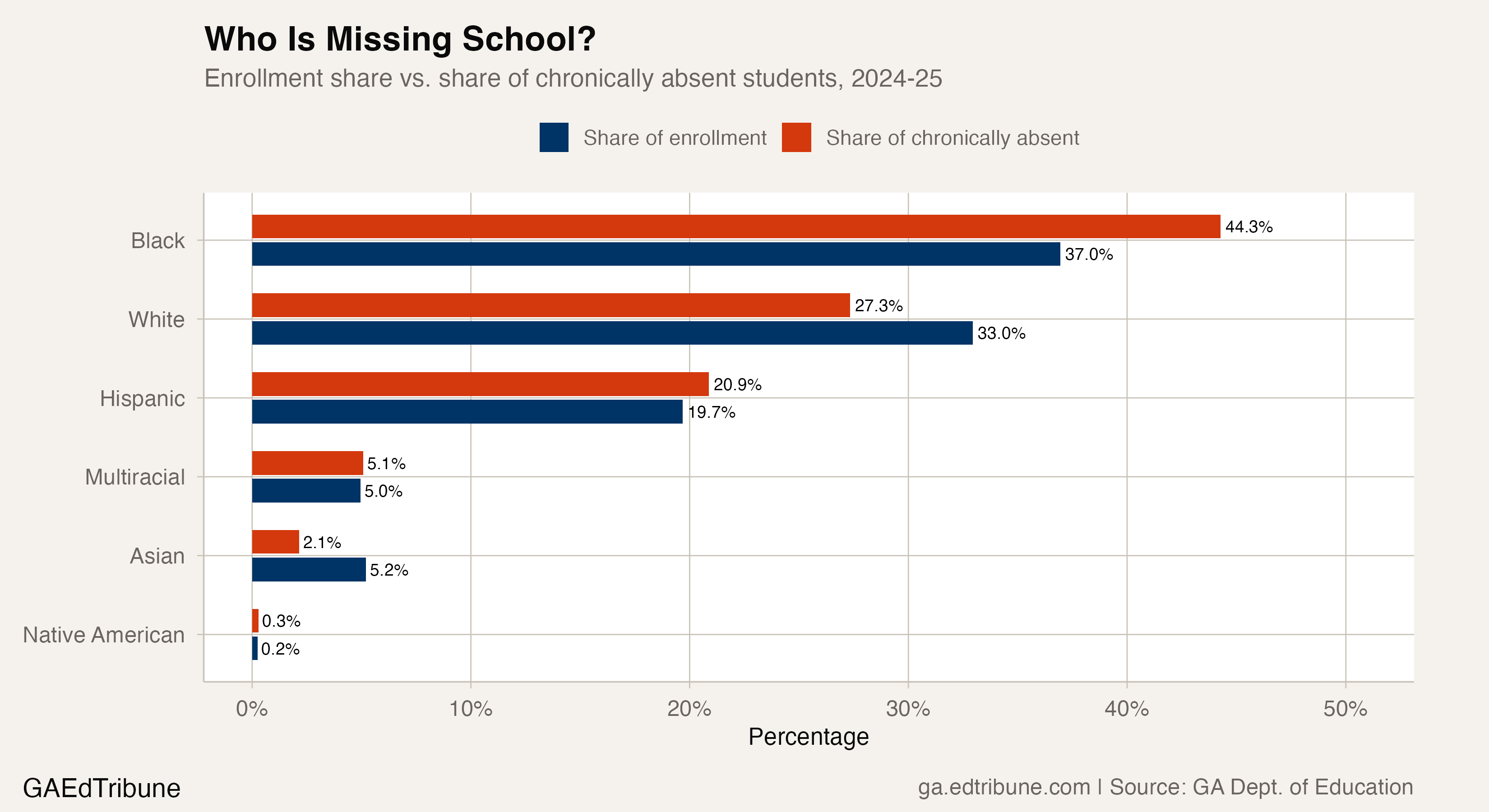
Hispanic students, who were virtually indistinguishable from white students on this measure before COVID (12.2% vs. 12.1% in 2019), now sit at 21.6%, a gap of 4.7 percentage points that emerged from near-zero. Asian students, at 8.4%, remain the only racial group below pre-pandemic white rates.
The paradox: overall rates fall, the gap grows
Georgia's statewide chronic absenteeism rate peaked at 24.4% in the 2021-22 school year and has dropped to 20.4% in 2024-25. That looks like progress, and in aggregate, it is. The state has recovered about a third of the ground lost during the pandemic.
But the recovery has been uneven in a specific, patterned way. White chronic absenteeism peaked at 21.6% and has fallen 4.7 points to 16.9%. Black chronic absenteeism peaked at 28.3% and has fallen only 3.9 points to 24.4%. The gap was 6.7 points at the crisis peak in 2022. It is 7.5 points now.
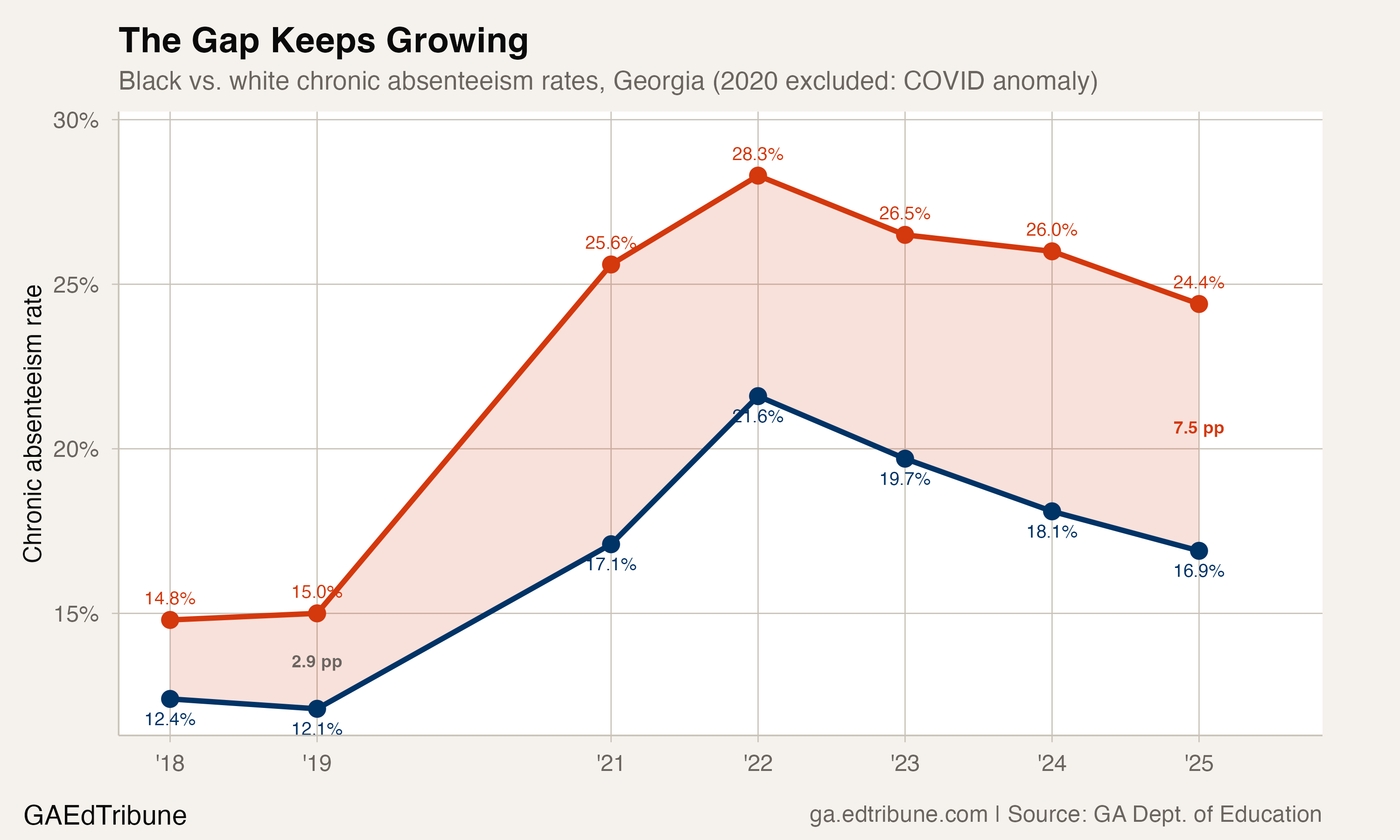
This is the most counterintuitive finding in the data: the equity gap is wider during the recovery than it was at the height of the crisis. White families, on average, have found their way back to regular attendance faster. Black families, on average, have not, and no single explanation accounts for why.
Every group worse, but not equally
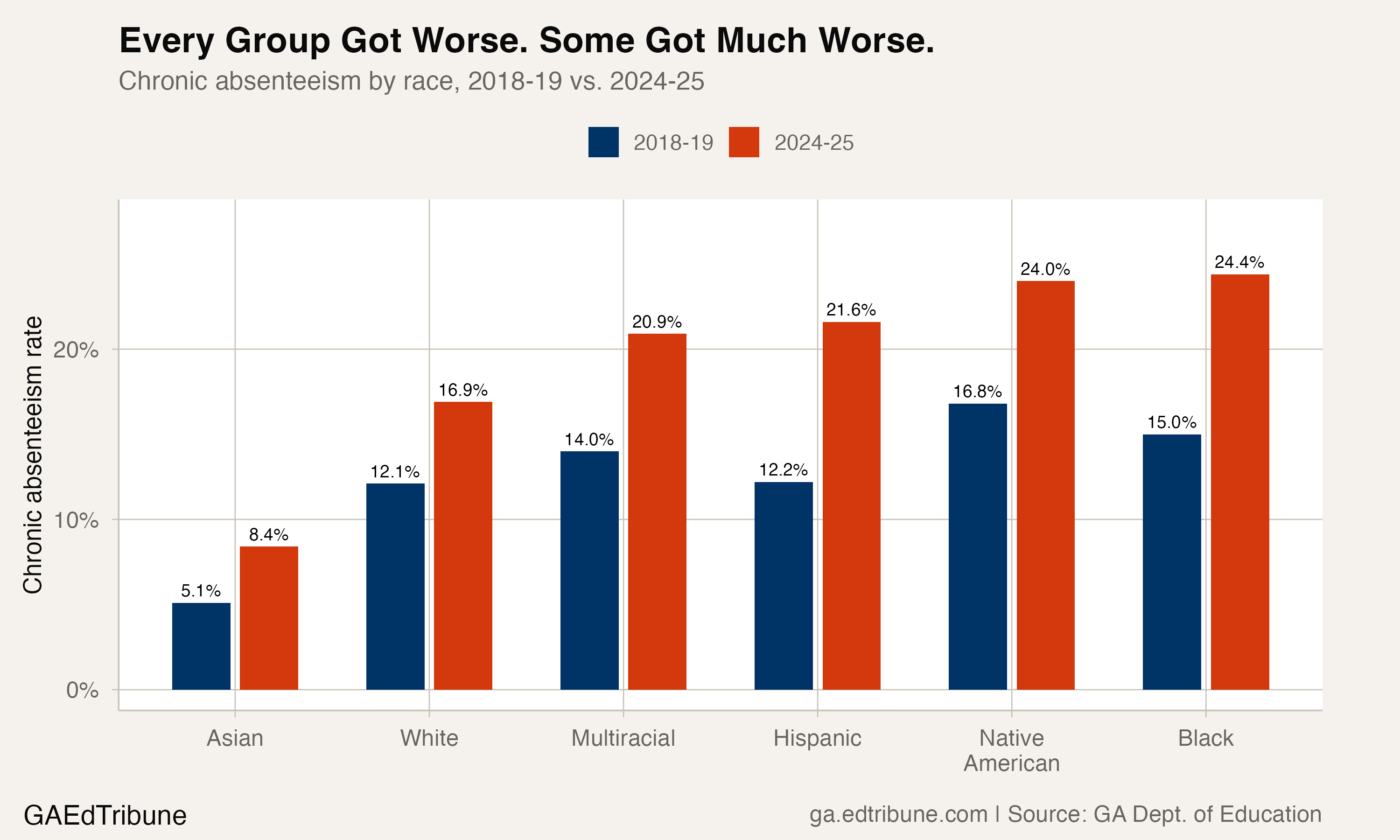
The before-and-after, 2019 to 2025, makes the scale visible. Asian students went from 5.1% to 8.4%. White students, 12.1% to 16.9%. Black students, 15.0% to 24.4%. Native American students, 16.8% to 24.0%. Every racial group in Georgia is worse off than before the pandemic. None have recovered.
The severe absence band tells a sharper story. Among Black students, 22.4% missed more than 15 days in 2024-25, compared to 17.5% of white students. Nearly one in four Black students in Georgia is not just chronically absent but severely absent, missing more than two weeks of instruction.
Inside the districts
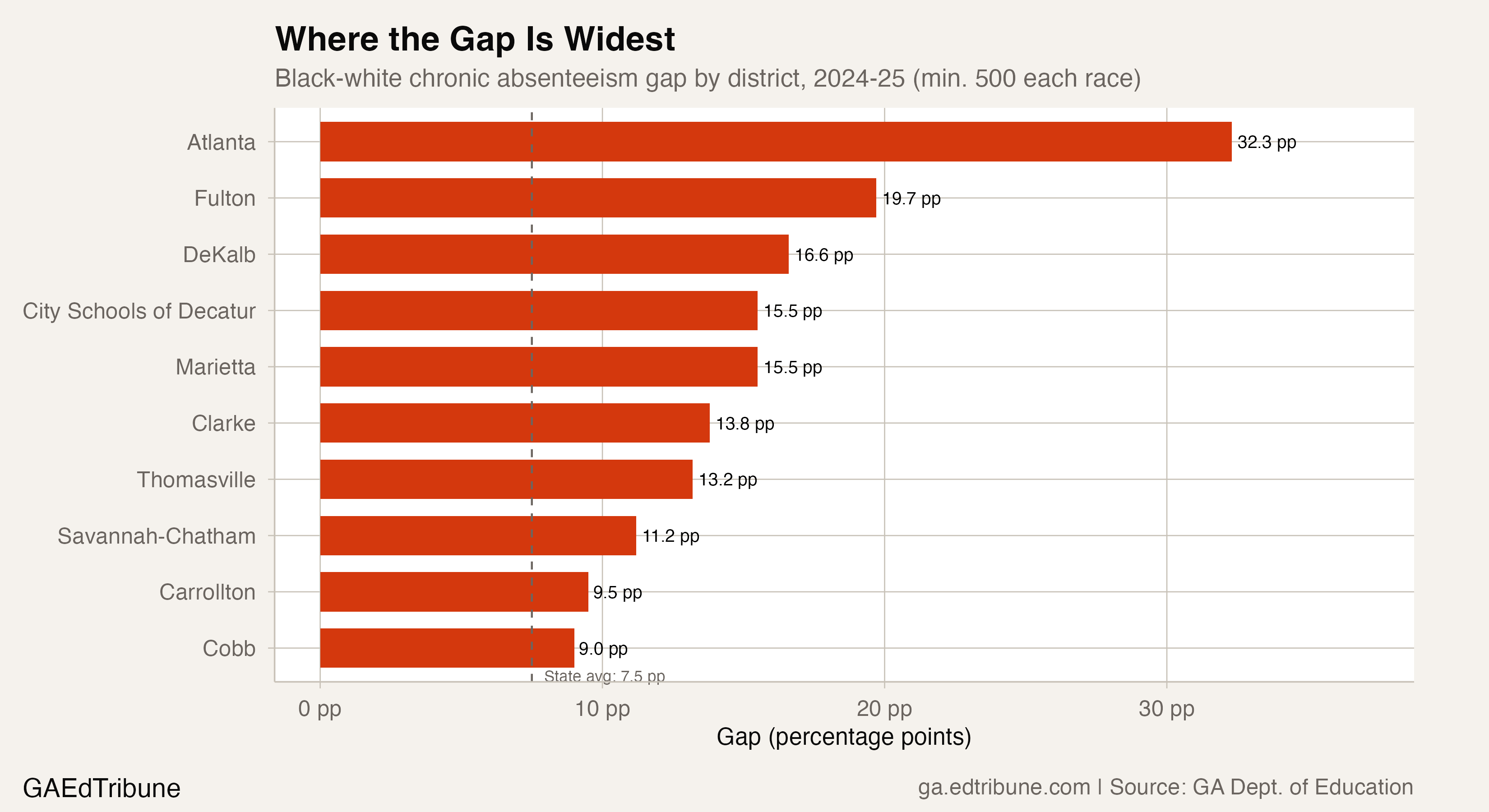
The statewide average masks enormous local variation. Atlanta Public Schools has the widest Black-white gap among large districts: 32.3 percentage points (38.9% for Black students vs. 6.6% for white students). Fulton County's gap is 19.7 points. DeKalb County's is 16.6 points. In each case, the district-level gap far exceeds the state average of 7.5 points.
At Cleveland Avenue Elementary in southwest Atlanta, social workers deployed by the District Attendance Review Team have been knocking on doors, identifying what keeps students home. "Sometimes the barrier is not just attendance. Sometimes attendance is a symptom of a bigger problem," Summer Pace, a school social worker, told WSB-TV. APS has placed social workers in every school and offered incentives including gift cards and classroom reward days. The district's overall rate dropped from a 38.5% peak to 31.9%, but that rate is still more than double Forsyth County's 8.7%, 30 miles north.
A handful of districts show the reverse pattern. In Worth County, Clayton County, and Putnam County, white students have higher chronic absenteeism rates than Black students. These are exceptions, not the rule, and most involve small sample sizes or credit-recovery alternative programs that distort the numbers.
Three gaps, one direction
The Black-white gap is the largest racial absence gap in Georgia, but it is not the only one widening. The Hispanic-white gap, the poverty gap, and the Black-white gap all moved in the same direction: up during the pandemic, and stubbornly resistant to recovery.
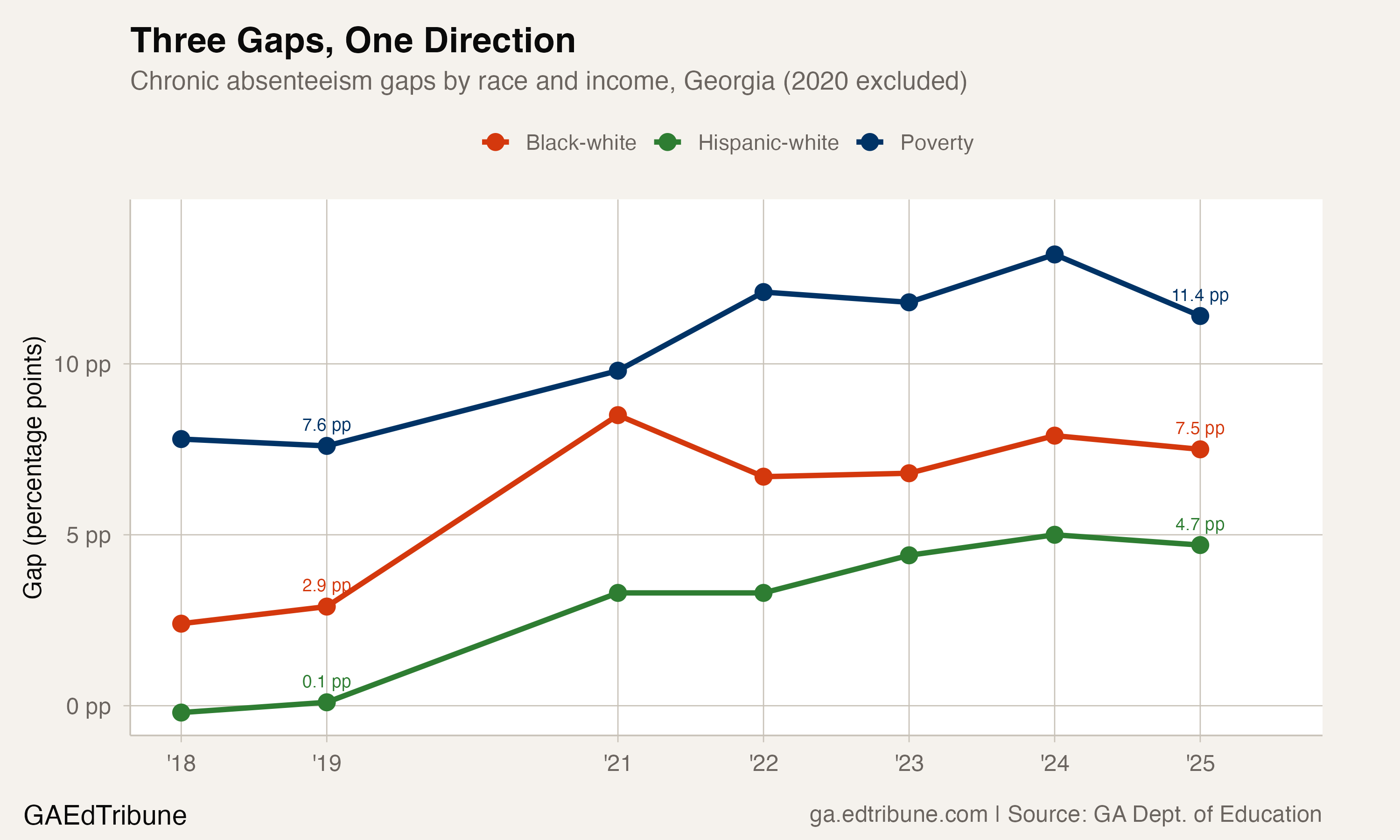
The poverty gap (economically disadvantaged vs. not) is the largest in absolute terms: 11.4 percentage points in 2025, up from 7.6 in 2019. It peaked at 13.2 points in 2024 before narrowing slightly. Because race and poverty overlap substantially in Georgia's student population, these gaps compound: a Black student from an economically disadvantaged household faces both the racial gap and the poverty gap simultaneously. The data cannot separate how much of the racial gap is explained by income, and how much persists independent of it.
The question the data raises but cannot answer
The deepest puzzle in this data is not that the gap exists. Racial gaps in school attendance predate the pandemic and predate this dataset. The puzzle is that the gap is still growing three years into recovery. White chronic absenteeism has fallen 4.7 points from its peak. Black chronic absenteeism has fallen only 3.9 points. Whatever is pulling students back into regular attendance, whether it is employer schedule flexibility, reliable transportation, stable housing, or simply the gravitational pull of routine, it is pulling harder on one side of the line than the other.
Georgia has 377,482 chronically absent students, 131,735 more than in 2019. Those students are not evenly distributed across the state's racial landscape. Until the recovery reaches them at the same pace, Georgia's attendance crisis is also an equity crisis, and one that the statewide average, by definition, cannot see.
Detailed code that reproduces the analysis and figures in this article is available exclusively to EdTribune subscribers.
Discussion
Sign in to join the discussion.
Loading comments...