At Five Forks Middle School in Gwinnett County, federal officials stood at a podium in October 2024 and announced $19 million in mental health grants for the district. One counselor for every 450 students, they noted, was not enough. The money would train new social workers, expand telehealth, and build a pipeline of school psychologists.
Twelve months later, 36,659 Gwinnett students were chronically absent. That is more than any other district in Georgia, more than the entire enrollment of most Georgia counties, and nearly double the number missing school before the pandemic.
The largest district, the largest problem
Gwinnett County Public Schools enrolls 199,231 students across 142 schools. It is the largest district in Georgia, the most ethnically diverse, and home to families speaking more than 100 languages. It is also, by raw count, the state's biggest contributor to the chronic absenteeism crisis.
The district's chronic rate stood at 9.4% in 2018-19. By 2024-25, it had reached 18.4%, a 1.96x increase. The trajectory was not a clean spike and recovery. Gwinnett actually peaked later than the state: its worst year was 2023-24 at 19.6%, two full years after Georgia hit its statewide high of 24.4% in 2021-22. The 1.2 percentage point drop in 2024-25 is the district's first improvement since the pandemic began.
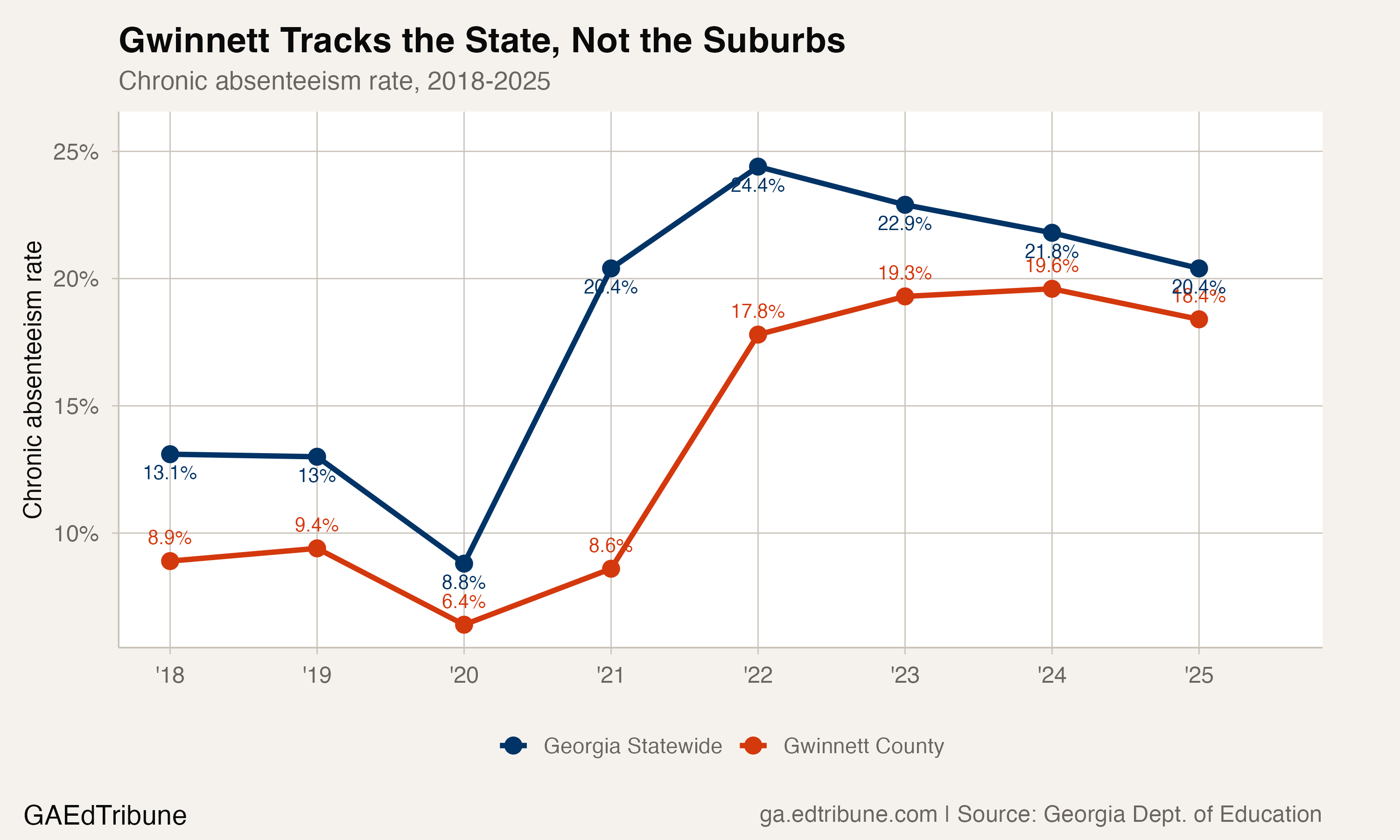
The comparison to the statewide line is instructive. Before COVID, Gwinnett ran 3.6 points below the state average, a reflection of its suburban affluence and operational scale. That gap has narrowed to 2.0 points. Gwinnett is no longer meaningfully outperforming the state; it is converging with it.
What 18,000 more absent students looks like
In 2018-19, Gwinnett had 18,400 chronically absent students. In 2024-25, the number is 36,659. The difference, roughly 18,000 students, is the population of a mid-sized Georgia school district.
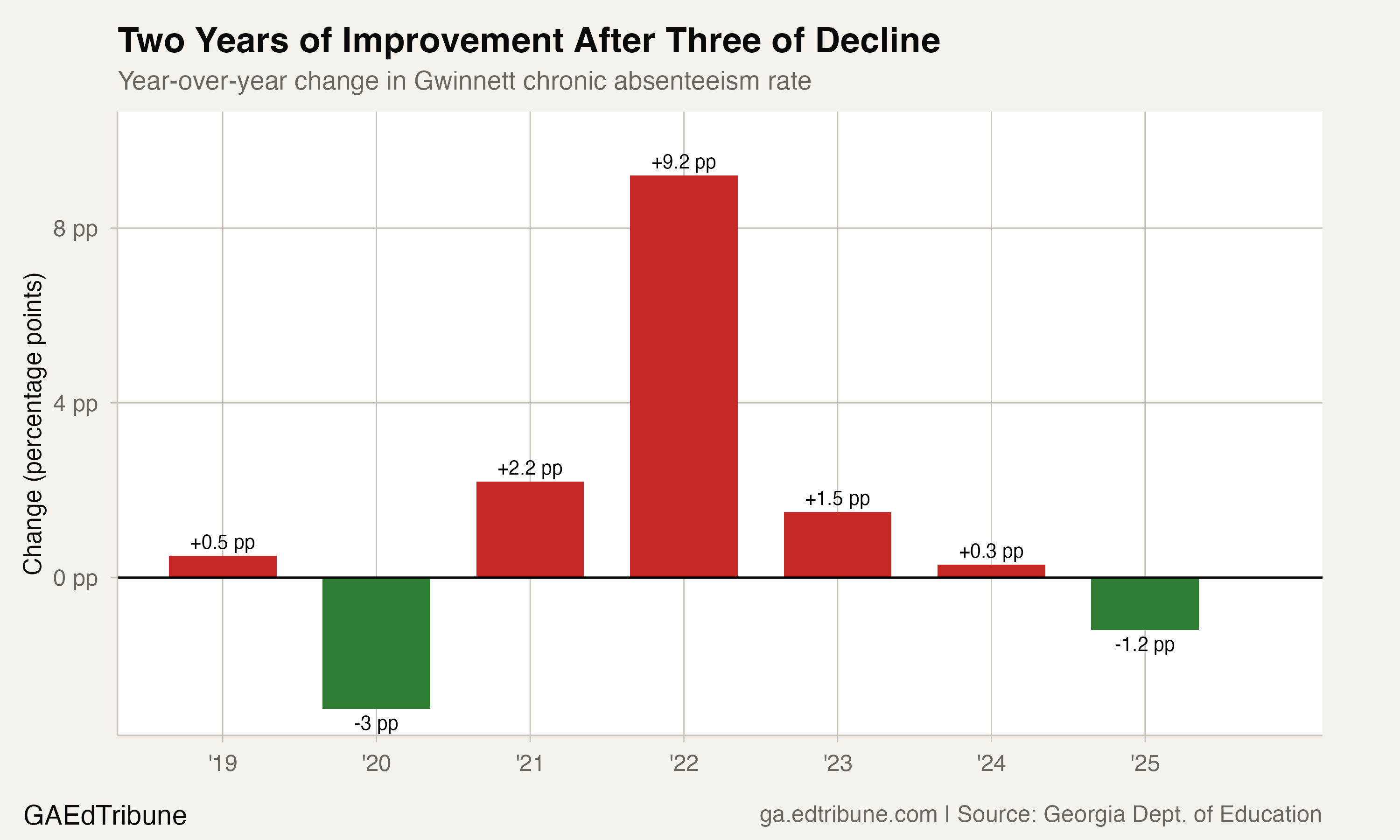
The year-over-year pattern reveals the damage was done in a single year. Between 2020-21 and 2021-22, Gwinnett's chronic rate jumped 9.2 percentage points, the largest single-year increase in the data. Two subsequent years of smaller increases (+1.5 and +0.3 points) pushed the rate to its 2023-24 peak before the modest 2024-25 pullback.
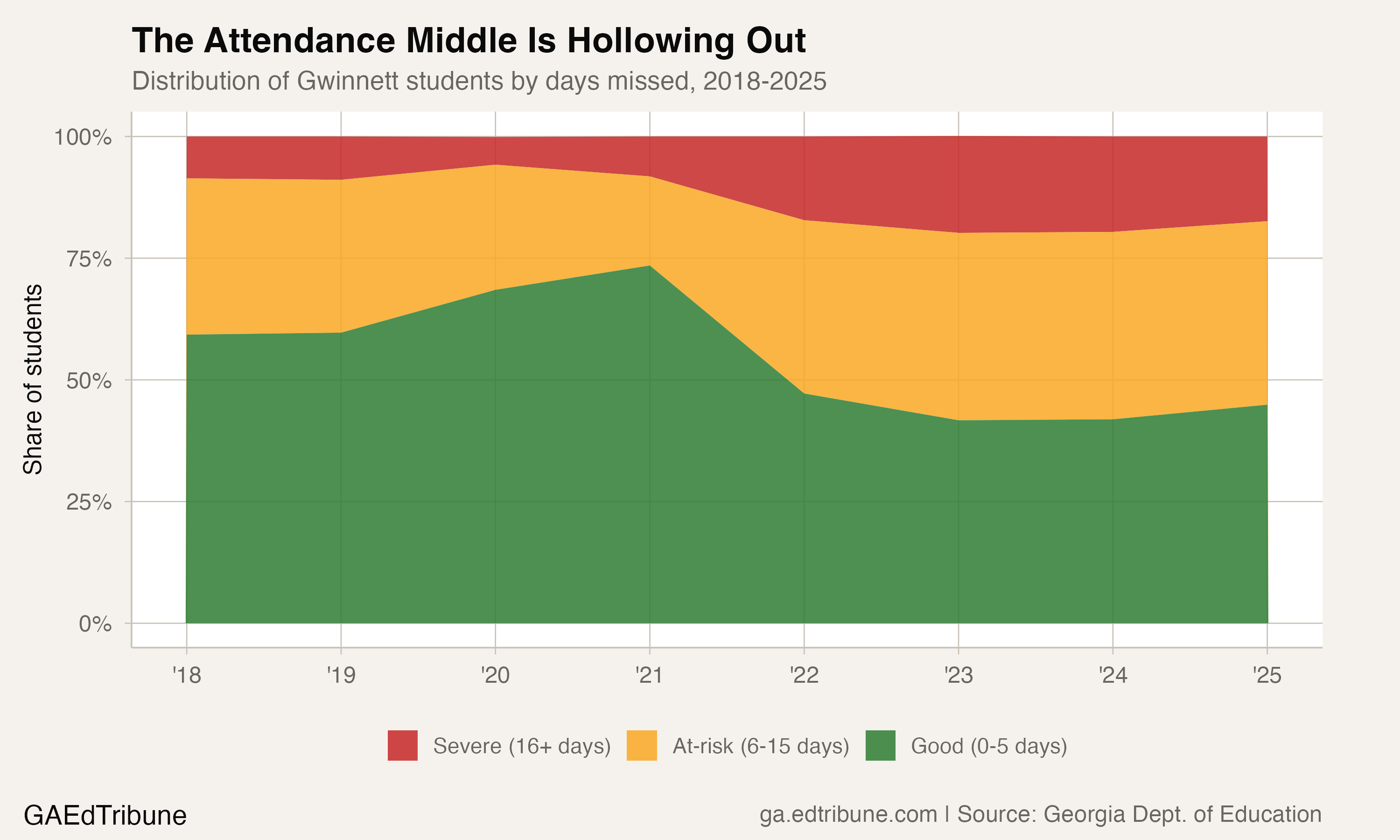
Before the pandemic, nearly 60% of Gwinnett students missed five or fewer days per year. That share has fallen to 44.9%. The severe absence category, students missing more than 15 days, doubled from 8.9% to 17.4%. Roughly one in six Gwinnett students is now missing more than three weeks of school annually.
The gap that isn't where you'd expect
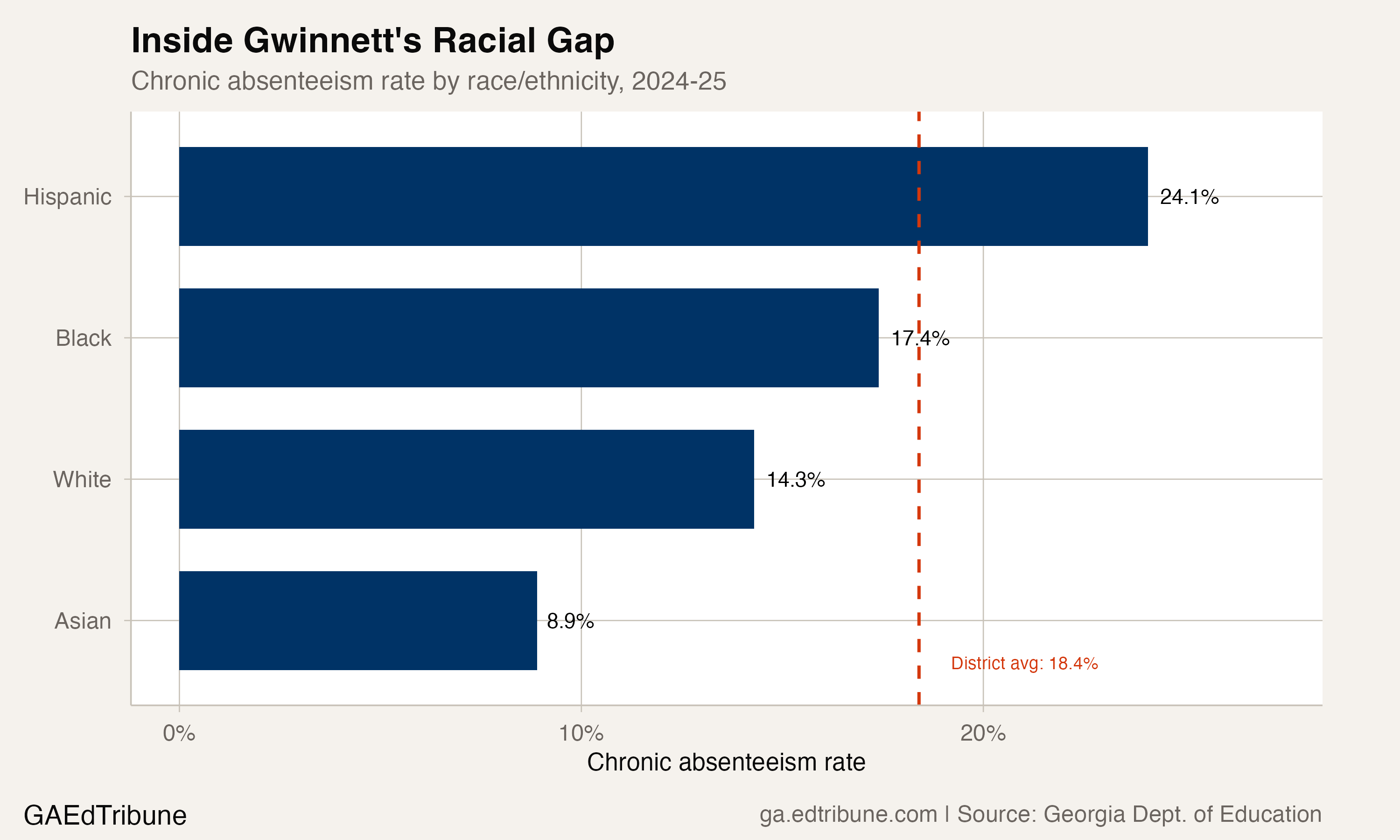
Gwinnett's internal disparities do not follow the pattern most Georgia districts exhibit. Statewide, the Black-white gap in chronic absenteeism is the dominant equity story: 7.5 percentage points in 2024-25. In Gwinnett, the Black-white gap is just 3.1 points (17.4% vs. 14.3%).
The larger story is Hispanic absenteeism. Hispanic students, who make up 37% of Gwinnett's enrollment and are the district's largest demographic group, have a 24.1% chronic rate, nearly 10 points above white students and 5.7 points above the district average. That rate has more than doubled from 11.8% in 2018-19.
English learners, a heavily overlapping population, tell a parallel story: 20.4% chronic absenteeism in 2024-25, up from 8.2% before the pandemic. Gwinnett's English learner population has also grown by 27%, from 44,187 to 56,286 students, meaning the district is simultaneously serving more multilingual families and losing more of them to chronic absence.
The pattern is consistent with research on language access barriers. When families cannot navigate attendance systems, communicate with school staff about excused absences, or access translated health resources, absences accumulate regardless of intent. Gwinnett's International Newcomer Center has served immigrant families for more than 30 years, but the scale of the current multilingual population may be outpacing the infrastructure designed to support it.
Where Gwinnett stands among its peers
Among metro Atlanta's largest districts, Gwinnett's 18.4% rate places it in the middle. Clayton County (28.8%), Atlanta Public Schools (31.9%), and DeKalb County (26.4%) are all substantially worse. Cobb County, Gwinnett's closest suburban peer, sits at 16.5%. Forsyth County, the wealthiest large district in metro Atlanta, holds at 8.7%.
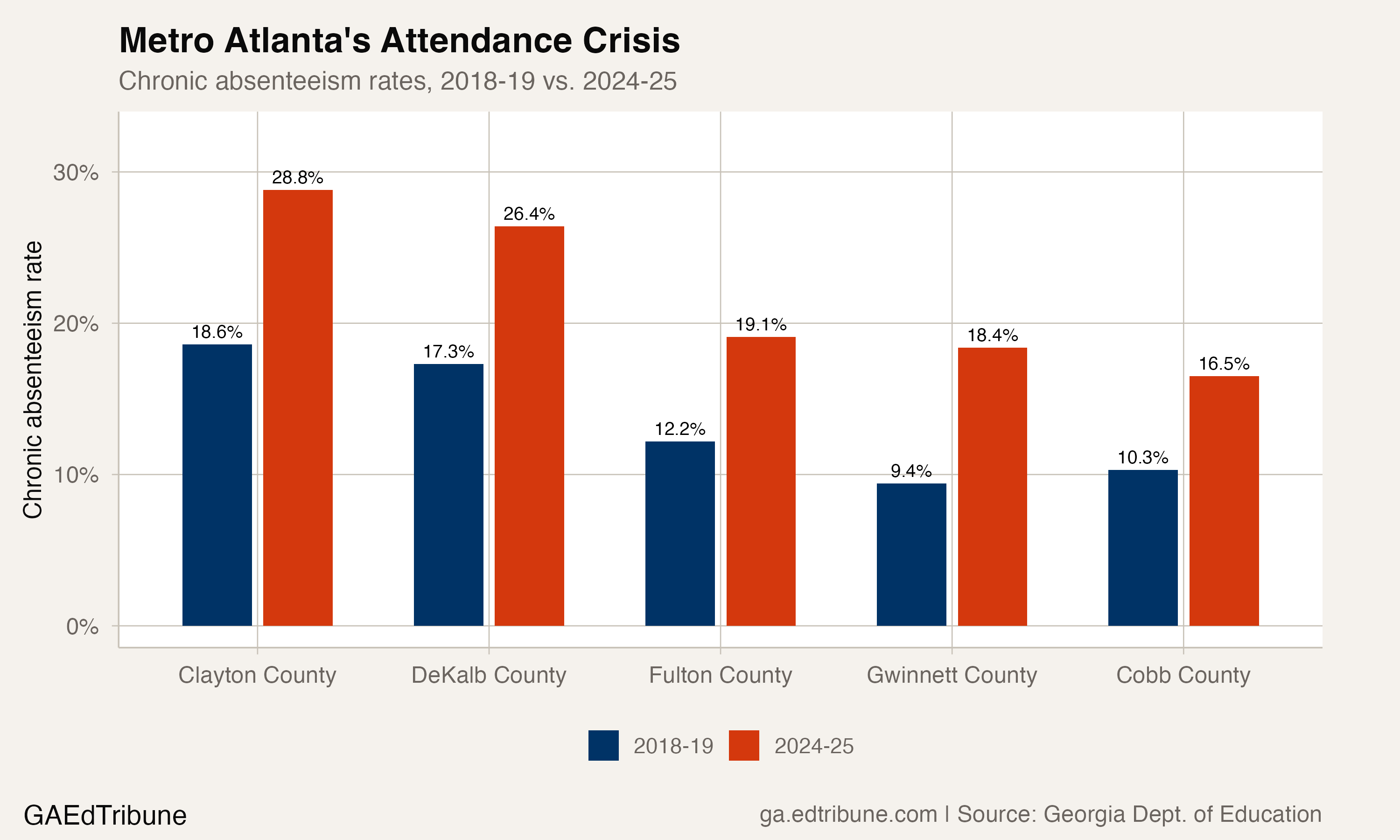
The more telling comparison is the rate of deterioration. Cobb's chronic rate grew 6.2 points since 2018-19. Gwinnett's grew 9.0 points over the same period, a 50% larger increase than its closest suburban peer, despite starting from a similar baseline. Gwinnett's demographic composition, which is substantially more diverse than Cobb's, likely explains part of the gap. But demographic mix alone does not account for a 9-point swing in six years; district-level factors, from transportation reliability to the depth of family engagement infrastructure, shape whether demographic diversity becomes an attendance liability.
The policy response
Georgia's legislature has begun treating chronic absenteeism as a crisis rather than a statistic. Governor Kemp signed SB 123 in April 2025, requiring districts with chronic rates above 10% to establish attendance review teams. Gwinnett, at 18.4%, falls well above that threshold.
The law prohibits expelling students solely for attendance problems and requires districts to investigate root causes, including mental health, housing instability, and transportation, rather than defaulting to punitive responses.
"This legislation will enable local school districts to identify and implement protocols that directly address this issue, get our chronically absent students back in the classroom." -- Sen. John F. Kennedy (R-Macon), Georgia Senate Press Office
The Senate Study Committee's final report, adopted unanimously in November 2025, proposed 22 recommendations including a three-tiered intervention model, real-time data systems, and a cross-agency task force spanning education, juvenile justice, health, housing, and transportation. Mental health providers who testified before the committee estimated that expanding services into elementary schools would cost the state roughly $34 million.
Gwinnett has its own investment to point to: the $19 million federal grant announced in 2024 for mental health staffing and training. The district's FY2025 budget funds five school social workers and 11 behavior coaches for a system of 142 schools. Whether that ratio is sufficient for a district where 36,659 students are chronically absent is the operating question.
What the first improvement means
The 1.2-point drop in 2024-25 is real, but it brings Gwinnett to 18.4%, still 9.0 points above its 2018-19 baseline. At that pace, the district would not return to pre-pandemic attendance levels until the early 2030s.
The structure of the problem makes a fast recovery unlikely. Gwinnett's attendance crisis is concentrated in its fastest-growing student population. Hispanic enrollment has grown from 61,988 to 73,633 since 2018-19. English learner enrollment has grown from 44,187 to 56,286. Both groups have chronic rates above 20%.
The district cannot solve its attendance problem without solving it specifically for multilingual families. Five social workers and 11 behavior coaches across 142 schools is a start. Whether it is enough for a district where 36,659 students are chronically absent -- where the Newcomer Center that once handled a manageable flow of immigrant families now faces a population that has grown by 12,000 in six years -- is the question that $19 million in federal grants has not yet answered.
Detailed code that reproduces the analysis and figures in this article is available exclusively to EdTribune subscribers.
Discussion
Sign in to join the discussion.
Loading comments...