In 2019, Georgia Cyber Academy had one of the lowest chronic absenteeism rates in the state: 1.0%. One in a hundred students was missing 10% or more of the school year. For a virtual school serving 12,290 students spread across all 159 counties, the number looked almost too clean.
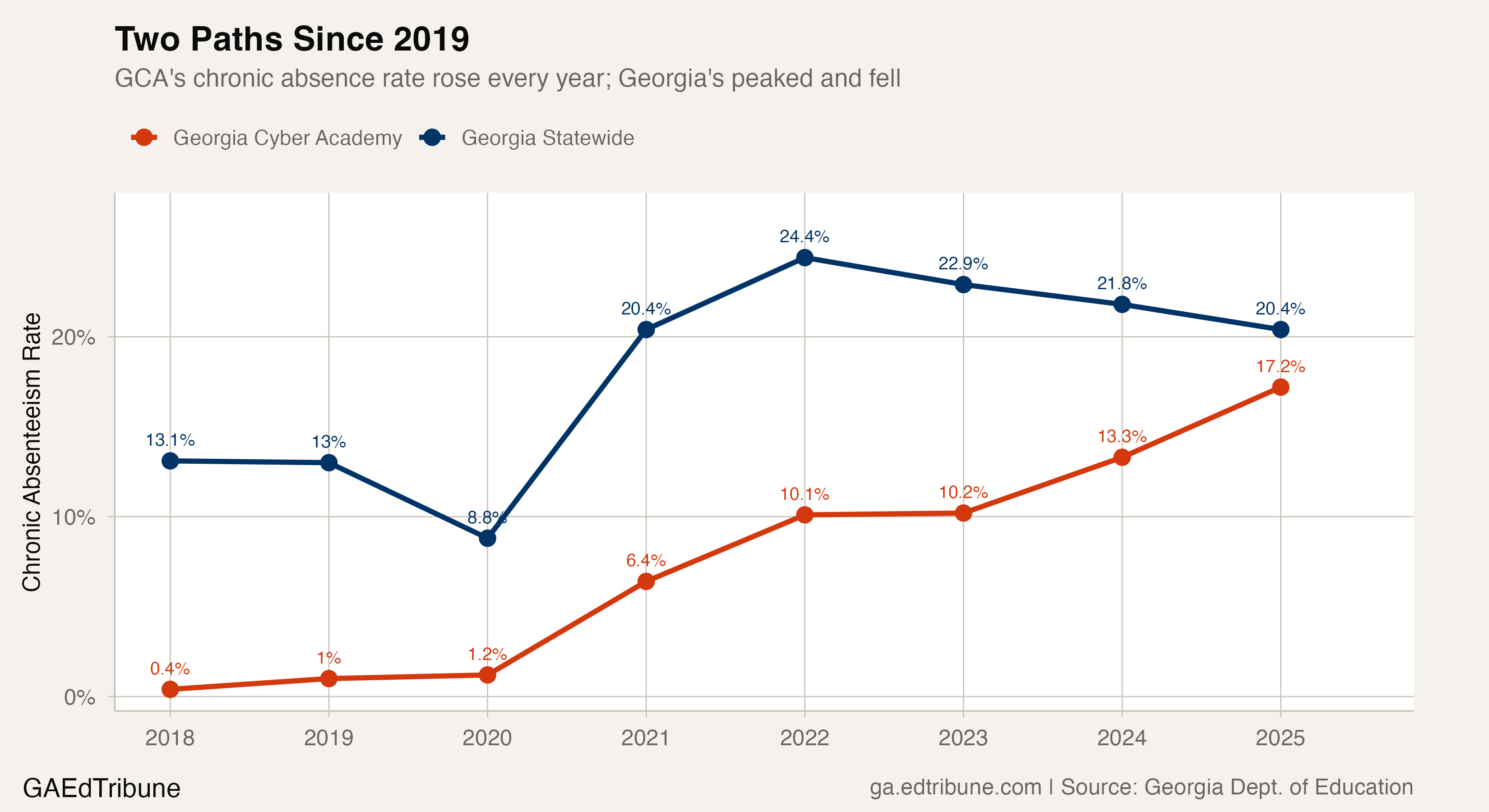
Six years later, that rate is 17.2%. It has risen every single year since.
Georgia Cyber Academy is the state's largest virtual charter, enrolling 11,782 students in 2024-25. It is also the only large school system in Georgia where chronic absenteeism got worse in 2025 by nearly four percentage points, while 159 of 228 districts with comparable data improved. Statewide, the chronic absence rate dropped 1.4 points to 20.4%, its lowest since before the pandemic. GCA moved in the opposite direction.
A streak with no plateau
The unbroken escalation has a shape worth examining. Before the pandemic, GCA's rate crept from 0.4% in 2018 to 1.2% in 2020. Then came the jump: 6.4% in 2021, 10.1% in 2022. Most Georgia districts followed a similar post-pandemic spike. The difference is what happened next. Statewide, the rate peaked at 24.4% in 2022 and has fallen for three consecutive years. At GCA, the rate has not fallen once. It rose 3.1 percentage points in 2024 and 3.9 points in 2025, the largest single-year increase in the school's eight-year data history.
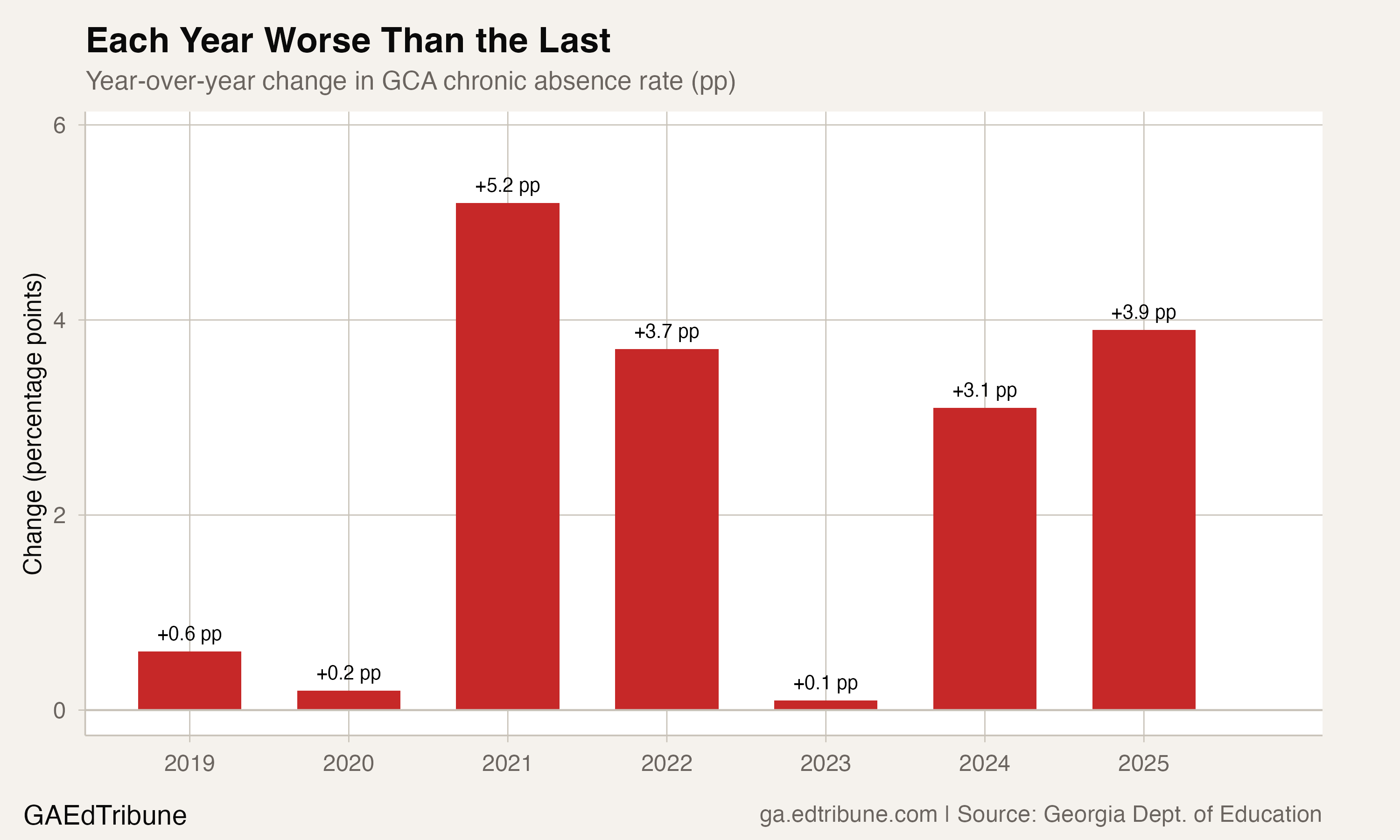
Among all Georgia districts with at least 5,000 students, GCA's 3.9-point increase in 2025 was the largest. The next closest, Tift County, rose 3.2 points. Most large systems moved in the other direction.
Losing the middle
The attendance bands tell a more granular story than the headline chronic rate. In 2018, 98.5% of GCA students missed 5% or fewer of school days. By 2025, that share had fallen to 52.4%, a decline of 46 percentage points. The students did not all migrate to the chronic category. Many landed in the moderate-absence band: 36.1% of students now miss between 6% and 15% of days, up from 1.2% in 2018. The share missing more than 15% of days, the most severely disengaged group, grew from 0.2% to 11.5%.
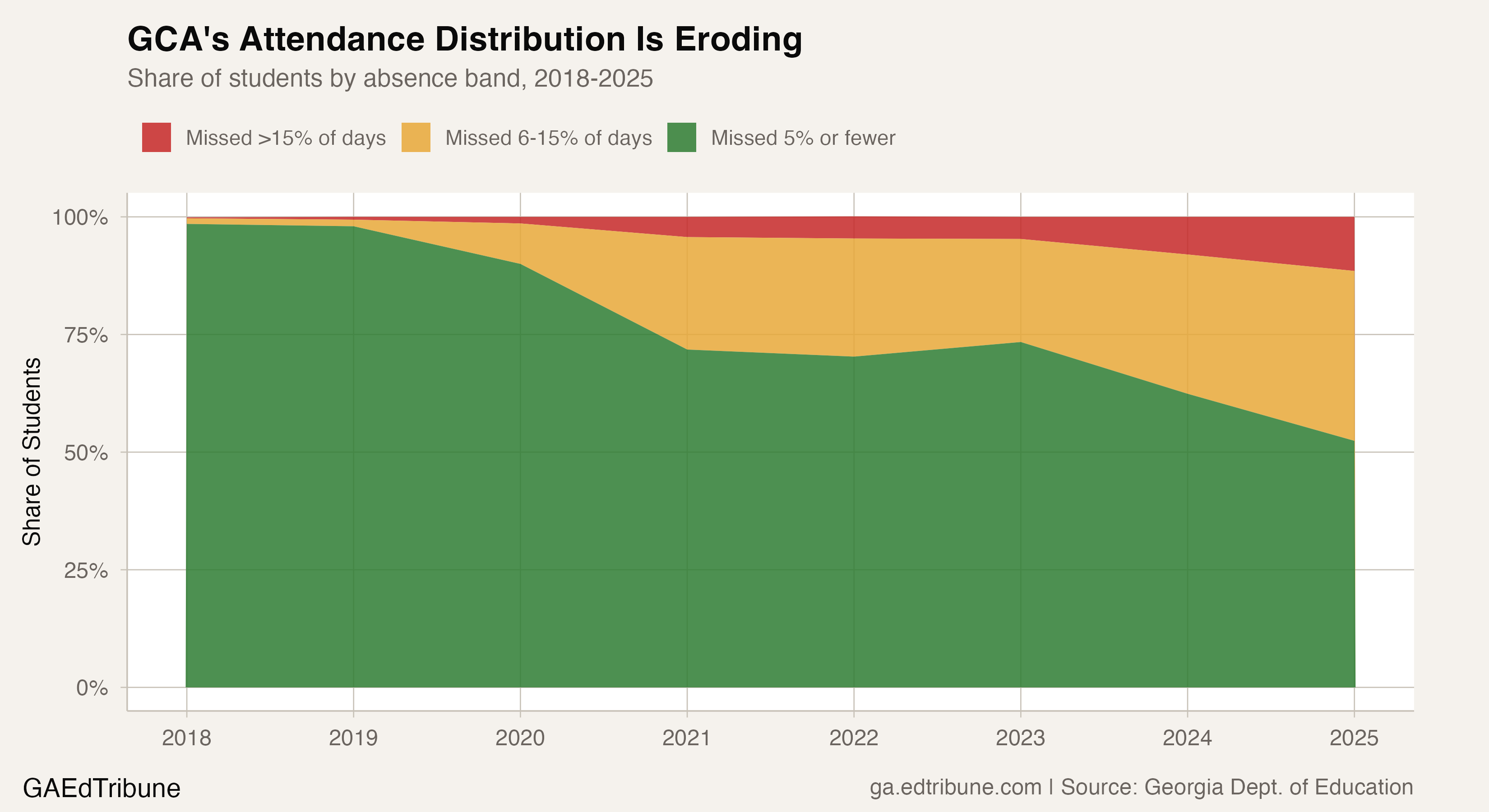
This is not a school with a small pocket of chronically absent students pulling the average. It is a school where the entire attendance distribution has shifted. Nearly half the student body is now in the moderate- or high-absence range.
Virtual school, physical question
What does it mean to be absent from a school that exists on a screen? Georgia has wrestled with this question for over a decade. A 2016 state audit found that the state's three largest online schools had reported 371 more students than their records supported, partly because Georgia had never defined what "present" means in a virtual classroom. The audit recommended uniform online attendance standards.
GCA now tracks attendance through live class participation requirements. Students identified as Beginning or Developing in proficiency must attend live sessions and face progressive discipline, including referral to a Student Attendance Committee, for missed sessions. The school requires 180 days of participation per year, per State Board of Education rules.
The difficulty is that logging in to a platform is not the same as sitting in a classroom where a teacher can see your face. Virtual attendance tracking depends on clicks, logins, and assignment submissions. A student who logs in but does not engage, or who completes work intermittently, occupies a gray area that brick-and-mortar attendance systems do not have to navigate. The national conversation about this measurement challenge has intensified since the pandemic, as states struggle to define "a day of attendance" for students learning from home.
One plausible interpretation of GCA's pre-pandemic rates, when chronic absence sat below 2%, is that the school was measuring something closer to enrollment status than daily engagement. If attendance thresholds were tightened over time to match evolving state expectations, the rising rate could partly reflect better measurement rather than worsening behavior. The data cannot distinguish the two.
The Connections divergence
The comparison to Georgia Connections Academy makes GCA's trajectory harder to explain as a sector-wide phenomenon. Connections Academy, the state's second-largest virtual charter with 7,903 students, traveled the opposite path. Its chronic absence rate peaked at 22.7% in 2019, then fell to 6.3% by 2023 before ticking up to 10.0% in 2025. Where GCA started low and climbed, Connections started high and improved.
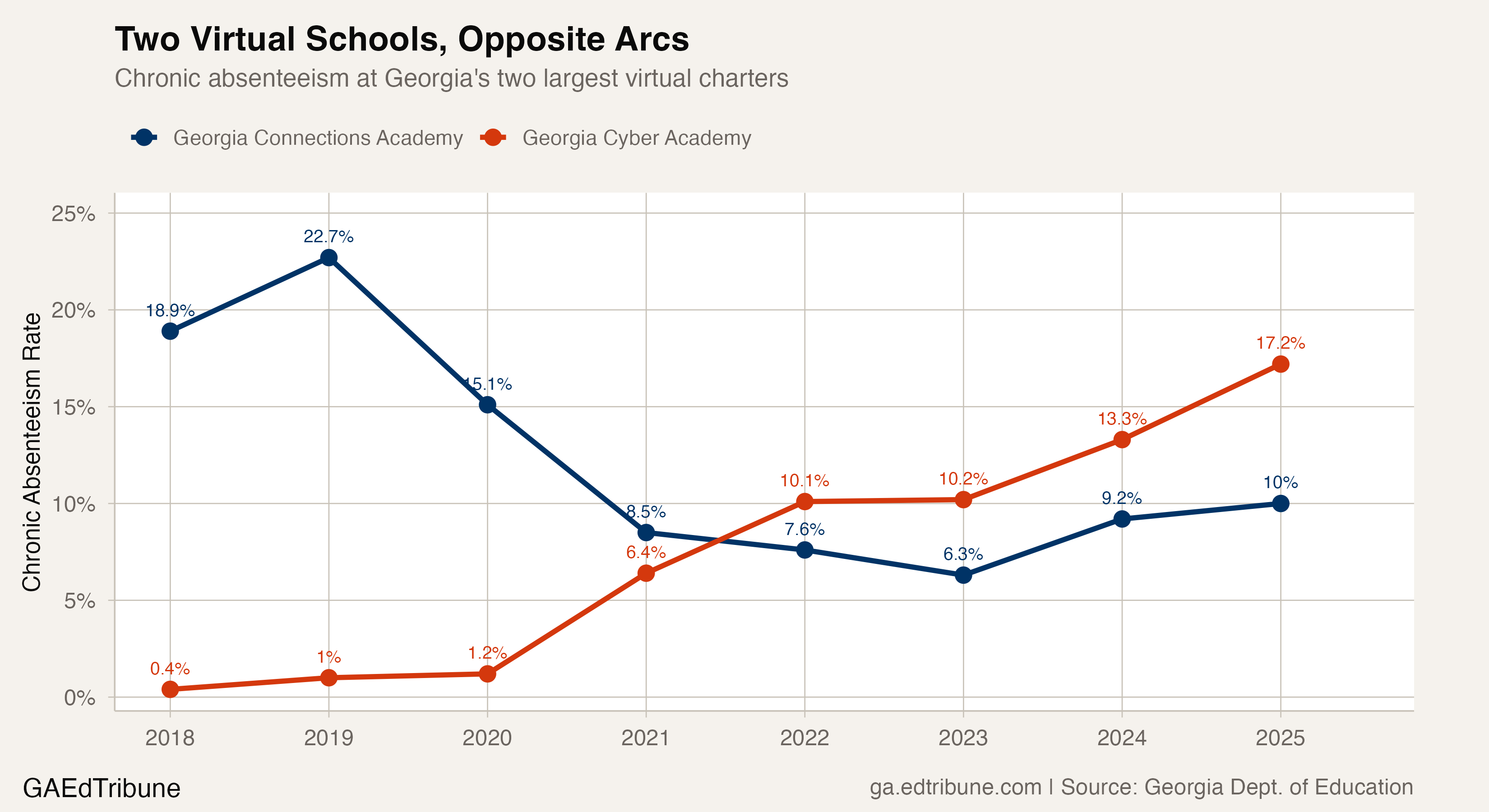
Both schools are statewide, tuition-free, K-12 virtual charters authorized by the State Charter Schools Commission. Both draw from the same pool of Georgia families choosing online instruction. The divergence suggests that the attendance pattern is school-specific, not inherent to the virtual model.
A counterintuitive equity pattern
At most Georgia schools, economically disadvantaged students have higher chronic absence rates than their more affluent peers. At GCA, the pattern flips. Students who are not economically disadvantaged had an 18.3% chronic absence rate in 2025, compared to 15.8% for economically disadvantaged students. Students receiving special education services had the highest rate of any subgroup: 23.5%, based on an enrollment of 2,276.
The inversion does not have an obvious explanation. One possibility is self-selection: families choosing virtual school for reasons unrelated to economics, such as medical needs, travel schedules, or dissatisfaction with local schools, may have less structure around daily attendance. The school's own enrollment data shows a roughly even split, with 5,166 economically disadvantaged students and 6,616 who are not, suggesting GCA draws broadly from across the income spectrum.
The state charter landscape
GCA does not exist in isolation. Georgia's State Charter Schools Commission authorizes 49 charter entities with at least 100 students, and the chronic absence picture across them varies wildly.
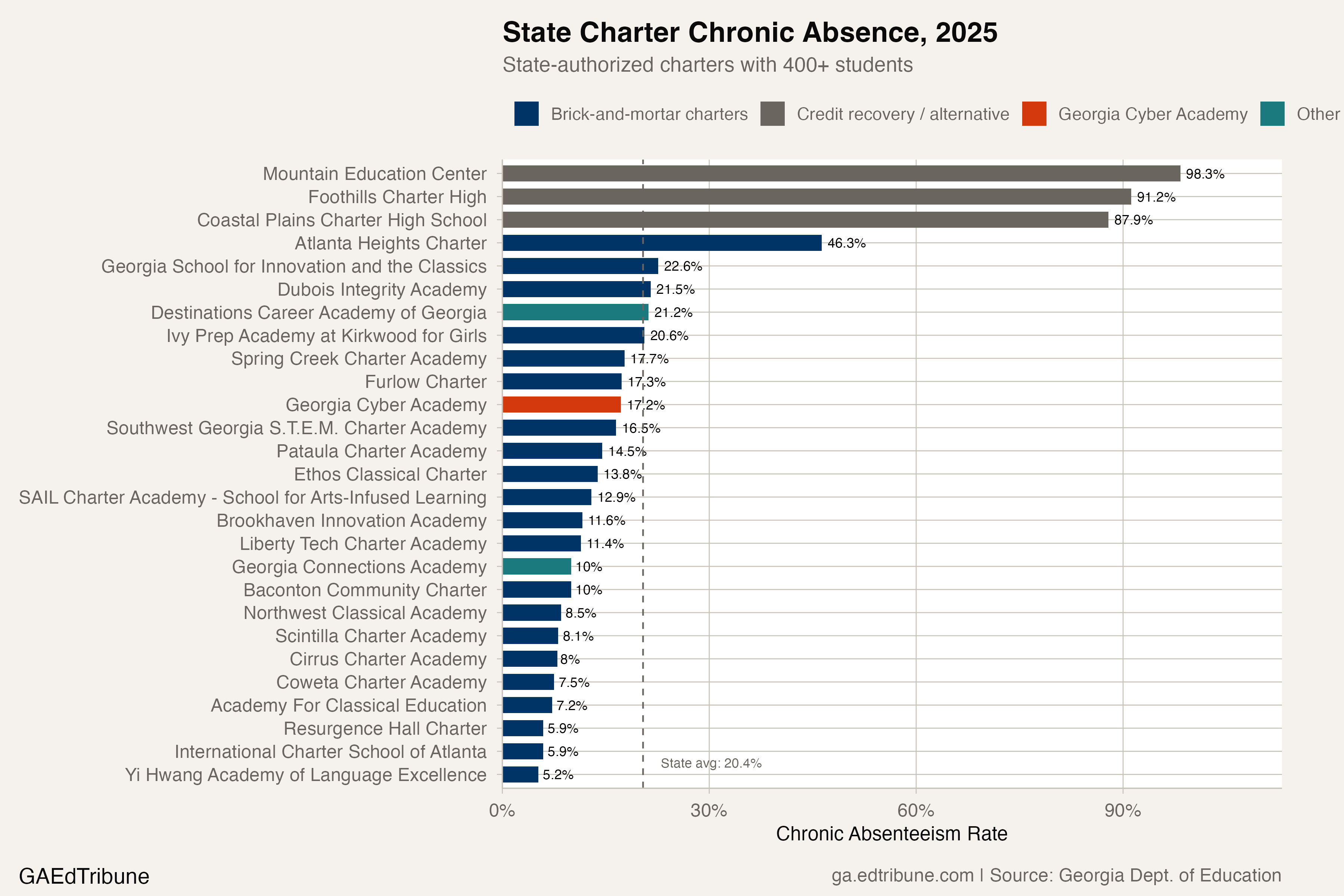
Three schools occupy a different universe entirely. Mountain Education Center, an evening high school program serving credit-recovery students across 18 North Georgia locations, reported a 98.3% chronic absence rate among its 2,948 students. Foothills Charter High School (91.2%, 2,175 students) and Coastal Plains Charter High School (87.9%, 2,208 students) posted similar numbers. These are self-paced, mastery-based programs designed for students who have dropped out, fallen behind, or work during the day. Their attendance structures do not map onto conventional metrics, and their rates should not be compared to traditional schools.
Below that tier, 16 of 49 state charters with 100 or more students exceeded the 20.4% statewide average, while 33 fell below it. GCA, at 17.2%, sits below the state average but above most brick-and-mortar charters.
What comes next
Georgia's legislative focus on chronic absence is intensifying. SB 123, signed by Governor Kemp in April 2025, requires any school system with a chronic absence rate above 10% to establish an attendance review team that reports progress to the General Assembly. At 17.2%, GCA exceeds that threshold. The law also prohibits expelling students solely for absenteeism, a shift toward support-based interventions.
State School Superintendent Richard Woods has committed Georgia to the 50% Challenge, an initiative backed by Attendance Works, EdTrust, and the American Enterprise Institute to halve chronic absenteeism within five years. The statewide rate has already fallen from its 2022 peak of 24.4% to 20.4%. Woods noted that the state's rate had reached its lowest level since before the pandemic: "Put simply, students cannot learn when they are not in school."
A Senate study committee chaired by Sen. John F. Kennedy adopted its final recommendations in November 2025, including a statewide definition of "a day of attendance" and a tiered intervention model. For virtual schools, that definitional question is the ballgame. If Georgia standardizes what counts as showing up online, GCA's rate could move in either direction depending on whether the current measurement is too loose or too tight.
The school that once reported 0.4% chronic absence now reports 17.2%. Whether that represents a genuine deterioration in student engagement, a correction from an artificially low baseline, or some combination, the trend line has no ambiguity: eight data points, seven consecutive increases, and no sign of a plateau.
Detailed code that reproduces the analysis and figures in this article is available exclusively to EdTribune subscribers.
Discussion
Sign in to join the discussion.
Loading comments...