On April 28, 2025, Governor Brian Kemp sat in a signing ceremony and put his name to seven bills. SB 123, the one about attendance, did not get its own press quote. It shared billing with a sports fairness act, a dyslexia screening measure, and a school safety package. The governor's office described it in a single sentence: the law "requires school systems with chronic absenteeism rates of 10 percent or more to establish an attendance review team."
What the sentence does not convey is the scale of the problem it is meant to address. In the 2024-25 school year, 199 of Georgia's 231 school districts exceeded that 10% threshold. The law's mandate applies to 86.1% of all districts, covering 94.5% of the state's 1.85 million students. Only 32 districts fall below the line.
SB 123 represents the state's most significant legislative response to a chronic absenteeism rate that has stubbornly refused to return to pre-pandemic levels. Georgia's statewide rate sat at 13.0% in 2018-19. It peaked at 24.4% in 2021-22. Three consecutive years of improvement since that peak have brought it back to 20.4%, but that is still 7.4 percentage points above the pre-COVID baseline, with 377,482 students missing 10% or more of the school year.

What the law does, and does not do
SB 123 has three core provisions. First, the bill text says no student may be expelled solely because of absences. Second, districts with chronic absenteeism at or above 10% must form attendance review teams that include administrators, counselors, social workers, teachers, other school personnel, and parents or guardians. Those teams must meet monthly to develop individual intervention plans for chronically absent students. Third, individual schools where the rate hits 15% must form their own school-level teams. In 2024-25, 1,409 of 2,301 schools, or 61.2%, crossed that 15% line.
Each county's student attendance and school climate committee was required to convene by November 1, 2025, and meet at least twice annually after that. Every committee was required to adopt a written student attendance protocol by June 1, 2026.
The bill text leaves the compulsory-attendance code's parent-penalty language in place, creates no dedicated appropriation for the teams, and requires intervention plans without setting a statewide success metric for them.
The 10% line barely functions as a filter
A threshold exists to sort institutions into two groups: those that need to act and those that do not. SB 123's 10% line fails that basic function. Only 32 of 231 districts sit below it, and most of those are small charter entities or tiny rural counties. Among the 15 largest districts in the state, only Forsyth County, at 8.7%, clears the bar.
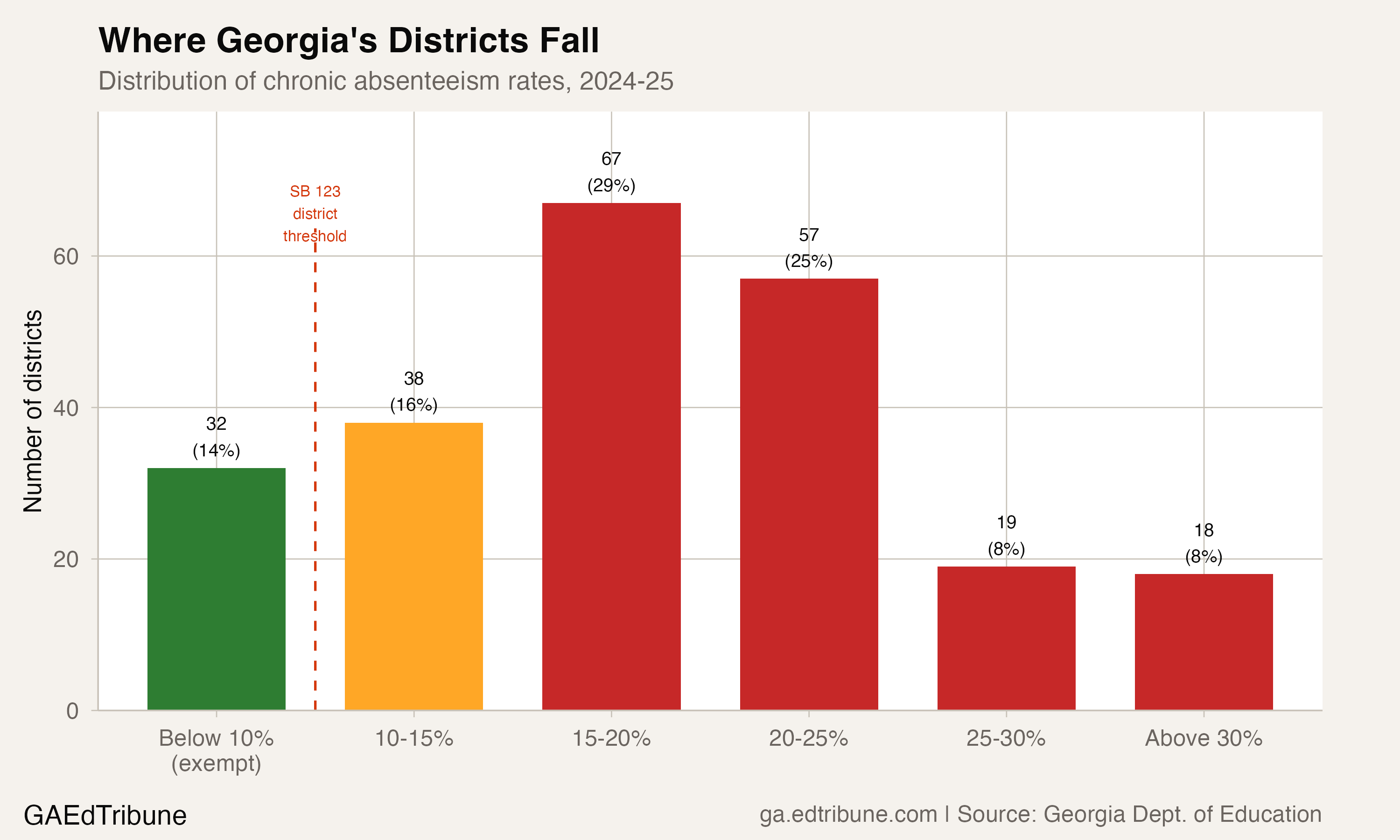
The median district rate is 18.4%. The mean among triggered districts is 21.5%. Atlanta Public Schools sits at 31.9%, Richmond County at 32.8%, Clayton County at 28.8%. These districts are not at 11% or 12%, flirting with the threshold. They are double or triple it. Gwinnett County, the state's largest at 199,231 students, has an 18.4% rate, putting it 8.4 percentage points above the trigger.
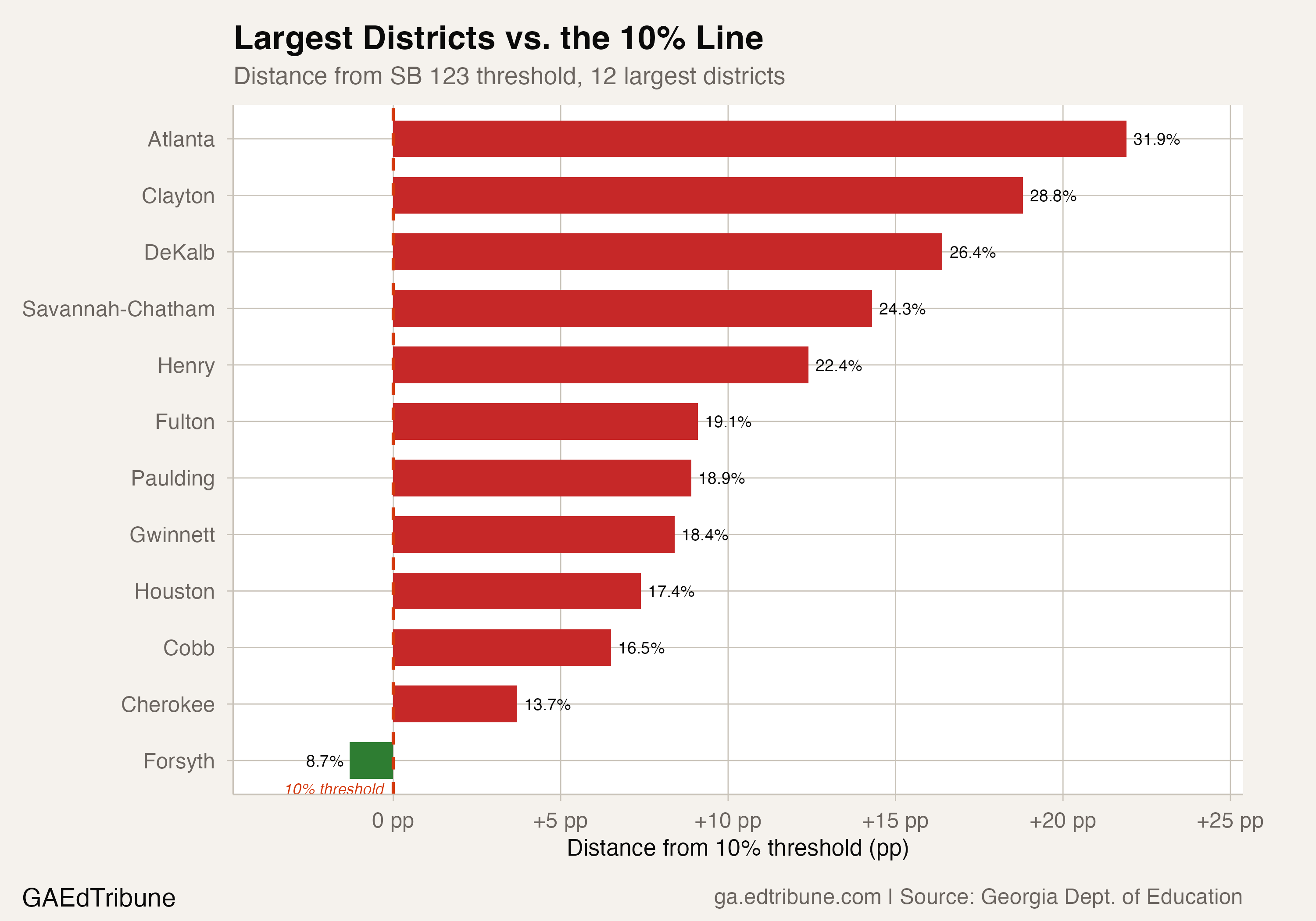
When a policy threshold captures 86% of the entities it governs, the question shifts from "who must comply" to "who must not."
A philosophical turn, three decades in the making
The expulsion ban is the provision with the sharpest edge. Until SB 123, the compulsory-attendance statute did not contain that categorical ban. The old logic was circular: a student fails to attend, so the school responds by making attendance impossible.
The Senate Study Committee's final report summarized State Superintendent Richard Woods as saying past attendance efforts leaned on the "hammer" of consequences and had not reduced absenteeism. The Truancy Intervention Project, a Fulton County program operating since 1991, had already demonstrated the alternative: pair chronically absent students with trained volunteers who identify root causes and connect families to resources. An Atlanta Bar Association profile says TIP has served more than 11,000 children and diverted 86.5% from the juvenile justice system.
"Chronic absenteeism doesn't just impact test scores, it puts entire futures of Georgia students at risk. Progress is possible when we approach this issue with urgency and unity." — Sen. John F. Kennedy, Georgia Senate Press Office, Aug. 2025
But the Senate Study Committee's 22 recommendations include proposals that cut against that philosophy. Among them: suspending driver's licenses for chronically absent high schoolers and barring chronically absent students from athletics and extracurricular activities. The committee also recommended expanding mental health funding beyond the current $20,000 per middle and high school to include elementary campuses.
The tension is unresolved. SB 123 says: stop punishing absence. The study committee says: consider new punishments. Both come from the same legislature.
The recovery stall
Three years of declining absenteeism have closed only 35.1% of the gap between Georgia's 2022 peak and its pre-COVID baseline. At the pace of improvement between 2022 and 2025, roughly 1.3 percentage points per year, the state would not return to its 2019 rate until 2031.
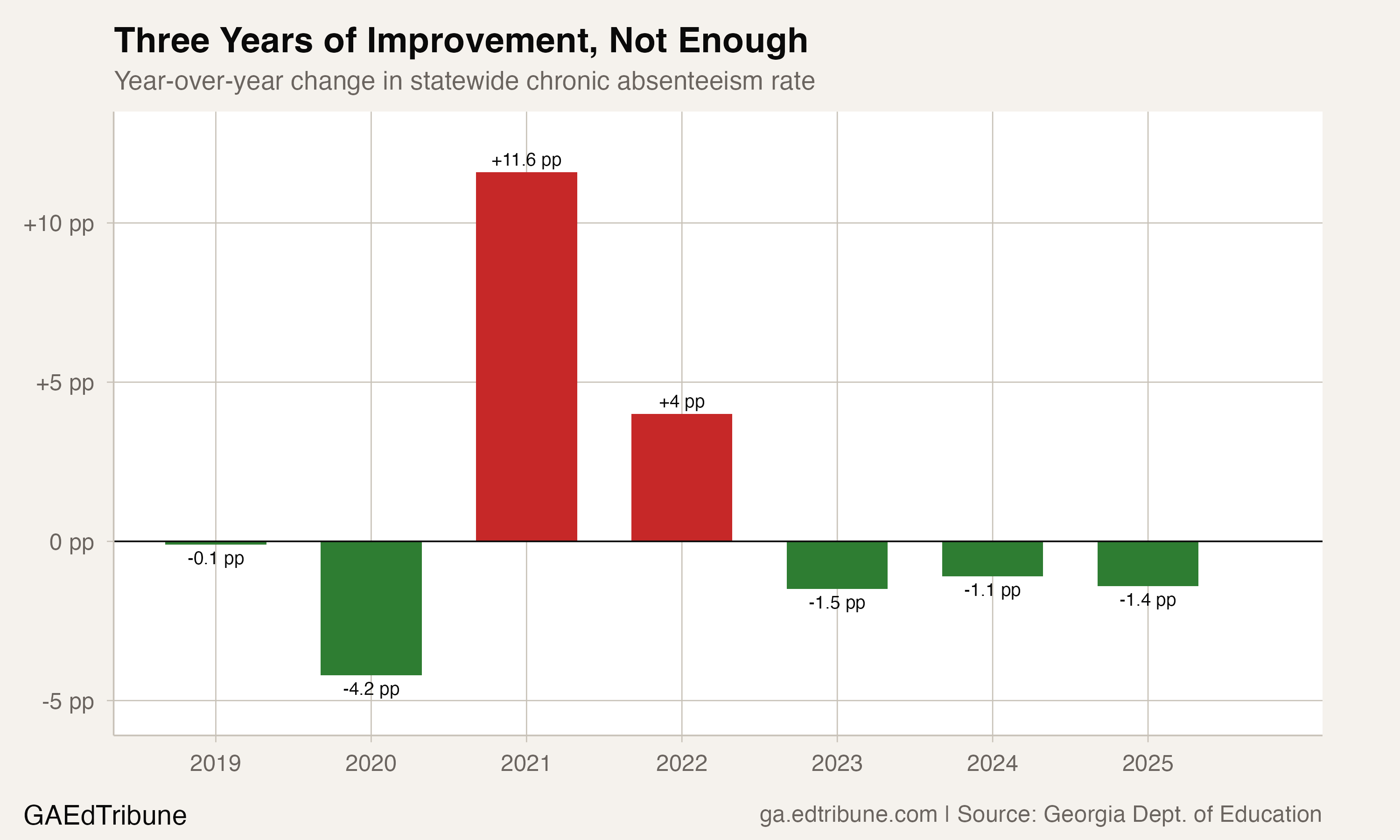
Only 12 of 194 districts with data in both years, 6.2%, have recovered to their pre-COVID chronic absenteeism rates. The other 182 remain above where they started.
Superintendent Woods has committed Georgia to the 50% Challenge, a bipartisan initiative backed by Attendance Works, EdTrust, and the American Enterprise Institute, pledging to cut chronic absence by half over five years. Using the article's 2024-25 statewide rate as the denominator, that would mean reaching approximately 10.2% statewide. In 2024-25, only 34 of 231 districts are at or below that target.
"Put simply, students cannot learn when they are not in school. When absences accumulate, it limits their opportunities and puts their futures at risk." — Superintendent Richard Woods, Aug. 2025
What the mandate does not address
SB 123 creates a structure: teams, meetings, protocols, and biennial compliance reports to the Department of Education. What it does not create is capacity.
(Suggestive context.) Mental Health America's 2025 access-to-care ranking puts Georgia in the bottom tier overall. The Senate study committee's final report listed Georgia's school counselor ratio at 450:1, compared with a national recommendation of 250:1. Children's Healthcare of Atlanta says its behavioral-health program subsidizes care for more than 8,000 new patients annually and provides specialty mental-health triage to more than 6,500 children experiencing behavioral crises each year. Juliana Chen, chief medical officer at Cartwheel Care, told the Senate Study Committee that students struggling with anxiety, depression, and other emotional challenges miss far more days of school than their peers.
(Suggestive context.) Transportation is another gap the mandate does not solve. The Senate report recorded lack of reliable transportation as one barrier to attendance and recommended transportation supports, safe walking routes, and ride-share partnerships as possible policy responses.
The law mandates that teams identify root causes. Whether districts have the staffing, funding, or community infrastructure to act on what they find is a question SB 123 leaves unanswered.
What to watch
SB 123 took effect July 1, 2025. The first compliance deadlines have now passed: county attendance committees were required to convene by November 1, 2025, and written attendance protocols were due June 1, 2026. Beginning in 2026, the Georgia Department of Education must submit a county-by-county compliance report by November 1 of each even-numbered year.
The first measurable test will be the 2025-26 chronic absenteeism data, which will reflect whether intervention teams formed during the year produced any measurable change, or whether the mandate generated paperwork without shifting outcomes. The 50% Challenge target puts Georgia on a five-year clock to reach roughly 10%. In 2024-25, the state was still twice that. The distance between a law's requirements and a school's reality has never been the kind of gap legislation closes on its own.
Detailed code that reproduces the analysis and figures in this article is available exclusively to EdTribune subscribers.
Discussion
Sign in to join the discussion.
Loading comments...