In the Class of 2018, 304 foster care students in Georgia did not graduate on time. That was not 304 out of thousands. The entire cohort was 484. Six out of every 10 foster youth who entered ninth grade four years earlier left without a diploma.
By 2025, the rate had climbed to 50.1%, a 12.9 percentage-point gain. The improvement is real. But the number still means that for every foster care student who walks across a stage in Georgia, another one does not. No other student group in the state comes close to that failure rate.
The floor of the graduation ladder
Georgia's statewide graduation rate reached 87.2% for the Class of 2025, a record and a 19.8 percentage-point climb from 67.5% in 2011. That rising tide lifted nearly every subgroup. Black students rose from 59.8% in 2011 to 86.7%. Economically disadvantaged students hit 86.0%, within 1.2 points of the state average. Students with disabilities gained 17.3 percentage points since 2018 alone, reaching 78.4%.
Foster care students sit 37.1 percentage points below the state average. The next-lowest subgroup, students who are currently homeless, graduates at 71.7%. The gap between foster care and homeless, the two groups most defined by housing instability, is itself 21.6 points.
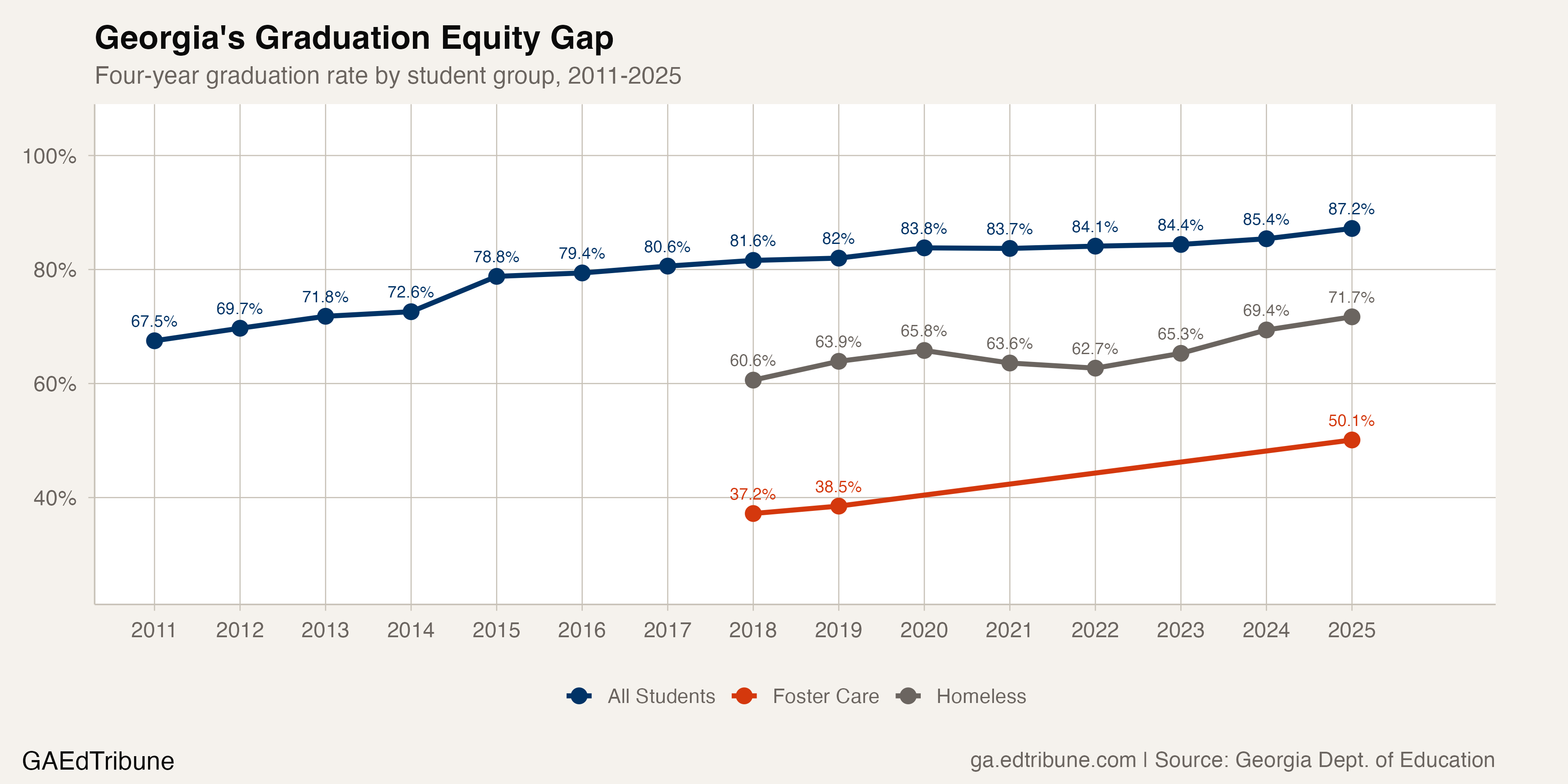
The data for foster care students is sparse: Georgia reported cohort graduation rates for this group only in 2018, 2019, and 2025. Five years of data are missing entirely. What the three available data points show is a group that has improved faster than the state average in percentage-point terms but started so far behind that the gap remains enormous.
441 students, 220 without a diploma
The foster care graduation cohort in 2025 was 441 students. That is smaller than a single large high school's senior class. In 2018, the cohort was 484; in 2019, it was 535. The shrinking count likely reflects changes in the foster care population itself. Georgia's Division of Family and Children Services reported over 11,000 children in state custody in recent years, but only a fraction of those are high-school seniors in any given year.
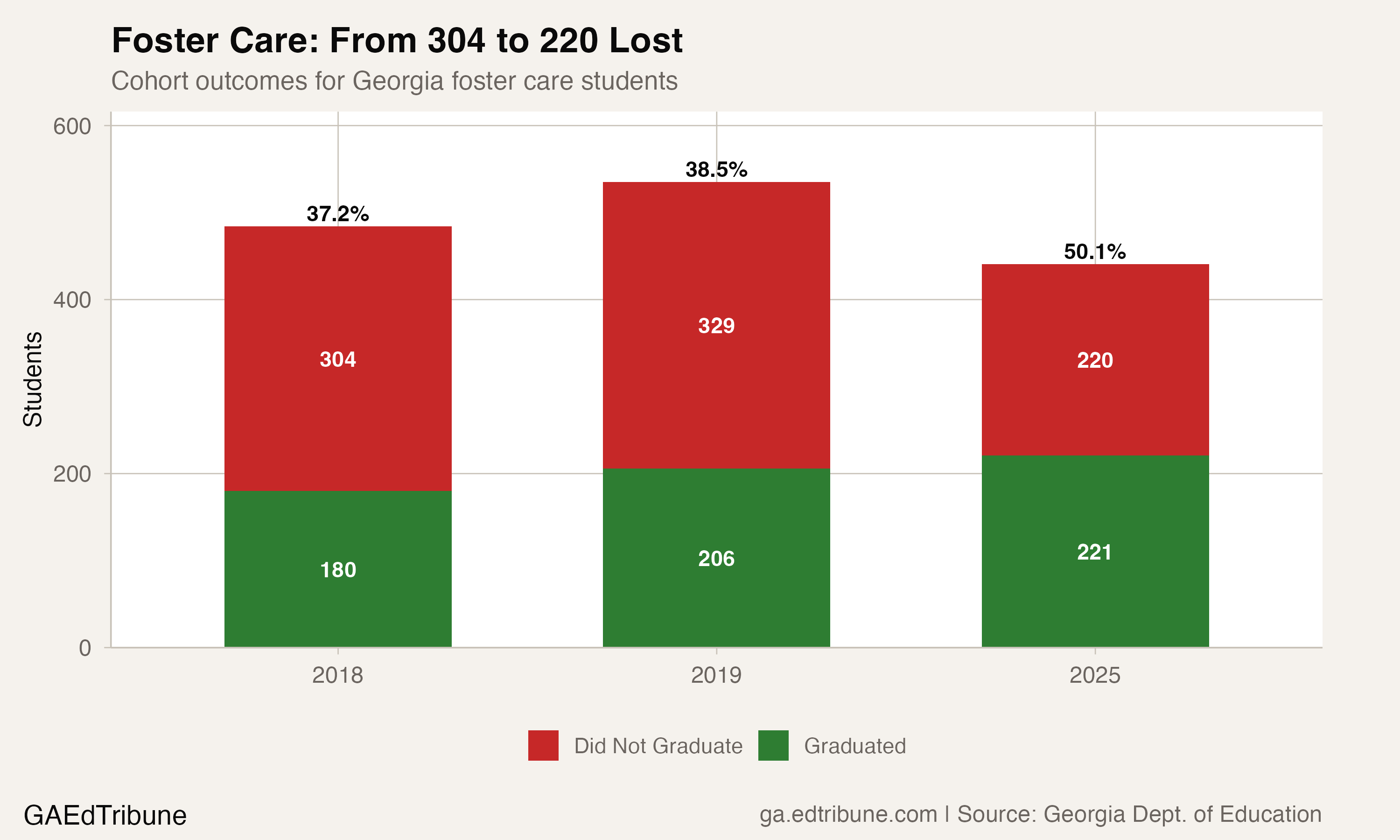
Of the 441 students in the 2025 cohort, 221 graduated and 220 did not. The non-graduate count dropped from 304 in 2018 to 220 in 2025, a reduction of 84 students. That is not a rounding error. It represents 84 young people who, under the conditions of seven years ago, would have left high school without a credential.
Whether those 84 students are finishing because of targeted intervention or because the statewide improvement tide is lifting foster youth alongside everyone else is impossible to determine from the data alone. Since 2017, the Multi-Agency Alliance for Children has administered the LEADS program in partnership with DFCS, providing wraparound educational support, tutoring, credit recovery, and advocacy for high-school-aged foster youth.
"Their accomplishments demonstrate the power of education, mentorship and community support." -- Tom Rawlings, DFCS Division Director, 2020
The LEADS program reported a 73% graduation rate among its participants and served over 1,500 youth, but it operates primarily in the Fulton and DeKalb County↗ET region. Statewide, the 50.1% rate suggests that foster youth outside that service area face far steeper odds.
The 5,709 students Georgia counts as homeless
Students who are currently homeless represent a larger cohort and a clearer trend line. The 2025 cohort was 5,709 students, 13 times larger than the foster care cohort. Their graduation rate reached 71.7%, an 11.1 percentage-point gain since 2018.
But the trajectory was not a straight line. The gap between homeless and all students narrowed from 21.0 points in 2018 to 18.0 points in 2020, then widened back to 21.4 points by 2022. That reversal coincided with the pandemic's second-order effects: rising housing costs, expiring eviction moratoriums, and a spike in student homelessness across metro Atlanta.
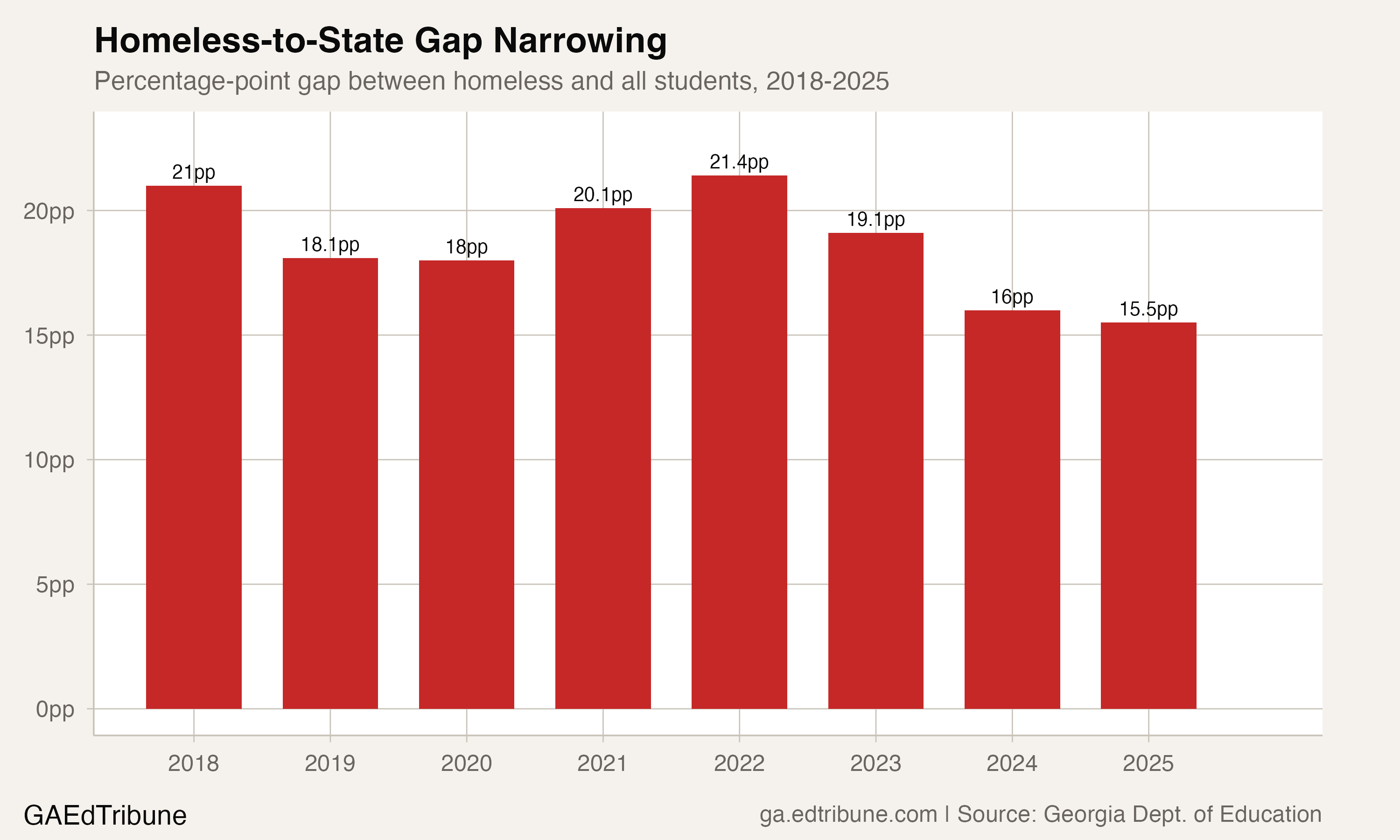
The narrowing since 2022, from 21.4 points to 15.5 points in three years, is the fastest sustained closure for this subgroup on record. Whether it holds depends on housing conditions that school systems do not control.
One detail in the homeless data deserves scrutiny: the cohort tripled from 1,674 in 2018 to 5,198 in 2019. A jump that large in a single year almost certainly reflects expanded identification under the McKinney-Vento Act rather than a tripling of actual homelessness. Georgia's Department of Education administers the program through local liaisons in every district, and improvements in identification would mechanically increase the denominator, potentially suppressing the graduation rate even as actual outcomes improve.
Where districts see the gap up close
Only three Georgia districts reported foster care graduation data with cohorts large enough to publish in 2025: DeKalb County (40.7%, 27 students), Gwinnett County↗ET (50.0%, 26 students), and Bibb County↗ET (62.5%, 16 students). Every other district either had too few foster care seniors to report or did not track the subgroup. The statistical invisibility is part of the problem. A school district cannot design interventions for a population it cannot measure.
Student who is currently homeless data is more widely available. Atlanta Public Schools↗ET graduated 85.0% of its 240 homeless seniors, well above the state homeless average. Polk County↗ET reached 88.4% with 155 students who are currently homeless. But Dalton Public Schools↗ET graduated just 45.9% of 98 homeless seniors, and Hall County↗ET managed only 54.2% of 96.
In Bibb County↗ET, the intersection of these two crises is visible in a single community. Georgia Public Broadcasting reported that the district enrolled an average of 682 students who are currently homeless per year between 2015 and 2021, while Macon-Bibb's emergency housing program served roughly 90 children annually. The McKinney-Vento liaison for the district described providing "school supplies, uniforms, book bags, band instruments, calculators, anything dealing with educational stability," plus tutoring and transportation. What the program cannot provide is housing itself.
Who gained most, and what that reveals
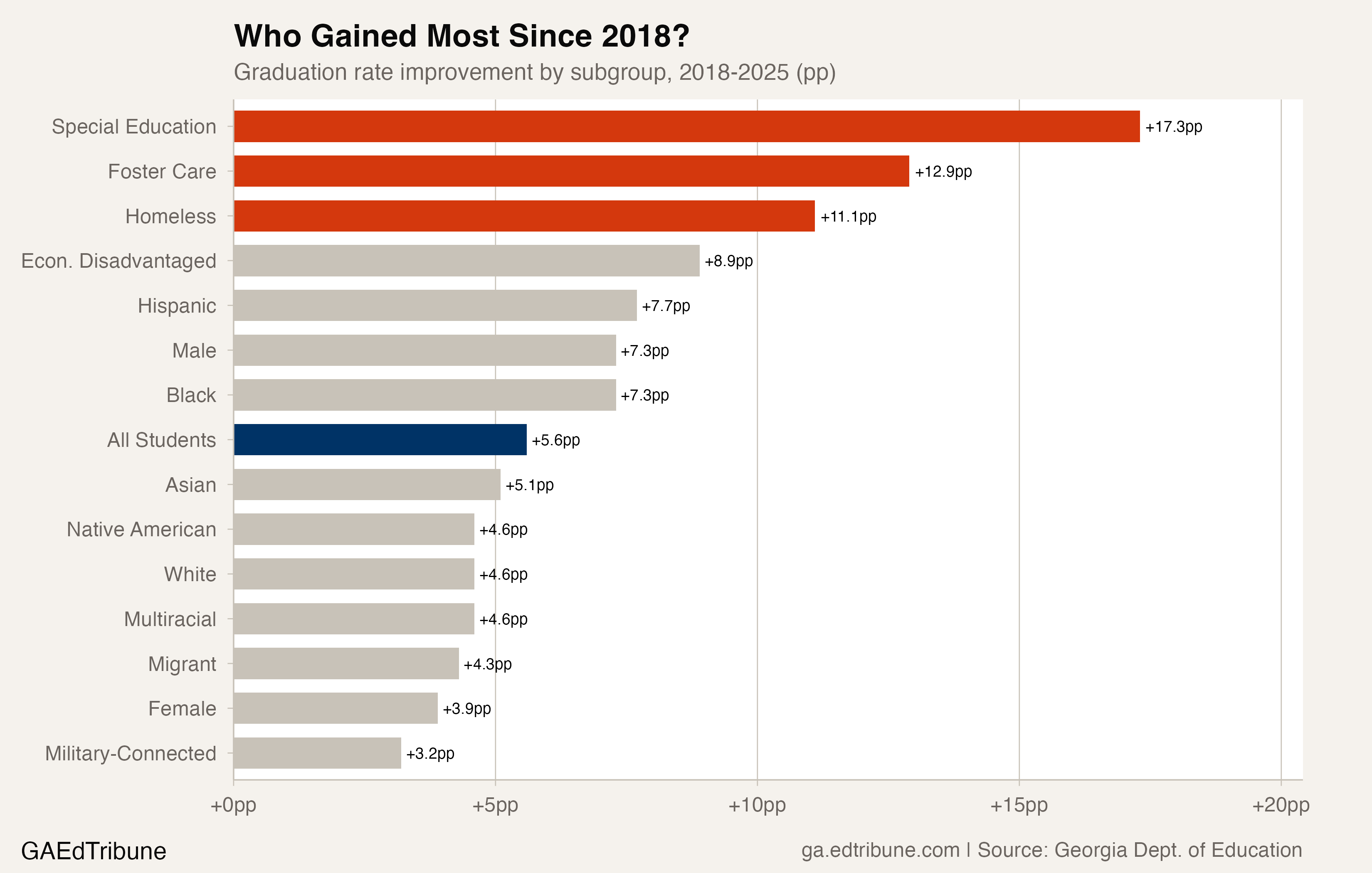
The three subgroups with the largest gains since 2018 are all service populations: special education (+17.3 points), foster care (+12.9 points), and homeless (+11.1 points). Economically disadvantaged students gained 8.9 points. The state average gained 5.6.
That pattern, where the most vulnerable subgroups improve fastest in percentage-point terms, is consistent with what happens when a state raises the floor rather than the ceiling. Georgia's graduation reforms over the past decade have focused on credit recovery, alternative pathways, and extended-year programs that disproportionately benefit students who were previously falling out of the system. The structure of a rising-tide approach works until the students who need the most intensive support hit barriers that school-level interventions cannot reach.
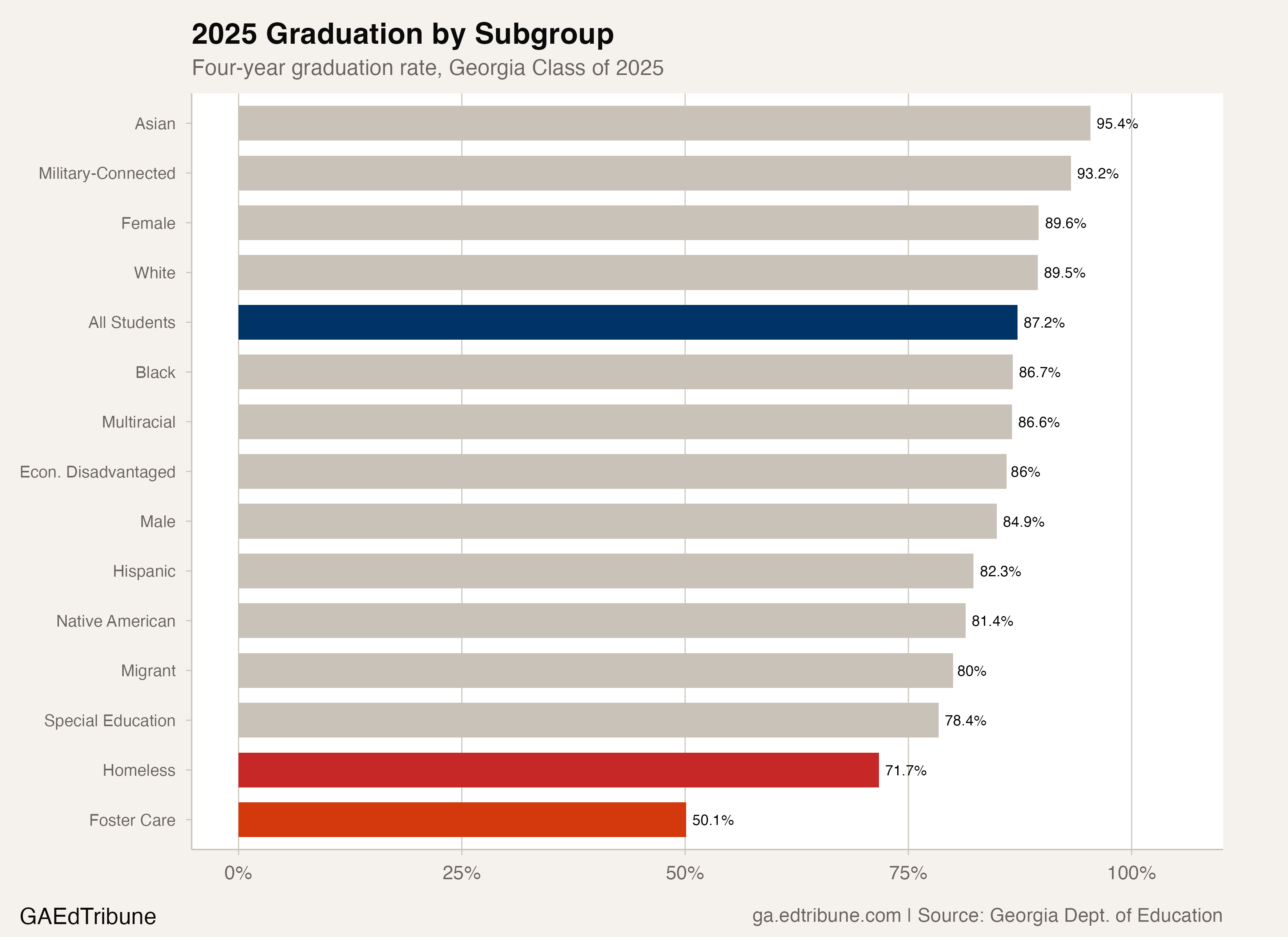
Foster care students face exactly those barriers. Housing instability, school transfers mid-year, the trauma of separation from family, and the absence of a consistent adult advocate all compound against graduation. National research has found that nine states graduate fewer than half of their foster youth within four years. Georgia's 50.1%, while still below the coin-flip threshold, now places it above that lowest tier.
Five missing years
The most important number in this analysis may be the one that does not exist. Georgia reported foster care graduation data for 2018, 2019, and 2025, but not for 2020 through 2024. Did the rate decline during the pandemic, as it did for students who are currently homeless? Did it plateau? Did it improve steadily? There is no way to know.
The gap in reporting matters because foster care students are wards of the state. Georgia has a direct obligation to these 441 young people that differs in kind from its obligation to the broader student population. The state controls their living arrangements, their school placements, and the stability of both. That five consecutive years of graduation data for this group went unreported, or was suppressed due to small cell sizes, represents a measurement failure for a population the state is specifically responsible for tracking.
For the 220 foster care seniors who did not graduate in 2025, the system designed to protect them produced the same outcome as the circumstances it removed them from. The 50.1% rate is an improvement. It is not yet an answer.
Detailed code that reproduces the analysis and figures in this article is available exclusively to EdTribune subscribers.
Discussion
Sign in to join the discussion.
Loading comments...