Correction (July 20, 2026; audited July 22, 2026): An earlier version calculated racial shares from a subset of categories rather than the full cohort, slightly overstating several 2011 and 2025 shares. White students were 34.0% of the 2011 cohort and 15.5% in 2025; Hispanic students were 20.5% in 2011; and Black students were 29.7% in 2011 and 33.8% in 2025. The article also overstated the continuity of annual gains and made claims about 2012-17, years the current package cannot reproduce. Finally, the package's reported graduate count yields 2,327 non-graduates in 2025, not the 2,328 estimate produced by multiplying the rounded rate. The endpoint changes and 2018-25 series remain verified. The later audit also removed aggregate-as-individual and predictive framing.
In 2011, Gwinnett County↗ET reported a 79.8% graduation rate for white students and 60.1% for Black students. That was a 19.7 percentage-point aggregate gap in Georgia's largest school district.
By 2025, the white graduation rate had climbed to 90.2%. The Black rate had climbed to 88.8%. The gap between them: 1.5 percentage points.
That collapse, from 19.7 to 1.5, is the most consequential graduation story in Gwinnett's data, and it happened while the district was simultaneously getting larger, more diverse, and more economically disadvantaged.
The scale of what changed
Gwinnett County Public Schools graduated 13,604 seniors in the Class of 2025, up from 8,520 in 2011. The district's four-year adjusted cohort graduation rate rose from 67.6% to 85.4% over that span, a 17.8 percentage point gain.
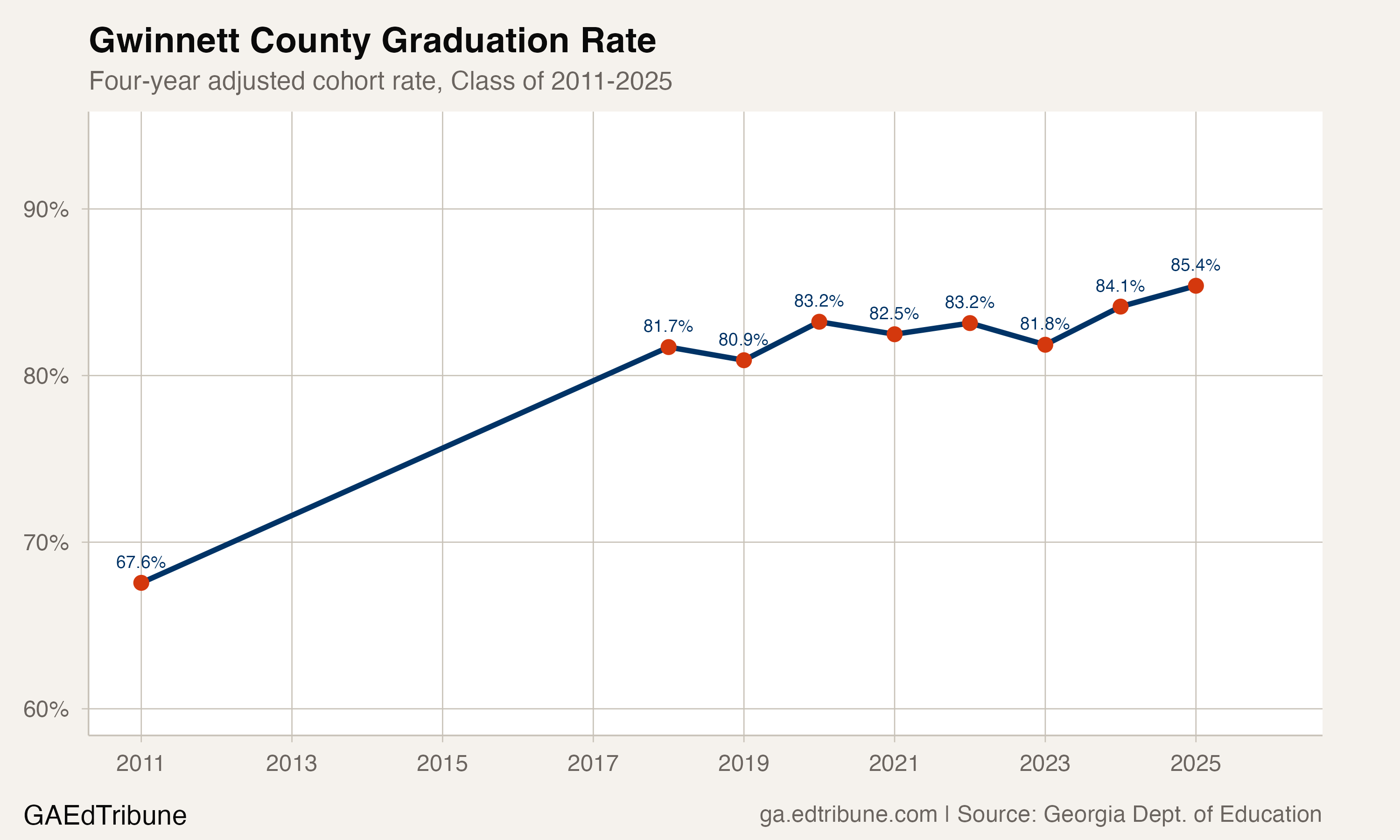
The cohort itself grew by 3,320 students, a 26.3% increase. If the rate had stayed frozen at 67.6%, those 15,931 seniors would have produced only 10,763 graduates. The rate improvement alone accounted for 2,841 additional diplomas beyond what cohort growth would have generated.
Put differently: Gwinnett produces 59.7% more graduates today than it did 14 years ago. One in every nine Georgia high school graduates now walks across a Gwinnett stage.
A district that changed before it improved
The demographic transformation in that cohort is extreme. In 2011, white students made up 34.0% of Gwinnett's graduating class. By 2025, they comprised 15.5%. Hispanic students went from 20.5% to 34.6% of the cohort, surpassing every other group. Black students grew from 29.7% to 33.8%.
Gwinnett is now a district where no single racial group accounts for more than 35% of its graduates. The student body reflects 114 languages, with roughly 27% of students classified as multilingual learners.
This is the context that makes the graduation gains notable. The package data show demographic change and a higher graduation rate over the same period, but they do not establish why the rate improved. Within the continuous 2018-25 series, Gwinnett gained in four of seven year-over-year transitions and reached the series high in 2025.
Where the gaps closed, and where they did not
The most striking movement is in the white-Black gap. From 19.7 percentage points in 2011 to 1.5 in 2025, that convergence is driven almost entirely by Black gains: from 60.1% to 88.8%, a 28.6 point improvement. White rates rose 10.4 points over the same period, from 79.8% to 90.2%.
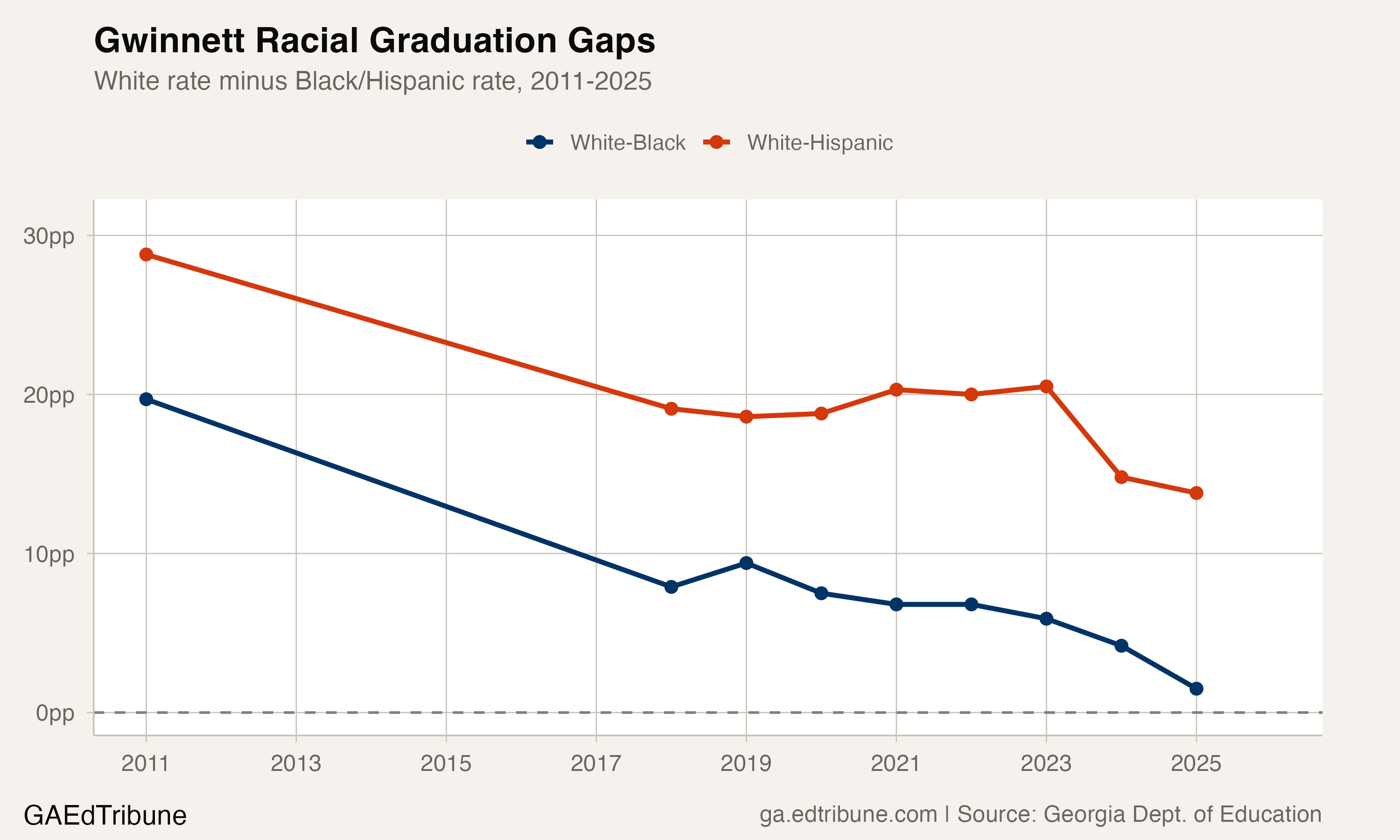
The white-Hispanic gap tells a different story. It shrank from 28.8 points to 13.8, a meaningful but incomplete closure. Hispanic students improved from 51.1% to 76.4%, a 25.3 point gain. At 76.4%, they remain the only major racial group below 80%.
Separately, students from economically disadvantaged families improved from 56.1% to 83.0%, narrowing the gap with their non-disadvantaged peers from 21.4 points to 5.6.
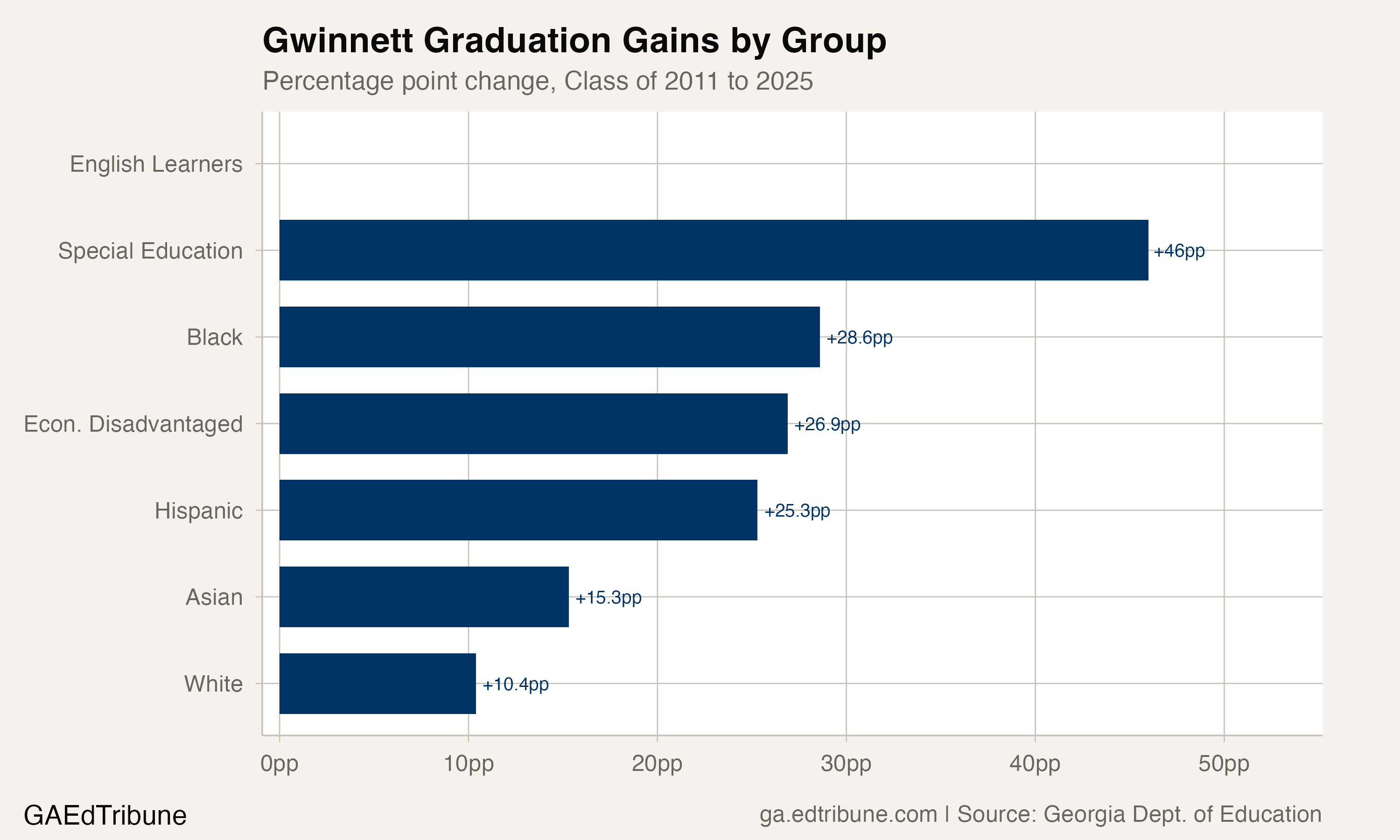
The single largest gain belongs to students receiving special education services: from 30.1% to 76.1%, a 46 point improvement. In 2011, fewer than one in three students with IEPs earned a diploma in four years. In 2025, more than three in four do. (The 2,051-student special education cohort in 2025 is 59.7% larger than the 1,284-student cohort in 2011, so this is not a shrinking-denominator effect.)
The 90% question
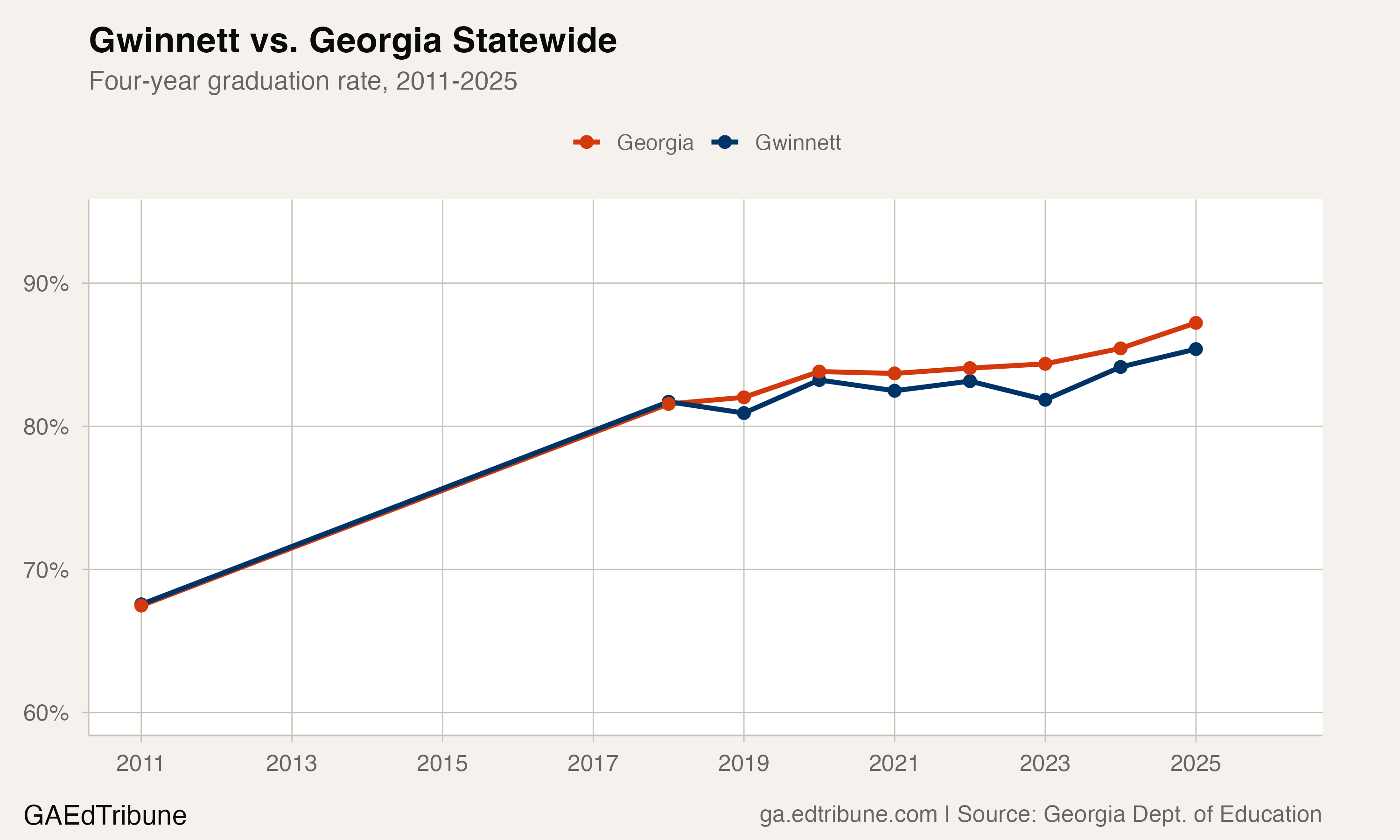
Despite the gains, Gwinnett trails the state average. Georgia posted an 87.2% graduation rate for the Class of 2025. Gwinnett's 85.4% leaves a 1.8 point gap. In the package's continuous 2018-25 series, Gwinnett was 0.1 point above the state in 2018 and below it in every year from 2019 through 2025.
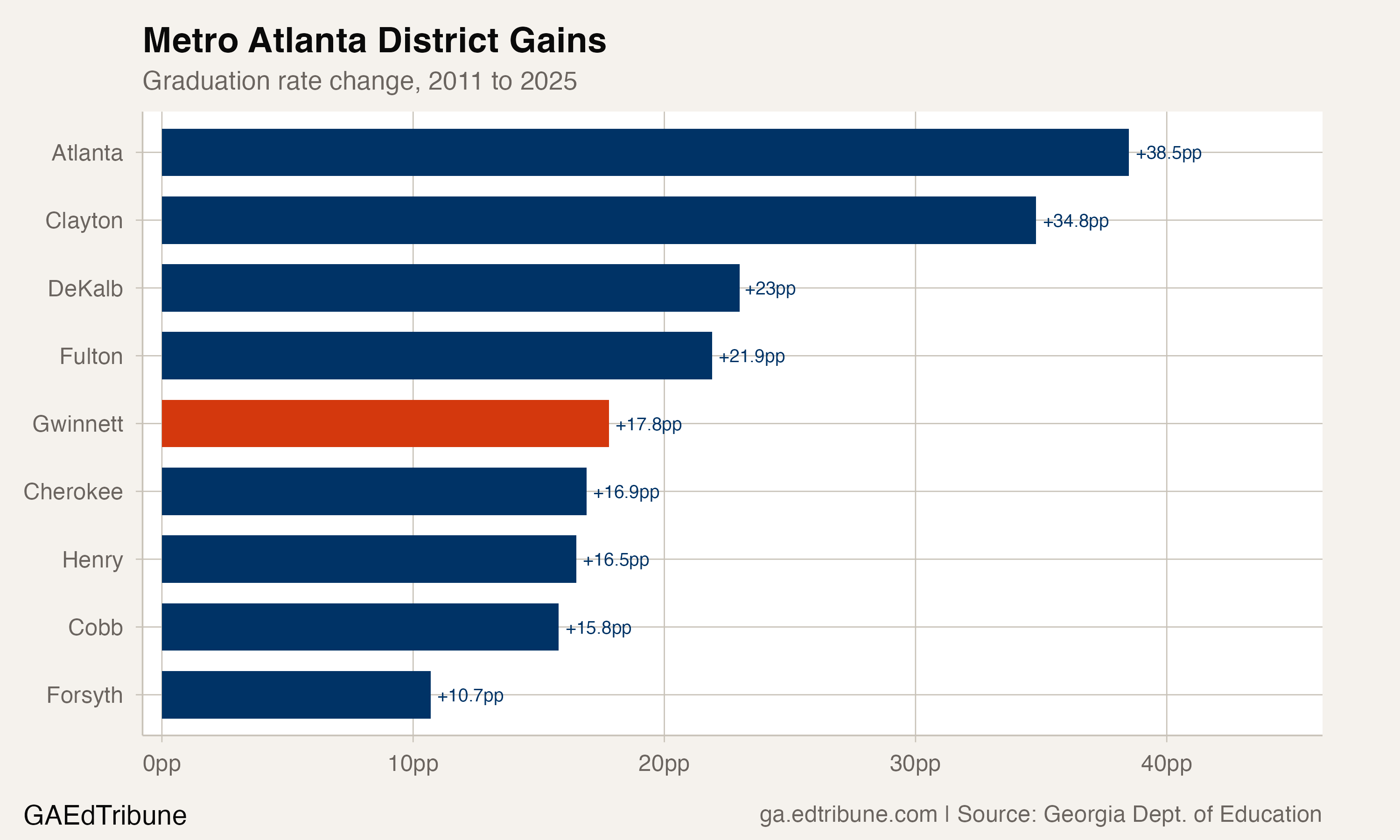
Among metro Atlanta's large districts, Gwinnett's 17.8 point gain ranks fifth. Atlanta Public Schools gained 38.5 points (from 52.0% to 90.5%), Clayton gained 34.8, DeKalb gained 23.0, and Fulton gained 21.9. The suburban districts that started higher, Cobb and Cherokee and Forsyth, had less room to climb but all now sit above 89%.
The Gwinnett County Board of Education has set a 90% graduation rate target for the Class of 2027, according to the Atlanta Journal-Constitution. Reaching that mark requires gaining 4.6 points in two cohorts. The district added graduation coaches to each of its school clusters as part of FY2025 budget investments.
A Hispanic-rate counterfactual
At 34.6% of the graduating cohort and a 76.4% rate, Hispanic students are the largest group and the lowest-performing among the reported racial categories. If Gwinnett's Hispanic rate equaled the current district average of 85.4% while the arithmetic contribution from all other groups held steady, the overall rate would be approximately 88.5%. This is a mechanical counterfactual, not a forecast; the package cannot predict how any subgroup rate will change.
"Students need to understand diversity matters and that schools help equip them for success." -- Former Superintendent Alvin Wilbanks, Atlanta Journal-Constitution
English learners graduated at 26.7% in 2011. Data for their 2025 rate are not available in the package's published cohort files. [Suggestive context:] The available rate rose to 50.0% in 2019, but that incomplete series cannot establish the current rate.
2,327 seniors who did not graduate
The non-graduation count offers a different lens on the same data. In 2011, 4,091 Gwinnett seniors did not earn a diploma within four years. By 2025, that number fell to 2,327, a 43.1% reduction, even as the cohort grew by 26.3%.
That 2,327 figure is both a measure of how far Gwinnett has come and a reminder of how much distance remains.
Detailed code that reproduces the analysis and figures in this article is available exclusively to EdTribune subscribers.
Discussion
Sign in to join the discussion.
Loading comments...