In 2011, Gainesville City↗ET graduated fewer than half its Hispanic seniors. The district, seat of Hall County↗ET in the northeast Georgia poultry belt, had been majority-Hispanic for years. Its four-year rate for those students was 48.8%.
By 2025, Gainesville graduated Hispanic students at 91.8%, a 43-point swing in 14 years. The transformation happened while the cohort itself more than doubled, from 209 seniors to 429. Gainesville did not improve by getting smaller or more selective. It improved by keeping a much larger group of students on track to finish.
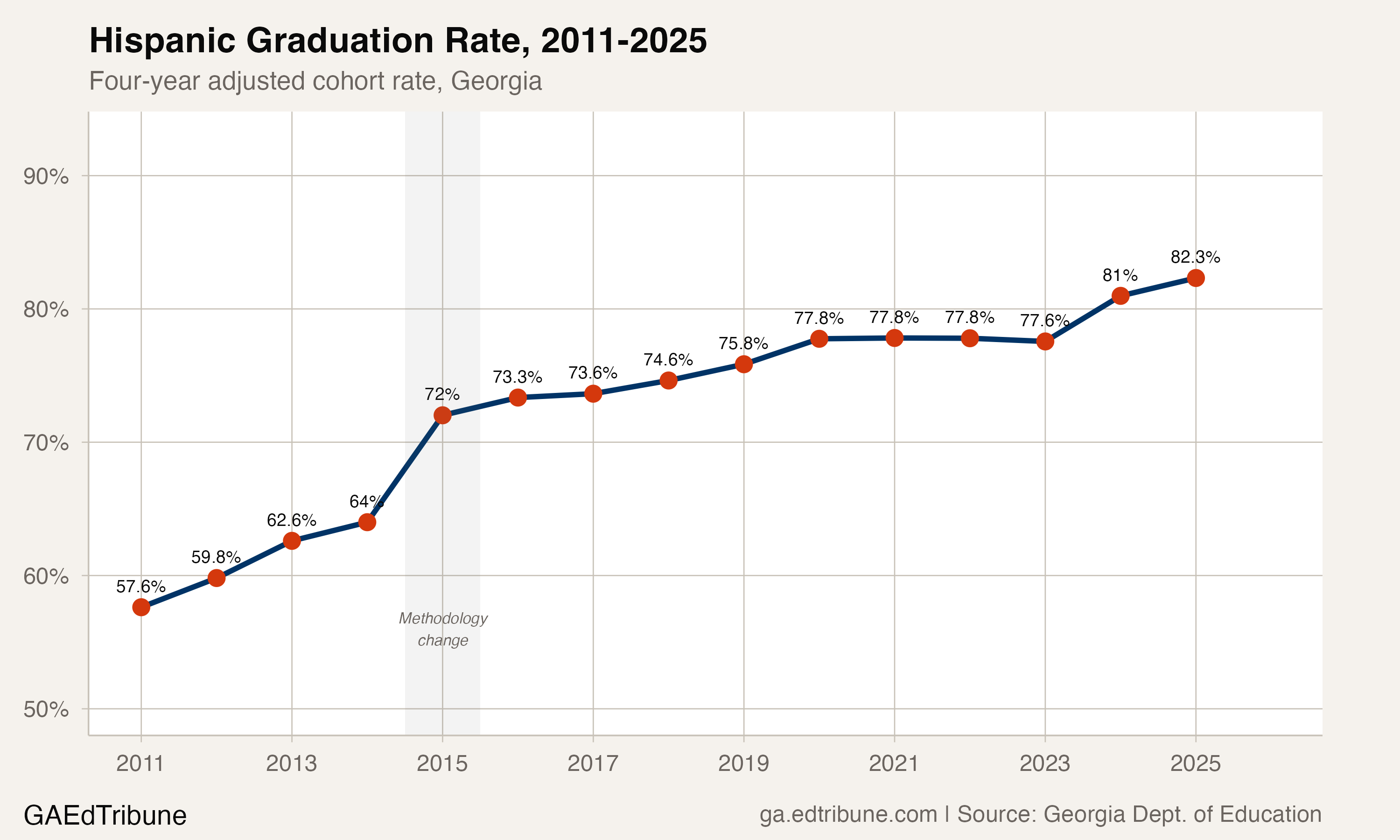
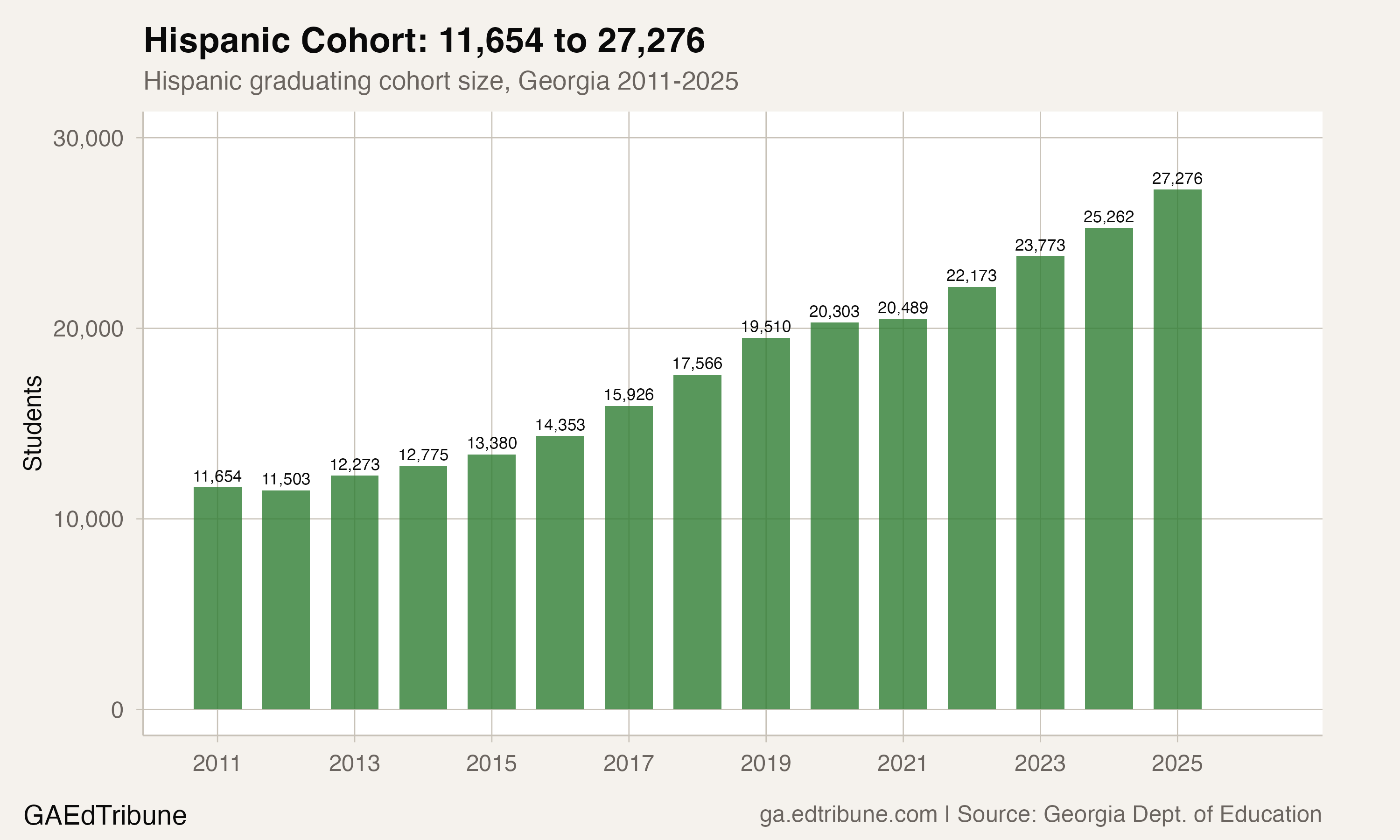
That pattern, rate climbing even as the population surged, defines Georgia's Hispanic graduation story statewide. The Hispanic graduating cohort grew from 11,654 in 2011 to 27,276 in 2025, a 134% increase that dwarfs the 8.4% growth in the overall cohort. The graduation rate for those students rose from 57.6% to 82.3%, a gain of 24.7 percentage points. Georgia now produces 22,454 Hispanic graduates per year, up from 6,715. That is 15,739 additional diplomas annually, more than the entire senior class of most Georgia counties.
One in five seniors is now Hispanic
The demographic shift is as striking as the rate improvement. In 2011, Hispanic students made up 8.9% of Georgia's graduating cohort. By 2025, that share had reached 19.2%, nearly one in five. Over the same period, the white cohort shrank from 58,295 to 49,138, and the Black cohort dipped from 53,436 to 52,787. Hispanic students absorbed nearly all of the state's cohort growth.
This growth reflects decades of Latino immigration into Georgia, which accelerated through the 1990s and 2000s. Poultry processing in Gainesville and Hall County, carpet manufacturing in Dalton↗ET and Whitfield County↗ET, and construction across metro Atlanta drew families who settled permanently. Georgia's Latino population surged 32.7% since 2010, outpacing the national average of 25.9%. The children of those families are now aging into the graduation pipeline in large numbers.
A caveat: Georgia changed its graduation rate methodology in 2015, producing a one-year jump of roughly 8 percentage points for Hispanic students. The post-2015 trend (72.0% to 82.3% over 10 years) is the more reliable measure of sustained improvement. Even so, the pre-2015 gains were real: from 57.6% to 64.0% in four years under the old formula.
The graduation rate improvement means those students are finishing high school at rates that would have been unrecognizable a generation ago. A simple decomposition of the 15,739 additional annual graduates reveals three sources: roughly 9,000 came from the larger cohort (more students entering, even at the old graduation rate), about 2,900 came from the higher rate applied to the original cohort size, and nearly 3,900 came from the interaction of both growing simultaneously. Cohort growth provided the volume. Rate improvement provided the multiplier.
The four-year wall at 78%
The trajectory was not smooth. After climbing from 57.6% in 2011 to 77.8% in 2020, the Hispanic graduation rate stalled. For four consecutive years, 2020 through 2023, the rate held between 77.6% and 77.8%, barely moving while the cohort continued to grow by roughly 1,500 students per year. Pandemic disruption flattened the trajectory, and it stayed flat for years afterward.
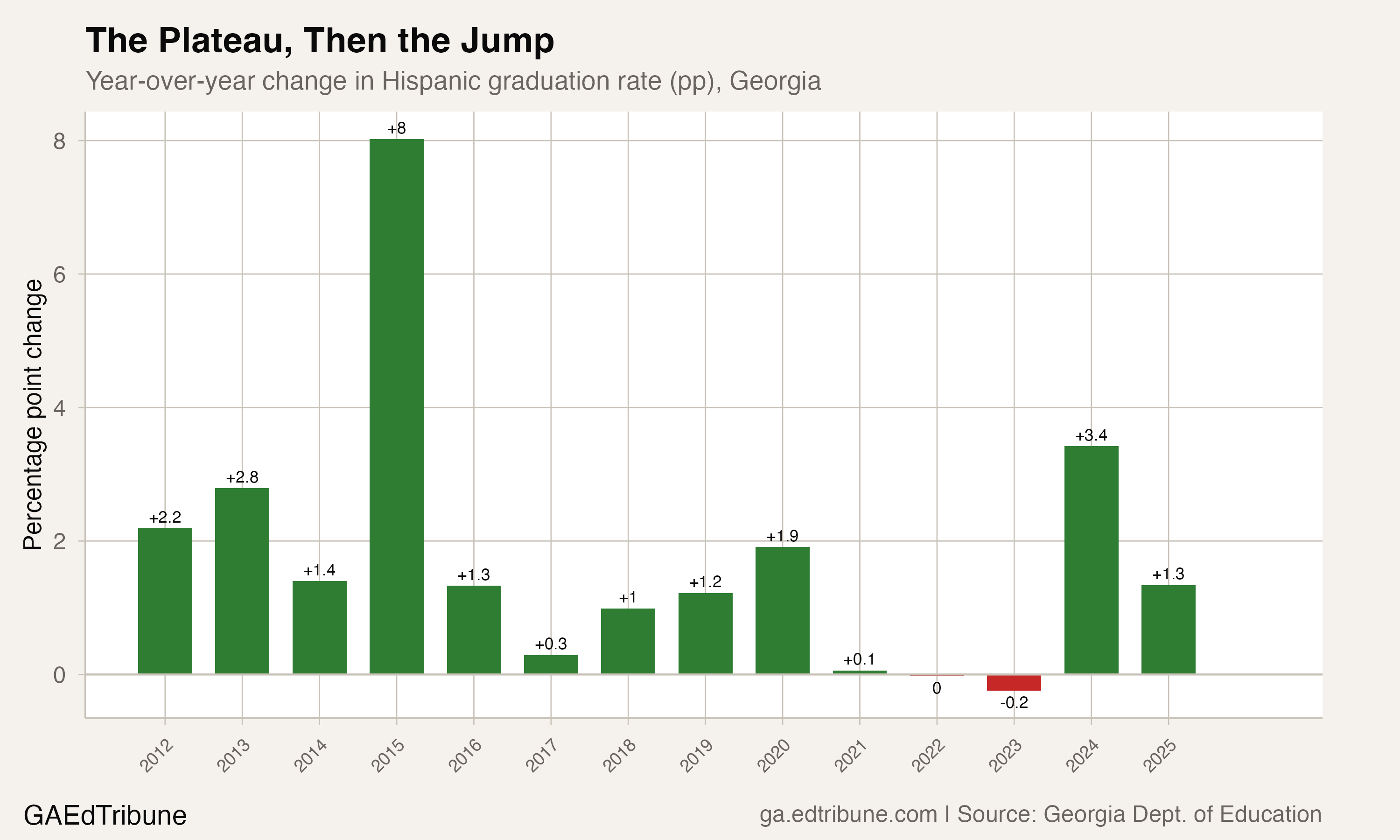
Then the rate broke through. In 2024 it jumped 3.4 points to 81.0%, and in 2025 it added another 1.3 points to reach 82.3%. The two-year gain of 4.8 percentage points ended the longest stall in the 14-year series.
What changed? Two forces likely converged. First, pandemic-era disruptions, which hit English learner families disproportionately hard, receded. Georgia's emergent bilingual students graduated at just 66.2% in 2022, 18 points below the state average. As schools stabilized, EL-heavy districts recovered. Second, districts with large Hispanic populations invested in targeted interventions. Gwinnett County↗ET, which enrolls the state's largest Hispanic graduating cohort (5,511 students), launched a mentoring program specifically for Hispanic students that begins in middle school to build foundations before high school.
The gap that didn't close
Georgia's white-Black graduation gap collapsed to 2.8 percentage points in 2025, one of the narrowest in the country. The white-Hispanic gap did not keep pace. It narrowed from 17.9 points in 2011 to 7.1 points in 2025, a meaningful improvement but still 2.5 times wider than the white-Black gap.
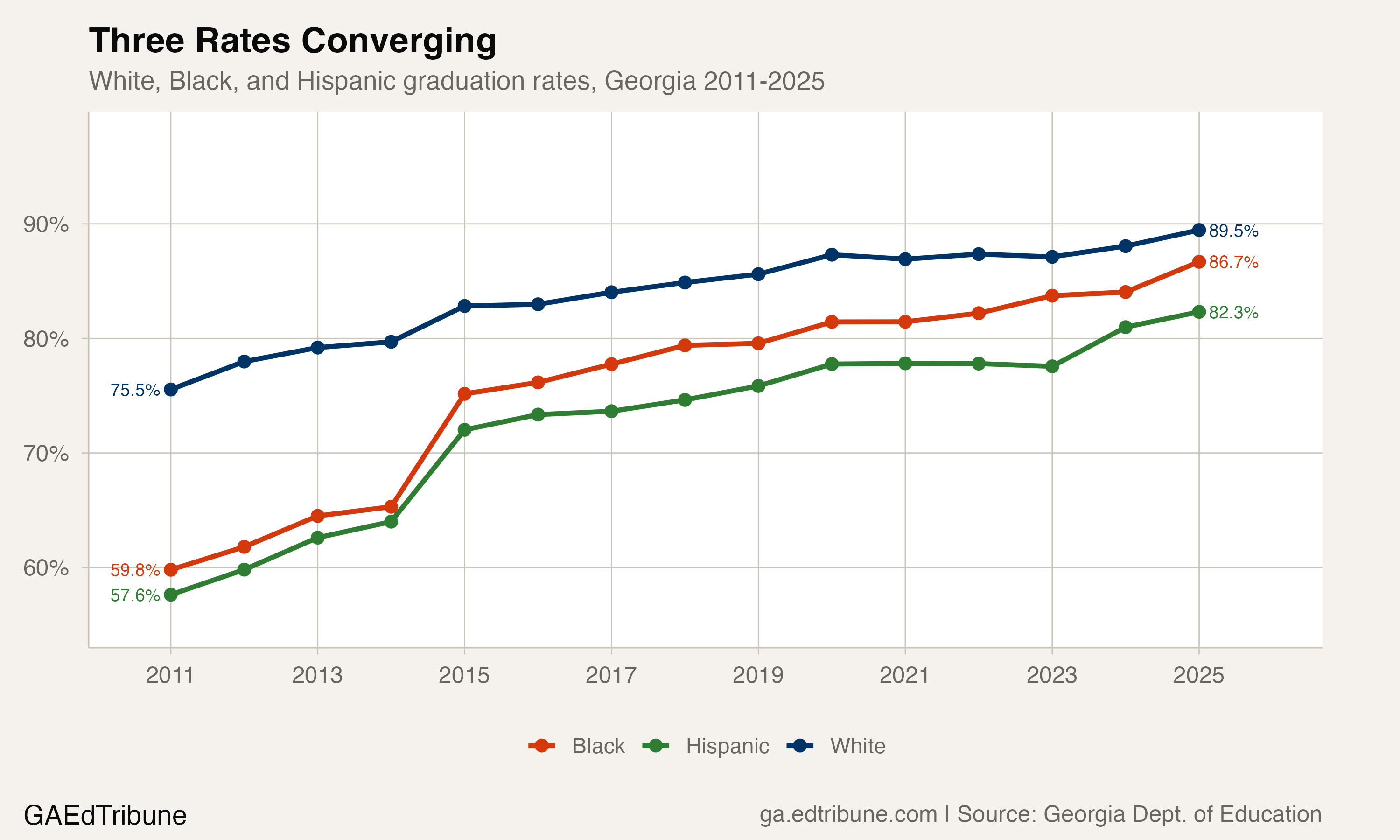
The gap dynamics shifted over the 14-year period. In 2011, the white-Hispanic gap (17.9pp) was wider than the white-Black gap (15.7pp), but both were large. By 2017, Black students had narrowed their gap to 6.3 points while the Hispanic gap still sat at 10.4. From 2020 through 2023, both gaps compressed slowly, but the Black rate surged from 83.7% to 86.7% in 2023-2025 while the Hispanic rate was stuck at 78%. The plateau hurt.
The remaining 7.1-point gap is distinct from other equity gaps because it operates on a population that is growing rapidly. A 7-point gap on 27,276 students means roughly 1,900 additional seniors not graduating on time, a number that grows each year as the cohort expands.
Where the gains landed
The district-level picture reveals a sharp split. Some of Georgia's largest Hispanic cohort districts posted extraordinary gains. Clayton County↗ET, where Hispanic seniors grew from 446 to 965, improved from 41.0% to 85.0%, a 43.9 percentage point jump. Fulton County↗ET gained 34.7 points, reaching 89.0%. Douglas County↗ET climbed 33.4 points to 88.0%.
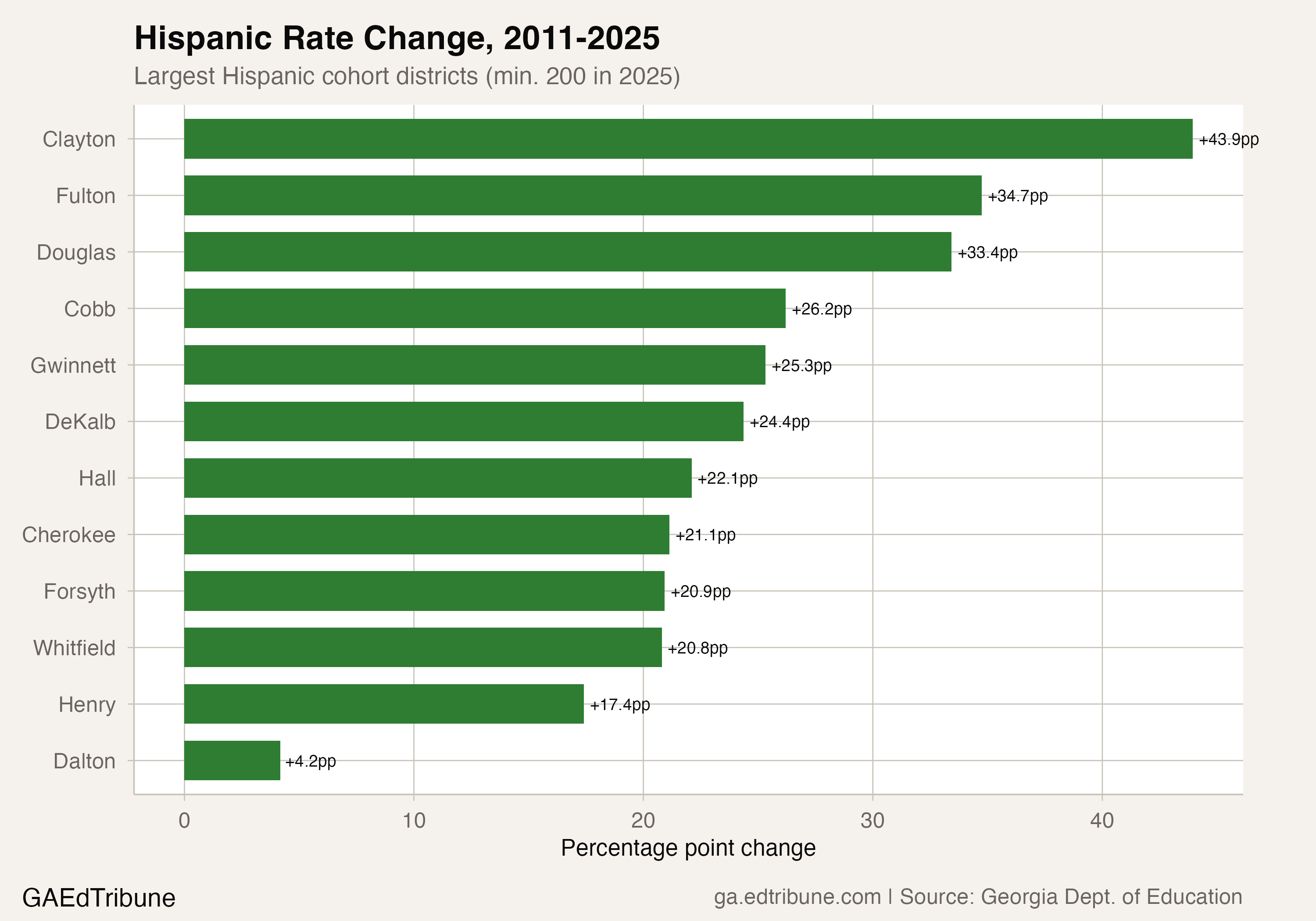
At the other end, Dalton Public Schools↗ET gained just 4.2 points over 14 years, from 76.9% to 81.1%. Dalton's Hispanic community is among Georgia's oldest and most established. The carpet industry drew Latino workers to Whitfield County beginning in the 1990s, and Dalton's schools were majority-Hispanic before many metro Atlanta districts had significant Hispanic enrollment at all. That head start may explain both the higher 2011 baseline (76.9% vs. the state's 57.6%) and the slower improvement: Dalton had already done much of the early work.
Whitfield County, Dalton's surrounding district, tells a different story. It climbed from 71.2% to 92.0%, a 20.8-point gain, and now graduates Hispanic students at a higher rate than Gwinnett County (76.4%), Cobb County↗ET (78.9%), or DeKalb County↗ET (71.1%). The districts with the largest Hispanic cohorts in metro Atlanta are not, on the whole, the ones with the highest Hispanic graduation rates. Forsyth County↗ET leads at 93.1%, but its cohort of 680 is one-eighth the size of Gwinnett's 5,511.
Gwinnett's scale problem
Gwinnett County deserves separate attention. Its Hispanic graduating cohort of 5,511 is larger than the total graduating class of all but a handful of Georgia districts. The rate improved from 51.1% to 76.4%, a 25.3-point gain that tracks the state average. But 76.4% is among the lowest Hispanic graduation rates of the 12 largest-cohort districts, ahead of only DeKalb County (71.1%). Gwinnett's Hispanic students account for about 33% of the district's enrollment and the highest dropout rate of any racial subgroup.
The district has responded. Its dual language immersion program operates at nine elementary schools in Spanish alone, with students spending half the school day learning content in the target language. A mentoring initiative for Hispanic students starts in middle school, building connections before the dropout-risk years of ninth and tenth grade.
Whether those investments move the needle at Gwinnett's scale, 5,511 seniors in a single cohort year, is the open question. Statewide, only 71 dual language immersion programs exist across more than 2,000 schools. Georgia ranked sixth nationally in English learner enrollment in 2021, with 80% of those students estimated to be Latino. The infrastructure for bilingual education has not scaled with the population.
What comes next
Hall County, where Hispanic students comprise nearly half of enrollment, posted 85.2% in 2025. Superintendent Will Schofield called the results "a testament to the hard work of our students, the dedication of our educators, and the strong partnerships we have with families and the community." But Deputy Superintendent Kevin Bales acknowledged gaps remain: "There are gaps to close for our black students, our English Language Learners, and our students with disabilities."
That tension, between real progress and remaining gaps, defines the Hispanic graduation story in Georgia. The state produced 15,739 more Hispanic graduates in 2025 than in 2011. The rate climbed 24.7 points. The white-Hispanic gap halved. By any measure, this is a success.
The 2020-2023 stall showed how quickly momentum can vanish. For four years, the rate barely budged while 1,500 additional students entered the cohort each year. The 2024-2025 breakout erased the plateau, but the math underneath it has not changed: every year the rate stays at 82% instead of climbing to match the Black rate of 86.7%, roughly 1,200 more students leave without a diploma than would otherwise. By 2030, the Hispanic cohort will likely exceed 30,000. Gwinnett alone will graduate a senior class the size of some Georgia districts. The 7.1-point gap between white and Hispanic students is not shrinking on autopilot. It will take the kind of sustained investment that Gainesville and Hall County have made, scaled to districts 10 times their size.
Detailed code that reproduces the analysis and figures in this article is available exclusively to EdTribune subscribers.
Discussion
Sign in to join the discussion.
Loading comments...