In Polk County, a rural northwest Georgia district of about 8,000 students, English learners have a 5.9% chronic absenteeism rate. The district overall sits at 17.2%. In Dalton, further up I-75 and the self-proclaimed "Carpet Capital of the World," the pattern repeats: English learners post a 14.4% chronic rate against the district's 16.4%. Across Georgia, in district after district, the students who might seem most vulnerable to missing school are actually the ones who show up.
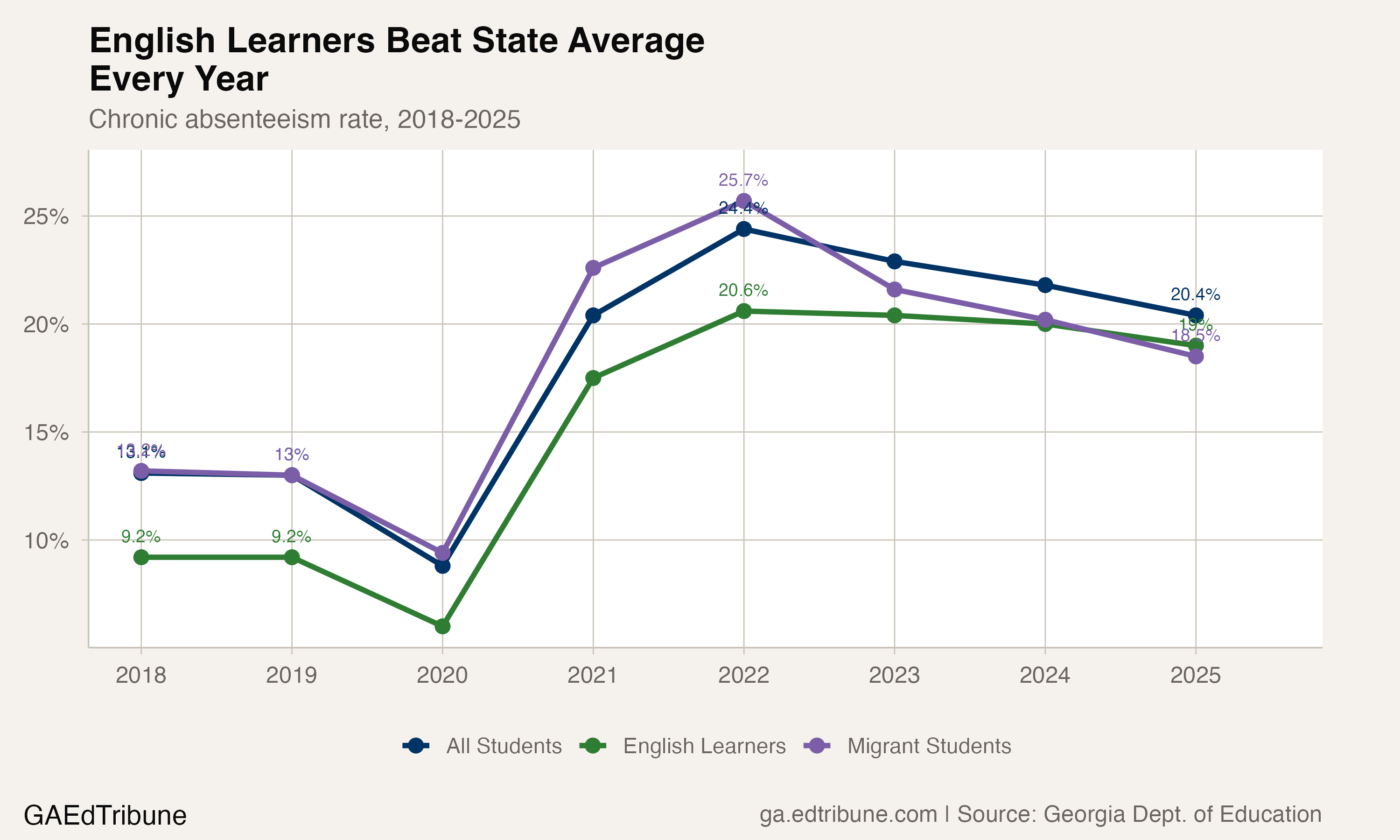
Georgia's 235,837 English learners carry a 19.0% chronic absenteeism rate, 1.4 percentage points below the statewide average of 20.4%. They have been below the state average every single year in the dataset, stretching back to 2018. In 86% of districts with at least 100 English learners, the pattern holds: EL students miss less school than the overall student body.
This is not what the national data would predict.
A Pattern That Defies the National Trend
Across the 27 states tracked by FutureEd and reported by The 74, English learner chronic absenteeism has generally surged past statewide averages since the pandemic. Before COVID, 14 of 27 tracked states had EL rates at or below their state average. By 2024-25, only six did. In Missouri, EL absenteeism jumped from 12% (below average) to 27% (five points above). In Alaska, Hawaii, and Oregon, EL rates now exceed state averages by more than 15 points.
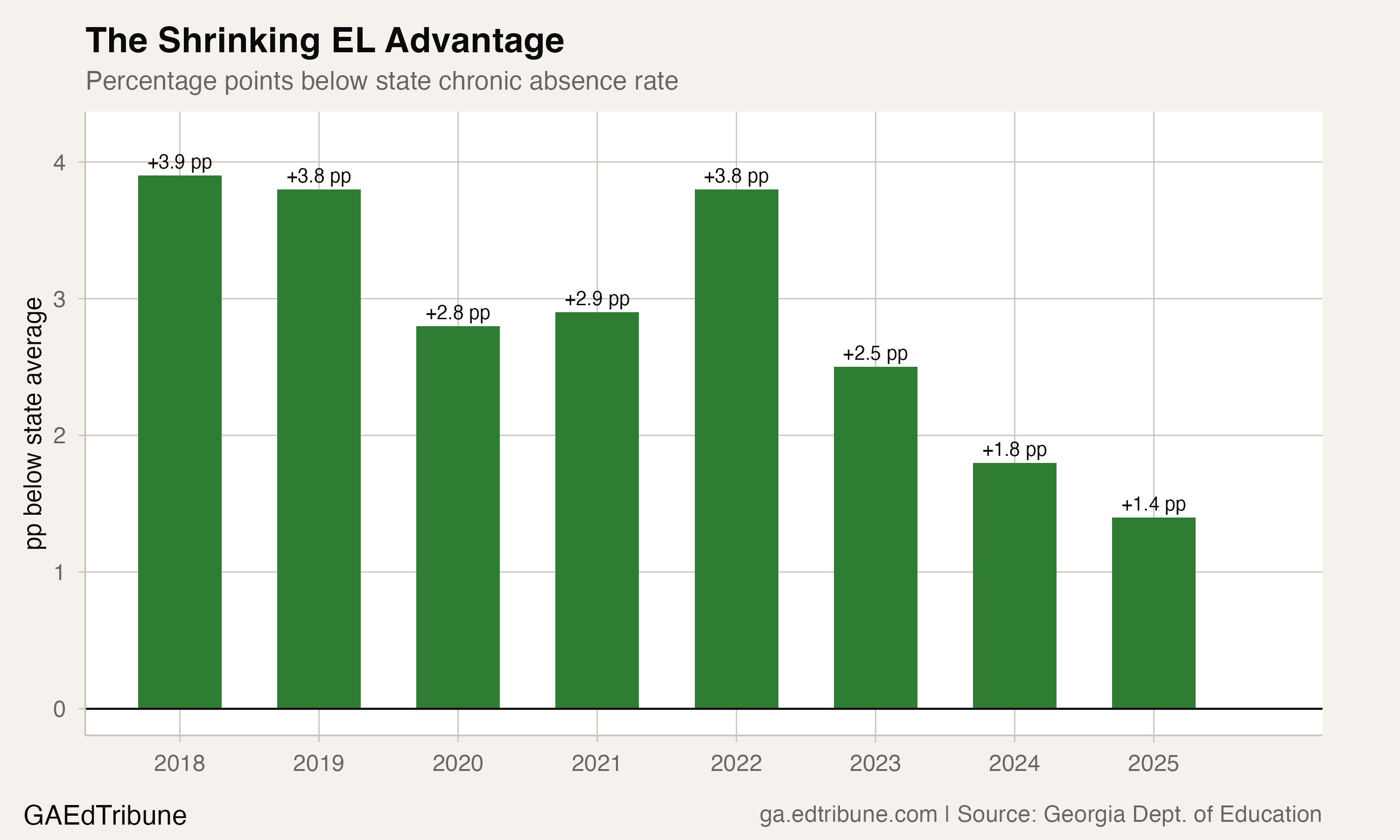
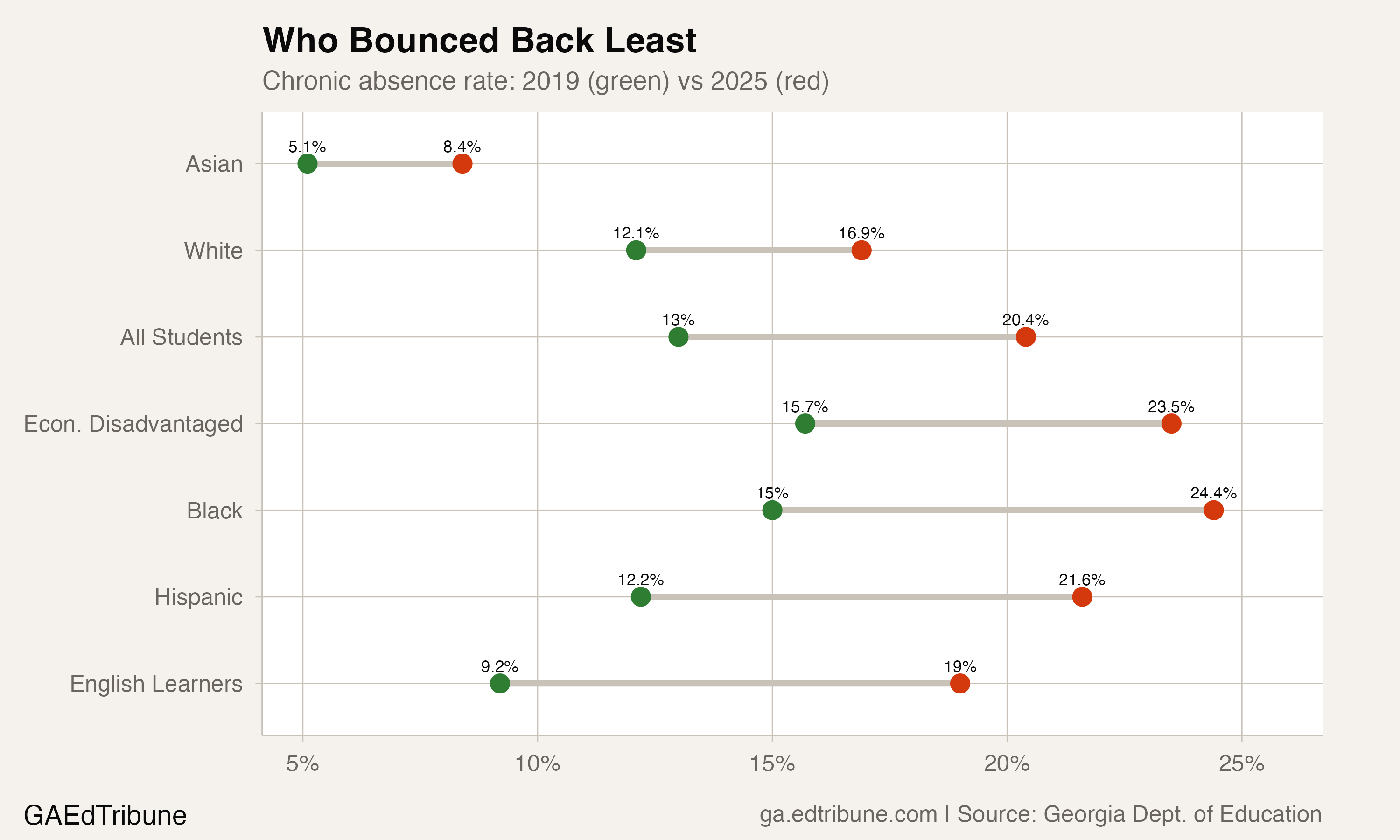
Georgia is moving in the opposite direction. Its English learners spiked during COVID by the same 11.4 percentage points as the overall student body, but they started from a lower floor: 9.2% in 2019 versus 13.0% statewide. That pre-pandemic gap of 3.8 points has narrowed to 1.4 points, and the advantage is clearly eroding. But the fundamental pattern has not broken.

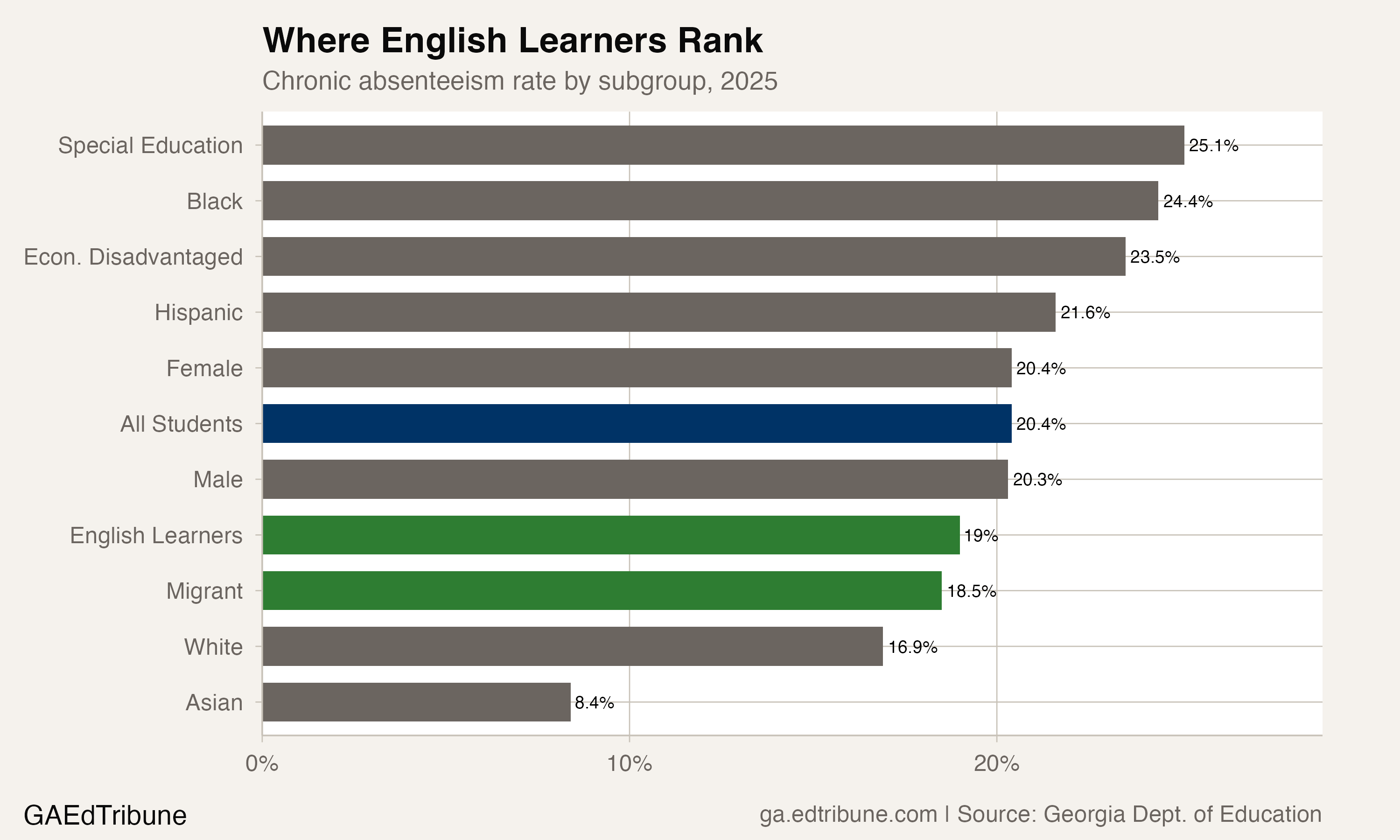
Migrant students tell a similar story. Their 18.5% chronic rate sits 1.9 points below the state average, despite the obvious disruptions of agricultural labor cycles and family mobility. Asian students, a group with substantial EL overlap, post the lowest rate of any subgroup at 8.4%.
Where English Learners Rank
Place Georgia's English learners on the full subgroup ladder and the picture sharpens. At 19.0%, they sit below not only the state average but also below Hispanic students (21.6%, a group with substantial EL overlap), female students (20.4%), male students (20.3%), and multiracial students (20.9%). Only white students (16.9%) and Asian students (8.4%) post meaningfully lower rates.

The comparison with Hispanic students is particularly instructive. Georgia's 364,358 Hispanic students carry a 21.6% chronic rate. Its 235,837 English learners, who overlap heavily with the Hispanic population (LEP enrollment is roughly 65% of Hispanic enrollment), carry a 19.0% rate. The subset designated as English learners attends school more consistently than the broader demographic group they largely belong to.
Note that English learners and Hispanic students are not parallel categories. They overlap substantially. Many EL students are Hispanic, and the EL designation reflects a service classification, not a demographic one. The comparison is useful for understanding the EL attendance advantage, not for summing the two groups.
The Immigrant Paradox in an Attendance Dataset
Researchers have a name for what Georgia's data shows. The immigrant paradox describes the counterintuitive finding that children of immigrants frequently outperform peers from native-born families on academic and behavioral measures, despite higher rates of poverty, language barriers, and social marginalization.
"Closer family ties characteristic of immigrant families account for roughly half of the advantage." -- Institute for Family Studies
The pattern is well-documented in academic achievement. Children of immigrants demonstrate better test scores, stronger spelling and science competition performance, and lower rates of disciplinary incidents. The Georgia attendance data suggests the paradox extends to showing up. Families navigating a new language and, often, a new country prioritize physical presence in school in ways that may erode in subsequent generations as families assimilate.
A 2024 study by Santibañez, Gottfried, and Freeman published in Educational Researcher found that when socioeconomic status and other characteristics are controlled for, EL-classified students actually have lower absenteeism than non-EL students. The raw numbers sometimes obscure this because EL families disproportionately face poverty, food insecurity, and transportation barriers. In Georgia, where 72.8% of all students are classified as economically disadvantaged, those structural barriers are widespread enough that the EL attendance advantage persists even without statistical controls.
The Advantage Is Shrinking
The story is not purely good news. Georgia's EL attendance advantage has been cut by nearly two-thirds since 2018.

In 2018, English learners posted a chronic rate 3.9 percentage points below the state average. By 2025, the gap is 1.4 points. The narrowing accelerated after 2022: the advantage bounced back to 3.8 points that year before compressing sharply through 2023 (2.5 pp), 2024 (1.8 pp), and 2025 (1.4 pp).
Two dynamics could explain the erosion. First, Georgia's EL population grew 27.8% from 2018 to 2025, adding over 51,000 students. A rapidly expanding group may dilute the attendance advantage as identification criteria broaden and more students with diverse circumstances enter the EL classification. Second, the post-COVID attendance crisis hit all subgroups, but English learners recovered less of their spike. All students clawed back 4.0 percentage points from the 2022 peak. English learners recovered only 1.6 points over the same period. The national FutureEd data confirms this pattern: EL students experienced sharper pandemic disruptions and slower recoveries in most states.

At the current pace of compression, about 0.8 points per year since 2022, the EL advantage would disappear entirely by 2027. Whether that reflects a real behavioral shift or an artifact of a changing EL population is a question Georgia's data alone cannot answer.
District by District, the Pattern Holds
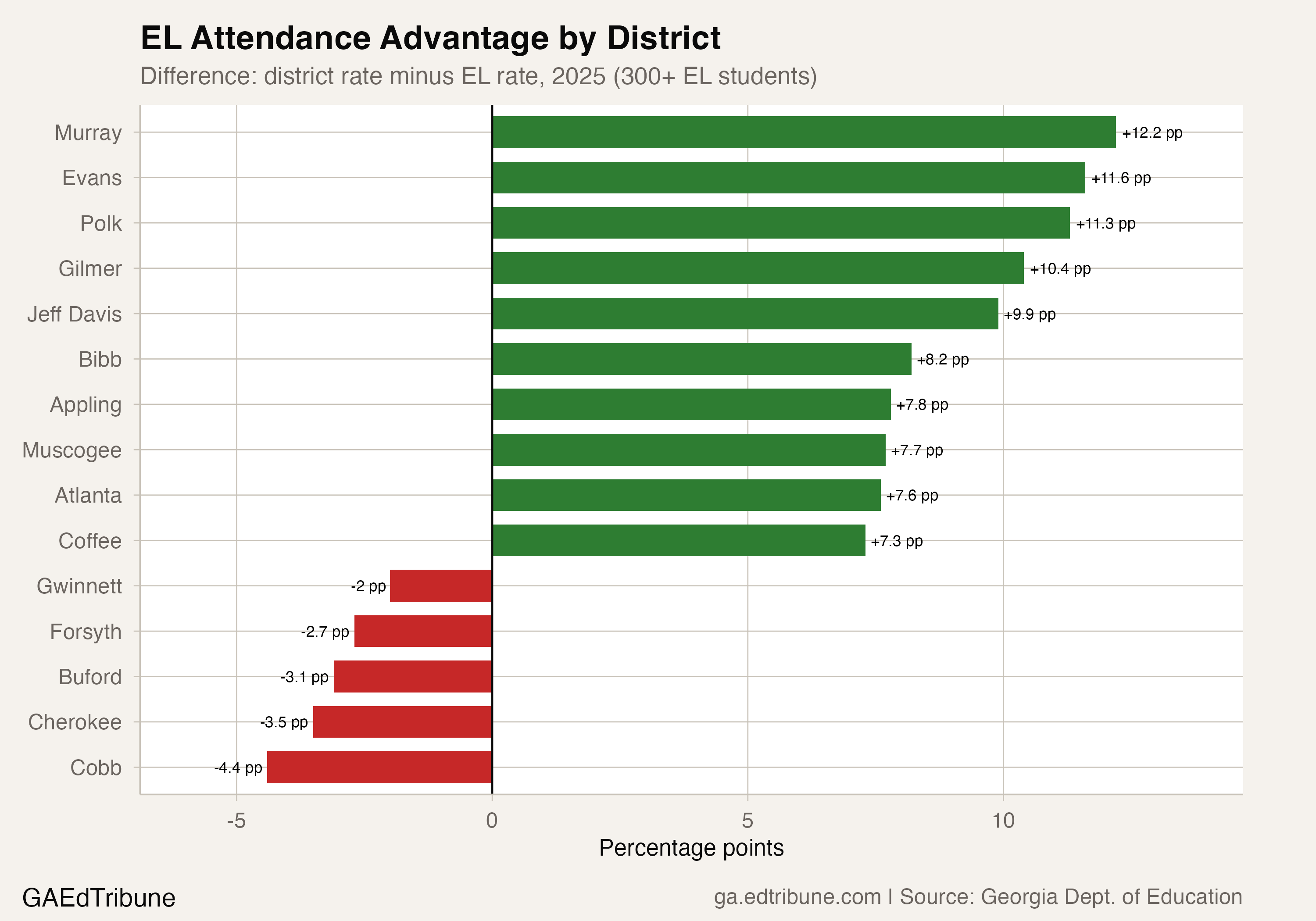
The EL attendance advantage is not a statistical artifact driven by a few large districts. In 101 of 117 districts with at least 100 English learners, EL chronic absenteeism is lower than the district's overall rate.

The largest advantages appear in rural and small-city districts. Murray County, in the carpet corridor of northwest Georgia, shows a 12.2-point EL advantage: the district's overall rate is 21.7% while its 973 English learners post 9.5%. Polk County's 11.3-point gap is the third largest among sizable EL populations.
The exceptions are revealing. In Gwinnett County, the state's largest district with 199,231 students and 56,286 English learners, the pattern reverses: EL chronic absence is 20.4% against the district's overall 18.4%, a 2.0-point disadvantage. Cobb County shows a similar inversion at 4.4 points. These are Georgia's most urbanized, most diverse suburban districts, places where the EL population may include more second-generation families and where the immigrant paradox's protective factors may have begun to attenuate.
The Georgia Budget and Policy Institute has documented structural challenges facing EL students in Georgia, including state-imposed caps that limit ESOL instruction to one-sixth of a school day for students in kindergarten through third grade and a teacher-to-student ratio of 1:39 in ESOL programs. Despite these resource constraints, EL attendance remains stronger than average.
What a New Law Cannot Measure
Governor Brian Kemp signed SB 123 on April 28, 2025, and the law took effect July 1, 2025. It requires attendance review teams in every district with chronic absenteeism above 10% and every school above 15%, and it prohibits expelling students solely for attendance problems.
Given that Georgia's statewide rate is 20.4%, virtually every district in the state is subject to the team requirement. The teams are charged with identifying root causes of absence. Georgia's English learner data suggests one of those root causes is not what policymakers might assume. The 235,837 students learning English are, as a group, more likely to be in school than their English-proficient peers.
The question SB 123's review teams will not easily answer is what makes these families' attendance patterns different and whether the advantage is durable. The three-year compression trend suggests it may not be. If Georgia's EL chronic rate continues its post-2022 trajectory, the state will join the national majority where English learners miss more school than average. The attendance data from Gwinnett and Cobb, where the pattern has already flipped, may be a preview of where the state is headed.
Detailed code that reproduces the analysis and figures in this article is available exclusively to EdTribune subscribers.
Discussion
Sign in to join the discussion.
Loading comments...