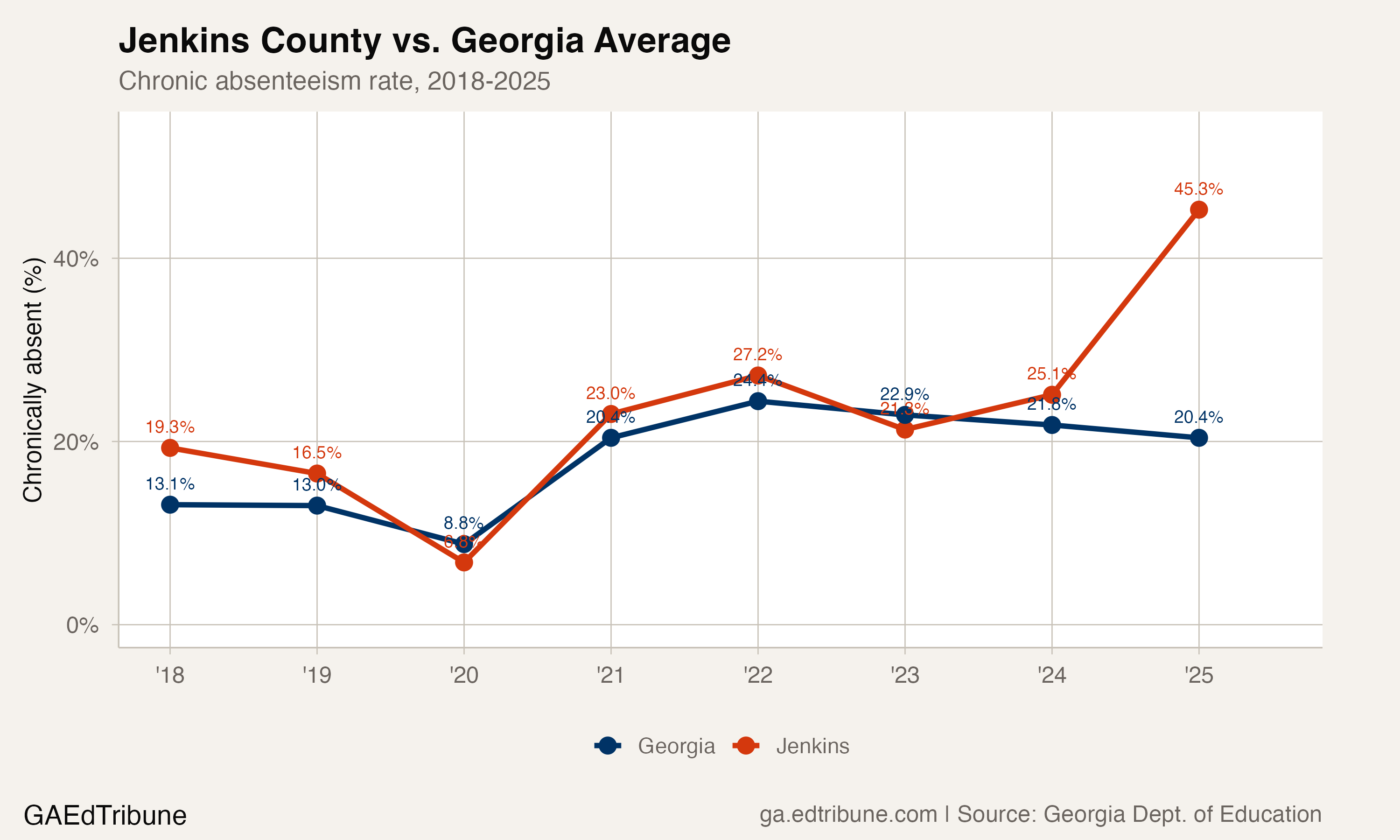
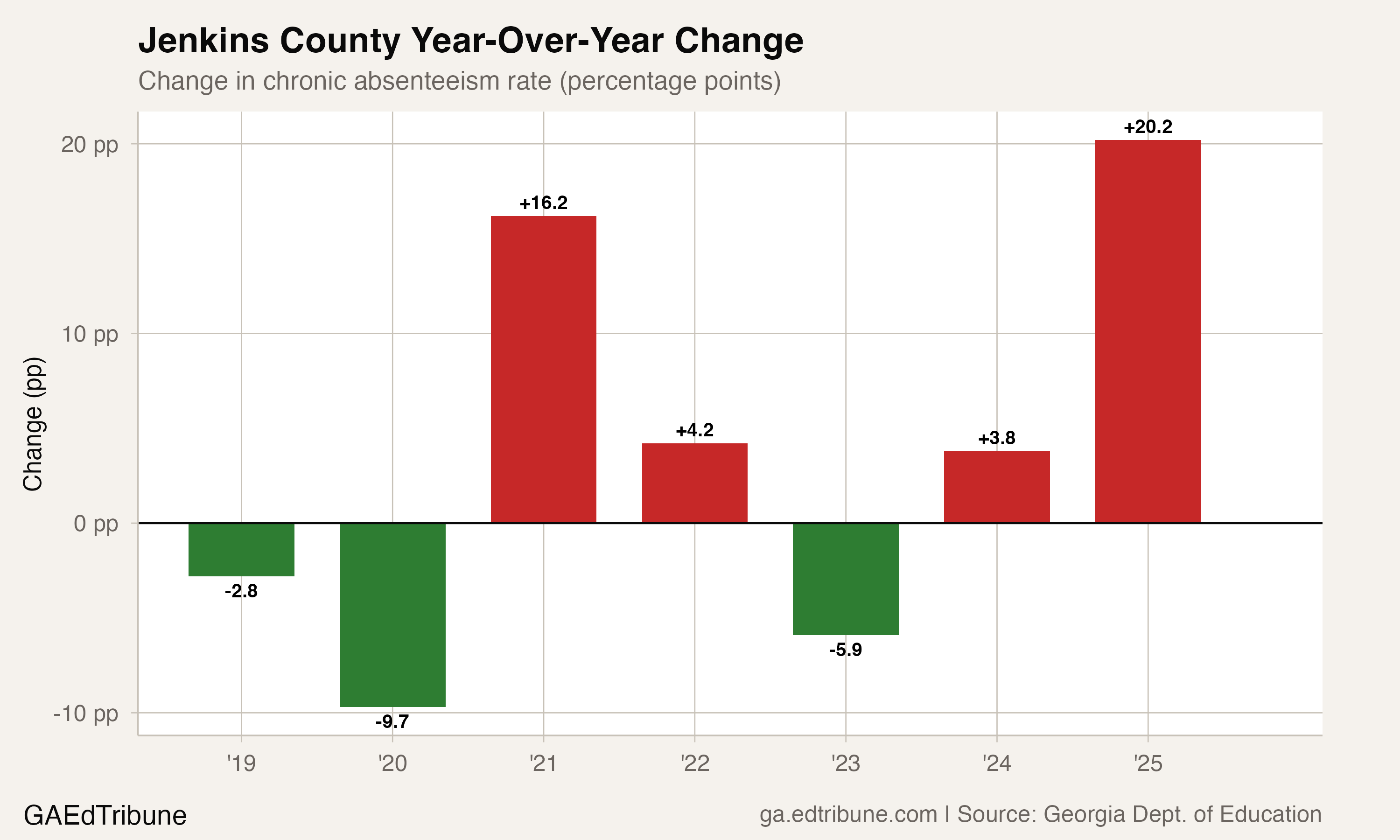
The number that shows up in Georgia's attendance dashboard for Jenkins County is 45.3%. Nearly half the district's students are chronically absent. That rate is more than double the statewide average of 20.4%, and it jumped 20.2 percentage points in a single year, the largest spike among traditional Georgia school districts between 2023-24 and 2024-25.
The number is real. But the story behind it has almost nothing to do with Jenkins County's three schools in Millen, the county seat of this rural southeast Georgia county of 8,700 people.
In August 2024, the Jenkins County School System partnered with ACCEL Schools to launch the Virtual Preparatory Academy of Georgia, a tuition-free online school that enrolls students statewide, kindergarten through 10th grade. In its first year, 967 students enrolled. Of those, 75.6% were chronically absent.
Those 967 students do not live in Jenkins County. They live across Georgia. But because the virtual school is authorized under the Jenkins County School System, their attendance records are counted in Jenkins County's district-level data.
Two districts in one number
Strip out the virtual school and Jenkins County's brick-and-mortar schools tell a different story. Jenkins County High School's chronic absenteeism rate was 18.5% in 2024-25, below the state average. Jenkins County Elementary was at 20.7%, roughly at the state average. The middle school, at 23.2%, was modestly above. Combined, the three traditional schools enrolled 1,191 students with a weighted chronic absenteeism rate of about 20.7%, an improvement from 25.1% the year before.
The Virtual Preparatory Academy, by contrast, reported a 75.6% chronic absenteeism rate across its 967 students. Three out of four virtual students missed enough school days to be classified as chronically absent.
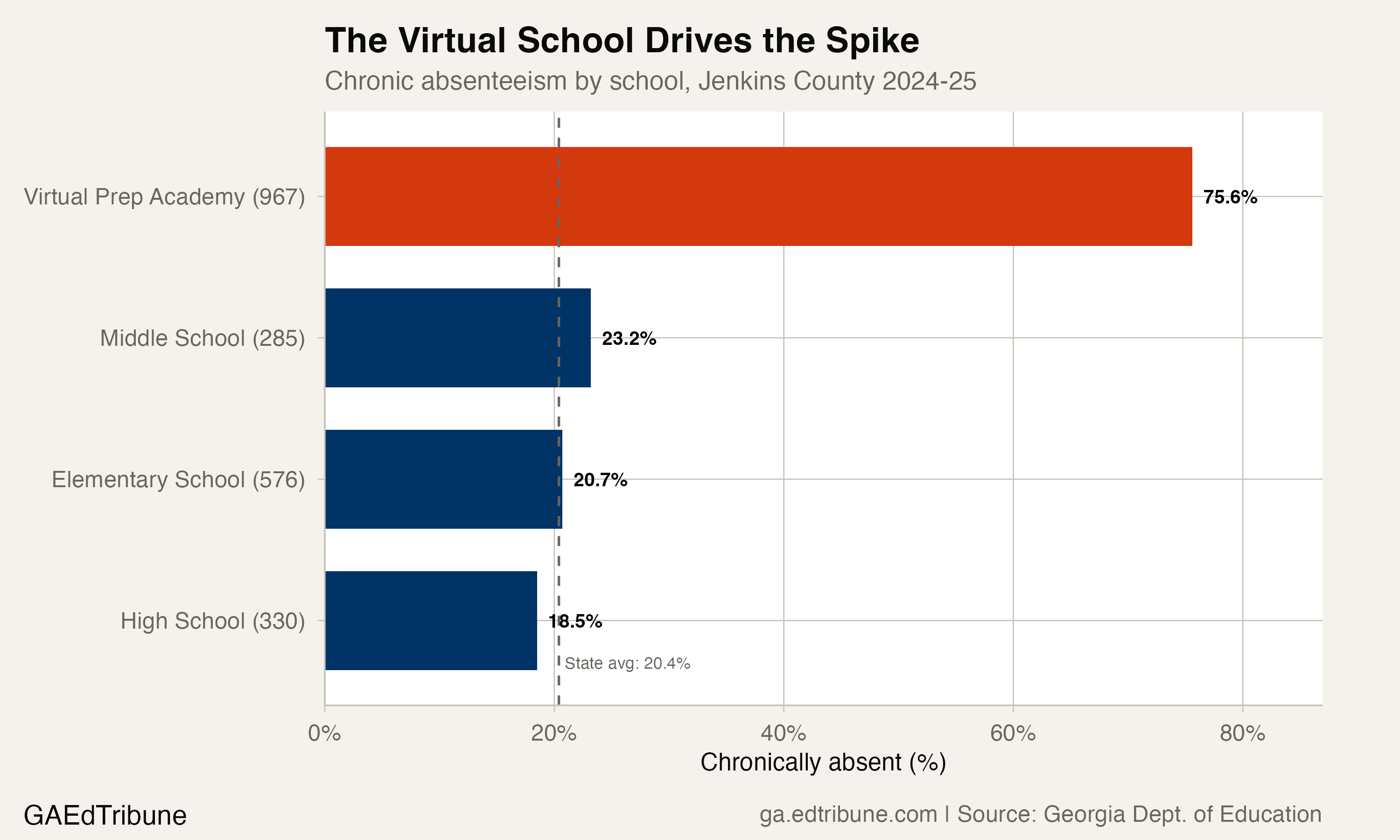
The gap is not subtle. The virtual school's rate is 3.6 times the elementary school's rate and 57 percentage points above the high school's. In a district where the virtual school accounts for nearly 45% of total enrollment, the distorted average overwhelms the brick-and-mortar reality.
A statewide school wearing a rural district's name
Jenkins County is not unique in hosting a virtual school. Georgia Cyber Academy, one of the state's oldest online schools, enrolls more than 11,000 students statewide and reported a chronic absenteeism rate of 17.2% in 2024-25, well below the state average. Mountain Education Center, a credit-recovery charter, reported 98.3% chronic absenteeism with roughly 2,950 students.
What makes Jenkins County unusual is the scale of distortion relative to the host district. Before the virtual school launched, Jenkins had about 1,170 students. The virtual school nearly doubled that count overnight. In most districts that host virtual schools, the virtual enrollment is a small fraction of the total, muting its impact on the headline number. In Jenkins, it is nearly half.
The partnership was deliberate. Superintendent Dr. John Paul Hearn told the press that partnering with ACCEL Schools gave the rural district access to "a wide range of courses" it could not offer on its own, including more than 30 Advanced Placement courses and 50 career and technology classes. For a district with three schools and a median household income of $44,389, roughly three-fifths of the state median, the arrangement brings in per-pupil funding for students the district does not need to house, transport, or feed.
The attendance problem virtual schools cannot solve
Virtual schools face a structural attendance challenge that predates Jenkins County. Tracking attendance in an online environment is harder than counting bodies in a building. Students may log in without engaging. Asynchronous coursework blurs the line between present and absent. And the students who enroll in virtual programs often do so because traditional school was not working for them, bringing higher baseline absence risk.
The 75.6% chronic absenteeism rate at the Virtual Preparatory Academy is extreme even by virtual school standards. Georgia Cyber Academy, which has operated for years and has had time to develop attendance systems, reported a chronic absenteeism rate of 17.2% in 2024-25, suggesting that mature virtual schools can hold their own on attendance. The Virtual Preparatory Academy opened its doors for the first time in August 2024, enrolling students on a rolling basis throughout the year. First-year programs routinely see inflated absence rates as enrollment stabilizes and students who enrolled but never fully committed wash out of the count.
Georgia's new attendance law, SB 123, signed by Governor Kemp in April 2025, requires attendance review teams in districts where 10% or more of students are chronically absent and in individual schools where at least 15% are. Under that threshold, the Virtual Preparatory Academy would require its own attendance review team. But the law is designed for brick-and-mortar schools where door-knocking and truancy interventions make sense. Whether those tools translate to a statewide virtual school with students scattered across 159 counties is an open question.
What the dashboard does not show
The Georgia Department of Education's attendance dashboard reports district-level chronic absenteeism without distinguishing between virtual and in-person schools. A parent in Millen researching Jenkins County's schools would see a 45.3% chronic absenteeism rate and have no way to know that the number is driven almost entirely by an online school serving students elsewhere in the state. A legislator citing the state's worst-performing districts would find Jenkins County near the top of the list.
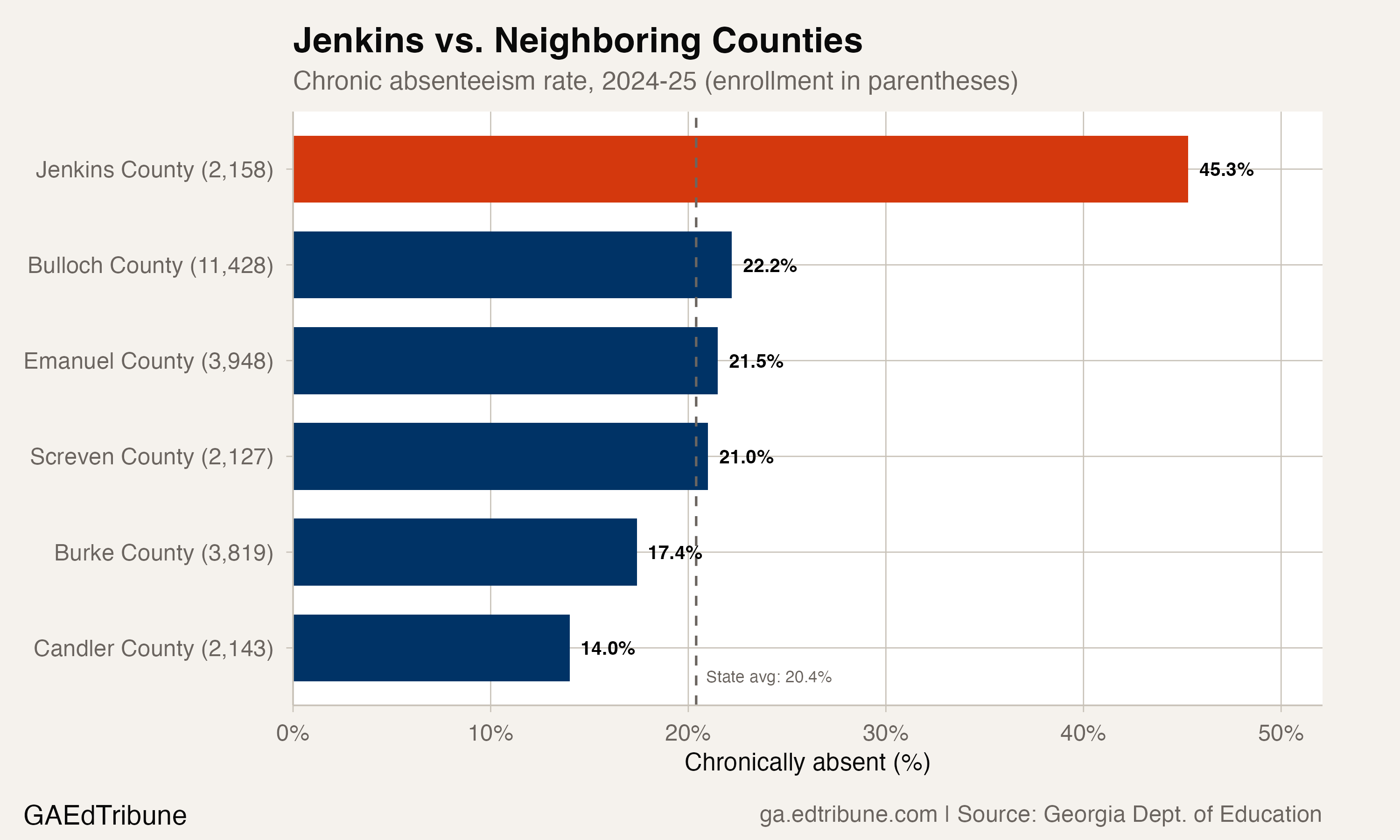
The peer comparison underscores the distortion. Among its five neighboring counties, Bulloch County (22.2%), Emanuel County (21.5%), and Screven County (21.0%) cluster near the state average. Burke County sits at 17.4%, Candler County at 14.0%. Jenkins, at 45.3%, appears to be in crisis. Remove the virtual school and Jenkins would rank in the middle of its neighbors.
The attendance bands tell the deeper story
Before the virtual school, Jenkins County's attendance profile looked like a district struggling but not exceptional. In 2018-19, 38.6% of students missed five or fewer days, 43.0% missed six to 15 days, and 18.4% missed more than 15. By 2024-25, the share of students in the severe category, missing more than 15 days, had climbed to 39.9%, while the good-attendance share fell to 23.1%.
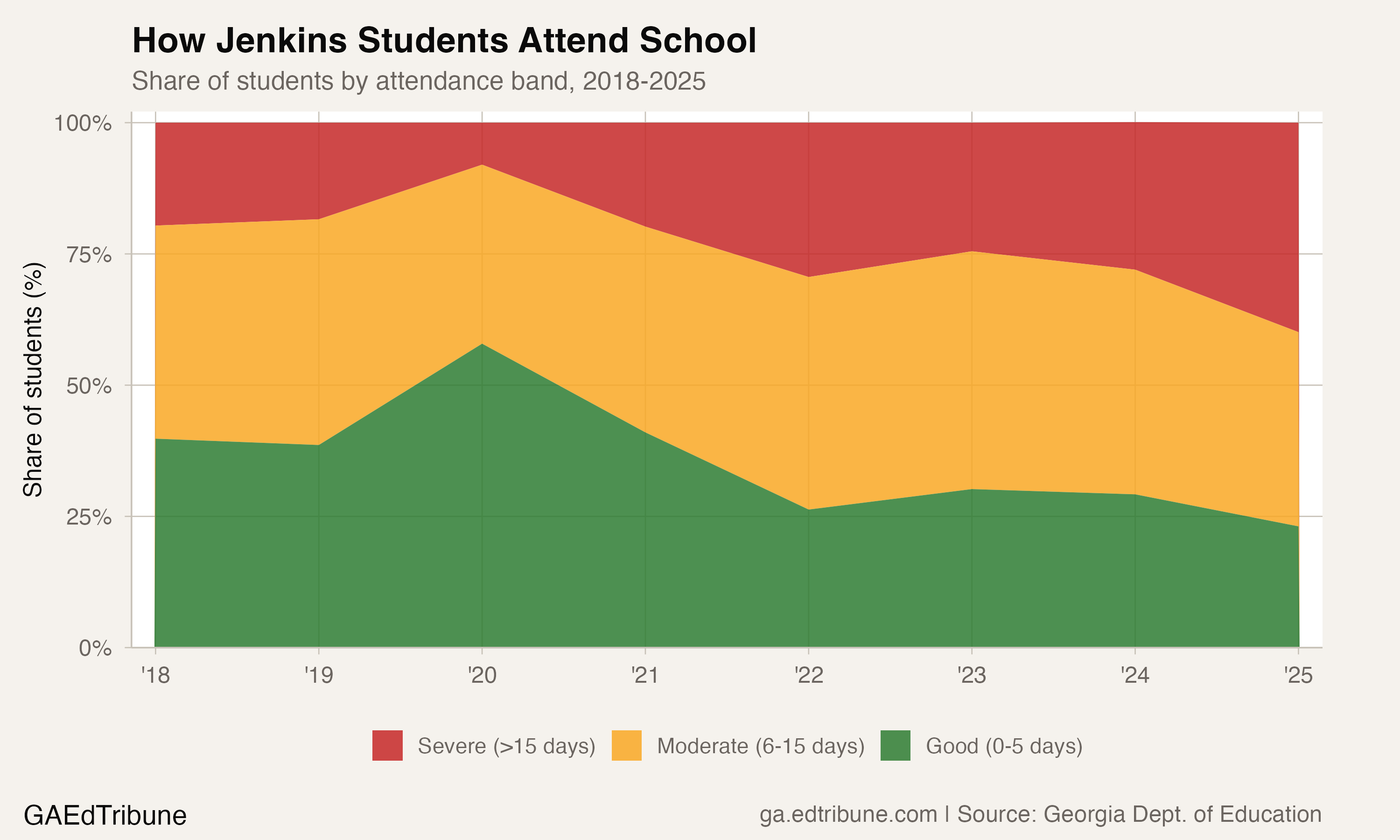
That shift is almost entirely the virtual school. Among the virtual school's 967 students, the severe-absence rate is embedded in the 75.6% chronic rate. The brick-and-mortar schools, meanwhile, have their own attendance challenges. The district is not immune to the forces affecting rural Georgia, where poverty, transportation gaps, and mental health access keep students home. Jenkins County's poverty rate of 22.9% is nearly double the national average, and only 10.3% of adults hold a bachelor's degree.
But the brick-and-mortar story is one of modest improvement, from 25.1% chronic absenteeism in 2023-24 to roughly 20.7% in 2024-25, a drop of 4.4 percentage points. That improvement is invisible in the district-level number.
What to watch
The Virtual Preparatory Academy plans to add a grade each year until it reaches K-12. If it grows as ACCEL Schools' other virtual programs have nationally, it could eventually enroll more students than all of Jenkins County's traditional schools combined. Whether the academy's attendance picture improves in year two, as first-year sorting effects fade, or whether three-quarters chronic absenteeism reflects a deeper structural problem with how virtual attendance is measured and enforced, will determine whether Jenkins County's dashboard number ever reflects the schools that Jenkins County families actually send their children to.
Detailed code that reproduces the analysis and figures in this article is available exclusively to EdTribune subscribers.
Discussion
Sign in to join the discussion.
Loading comments...