In 2019, the chronic absenteeism pattern in Georgia looked the way it had for years: boys missed more school than girls. The gap was modest, 0.4 percentage points, 13.2% to 12.8%. But consistent. Boys had higher rates every year from 2017-18 through 2020-21.
That pattern broke in 2021-22 and has not returned. Girls now have marginally higher chronic absenteeism than boys: 20.4% to 20.3% in 2024-25. The gap is small. What makes it notable is not the size but the direction, and what it took to flip it.
A gap that reversed under pressure
Before the pandemic, the gender gap in chronic absenteeism held steady between 0.3 and 0.5 percentage points, boys above girls, every year from 2017-18 through 2019-20. The pattern was unremarkable precisely because it was so stable.
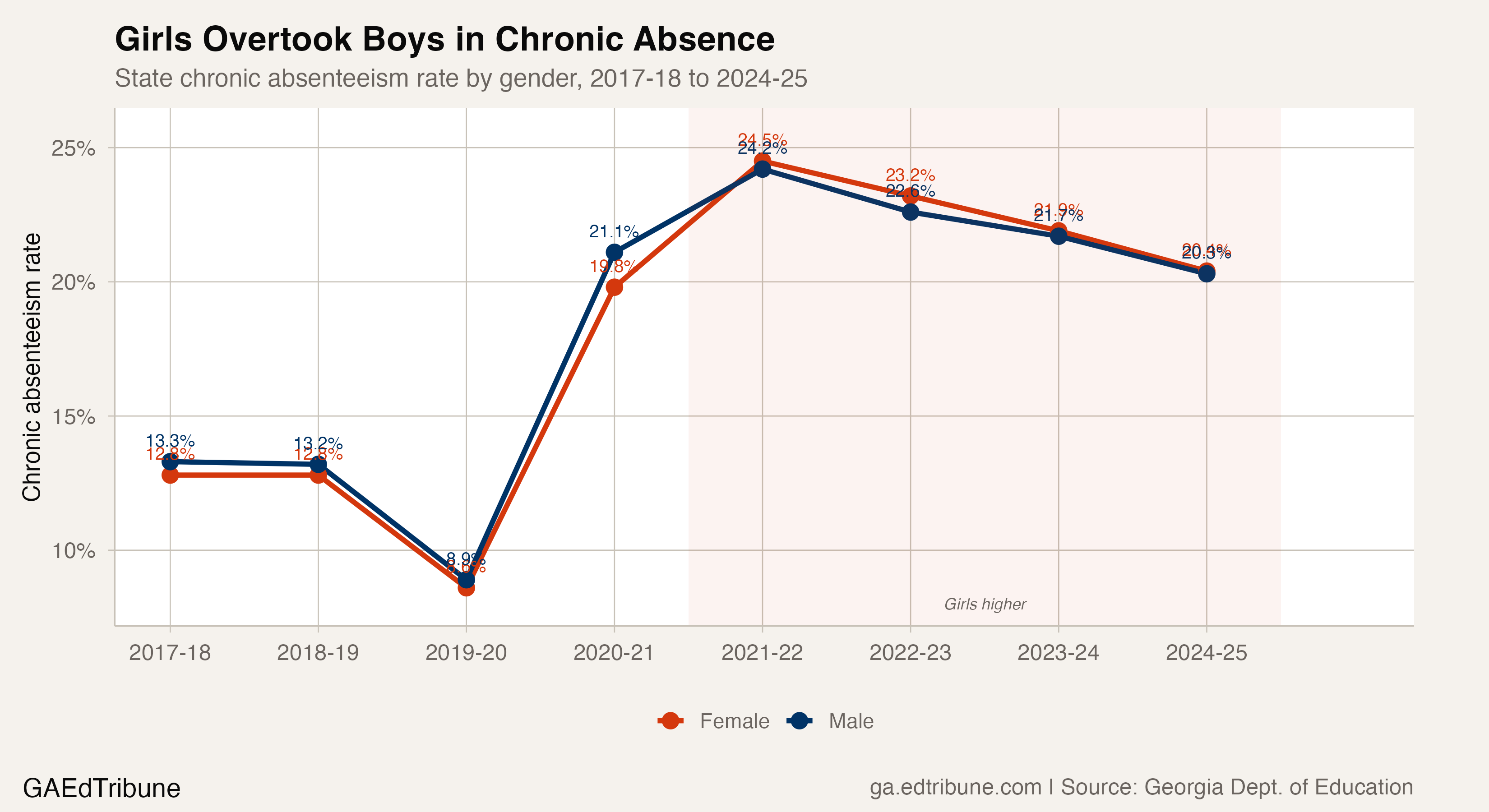
COVID broke it apart. In 2020-21, both genders surged, but boys surged harder: male chronic absenteeism jumped 12.2 percentage points (from 8.9% to 21.1%) compared to 11.2 points for girls (8.6% to 19.8%). The gender gap actually widened to 1.3 points that year, its largest margin on record, still favoring girls.
Then the reversal. By 2021-22, girls' chronic absenteeism climbed to 24.5% while boys' peaked at 24.2%. For the first time, girls were missing more school. The gap was 0.3 points in the other direction. And it has stayed there: 0.6 points in 2022-23, 0.2 points in 2023-24, 0.1 points in 2024-25.
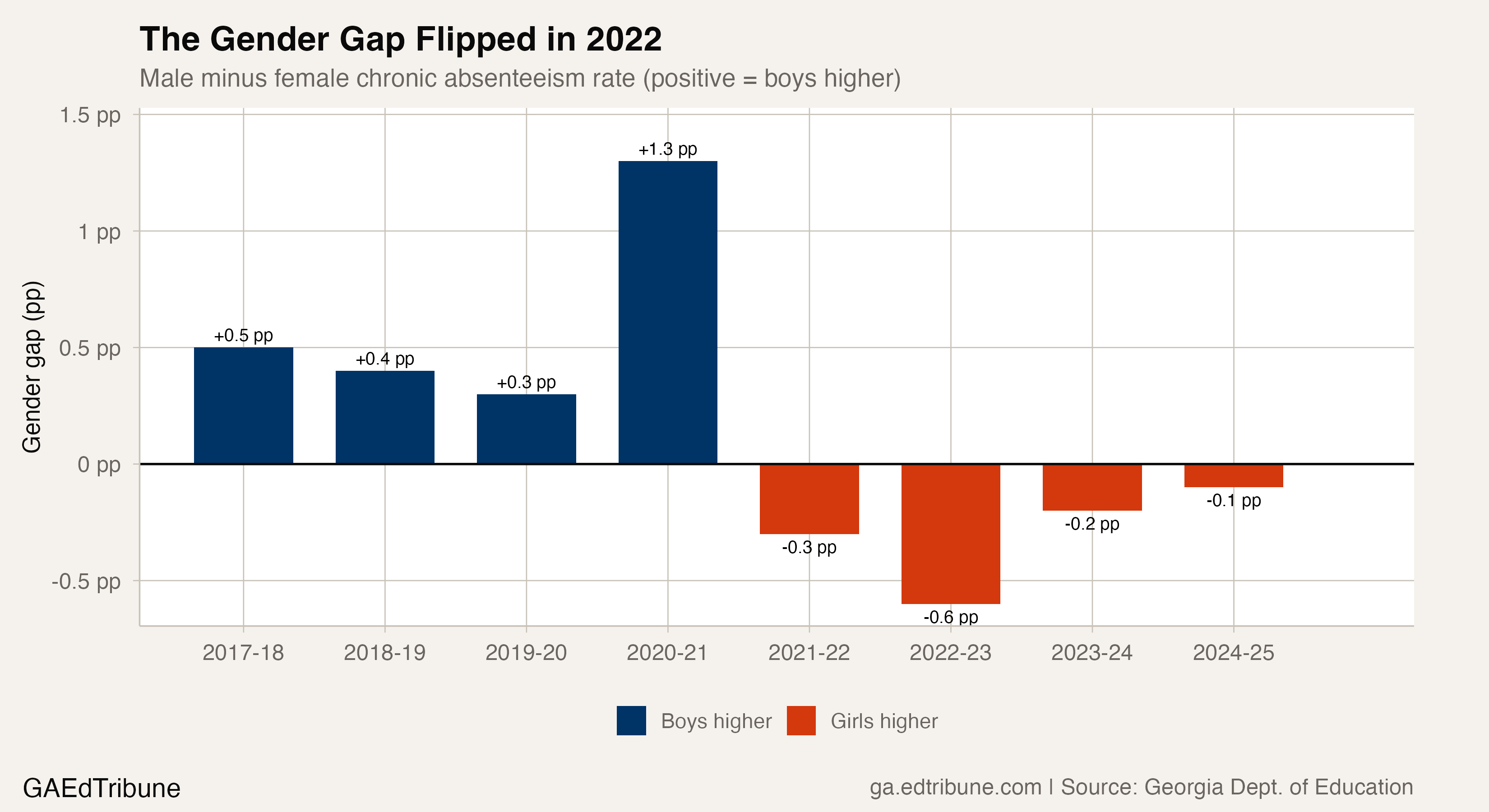
The reversal matters because of what happened next. Both genders improved as the pandemic receded, dropping at roughly the same pace: girls fell 4.1 points from their 2021-22 peak, boys fell 3.9 points from theirs. But because girls peaked higher, they remain above boys after three years of parallel recovery. The gap narrowed from 0.6 points to 0.1, but it did not close.
Severe absences tell the same story
The flip is not limited to the 10%-of-days chronic threshold. Among students missing more than 15 days of school, girls overtook boys in the same year and by a wider margin.
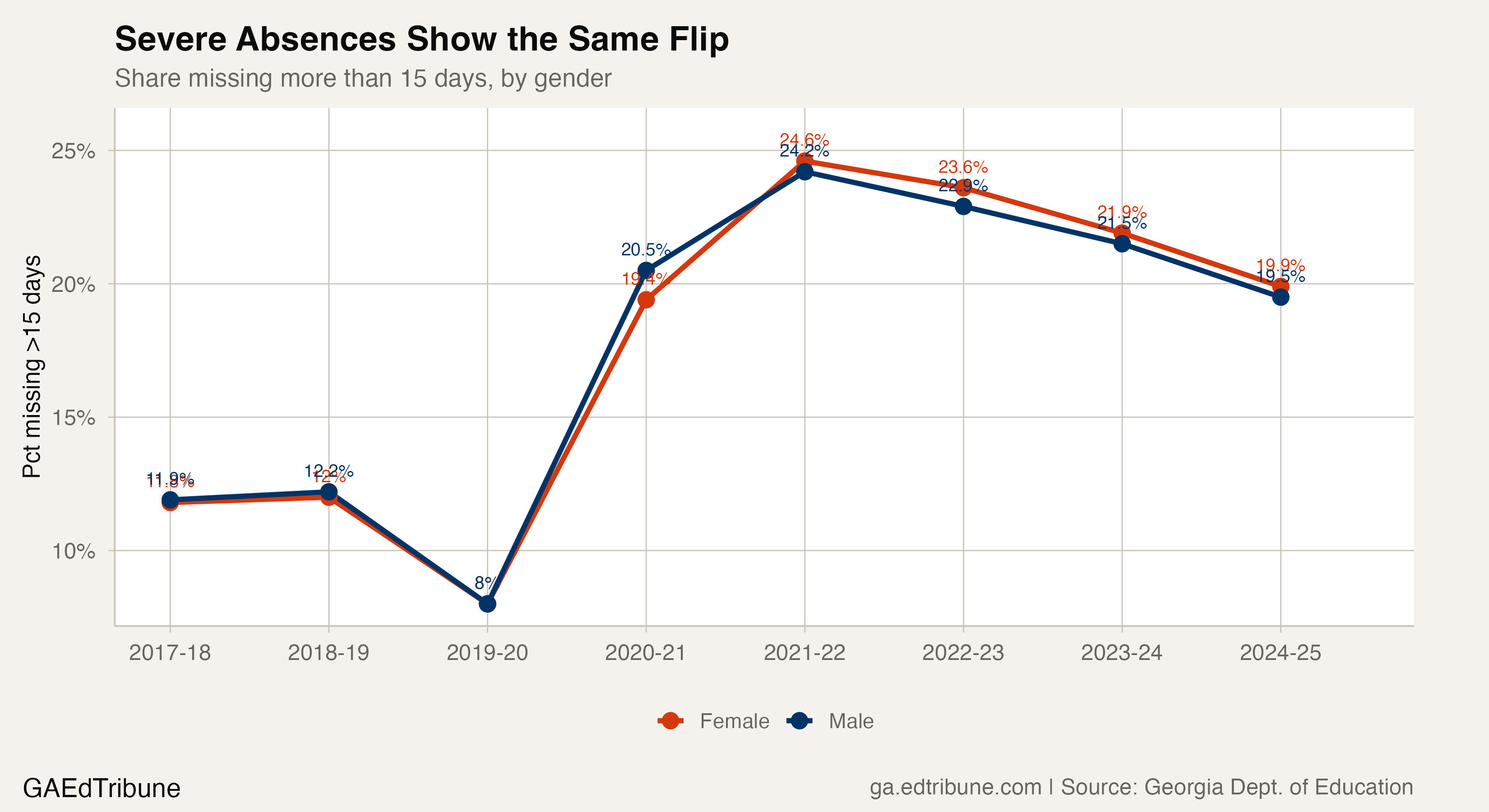
In 2018-19, 12.2% of boys and 12.0% of girls missed more than 15 days. By 2024-25, 19.5% of boys and 19.9% of girls crossed that threshold. The gap in severe absences is 0.4 percentage points, four times the gap in the overall chronic rate.
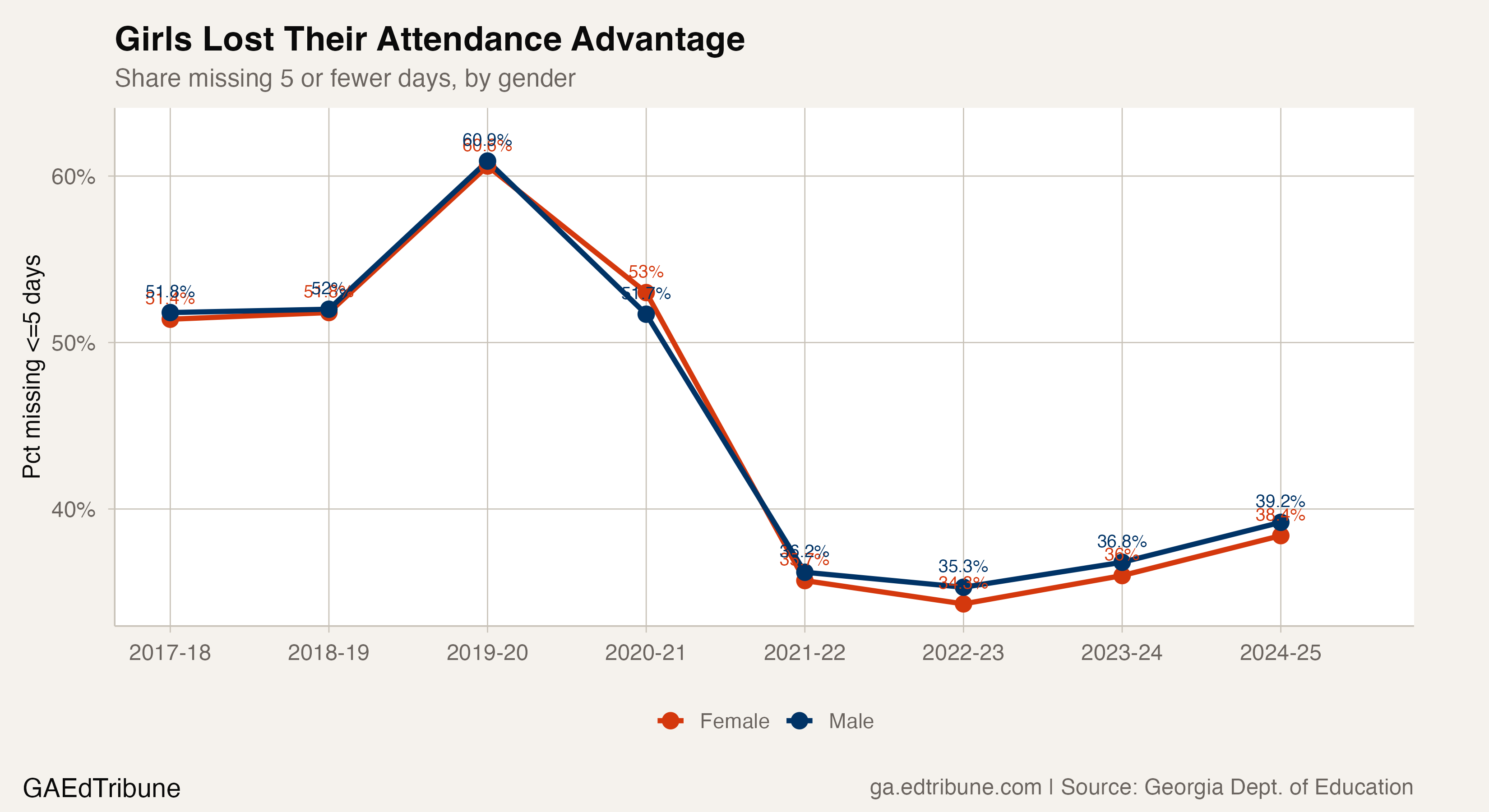
At the other end, the good-attendance gap widened against girls. Before the pandemic, boys had a narrow edge in the share missing five or fewer days: 52.0% to 51.8% in 2018-19, a 0.2-point gap. By 2024-25, that gap quadrupled: 39.2% of boys versus 38.4% of girls, 0.8 points apart.
The district picture: a close race everywhere
At the district level, the flip is widespread but not universal. Among Georgia's 85 district records with at least 2,000 male or female students in 2024-25, 40 had a higher female chronic rate compared to 38 where boys were still higher; two were tied. In 2018-19, the split was 30 districts with girls higher and 47 with boys higher.
The largest gender gaps skew toward smaller and rural districts. Jones County (2.4-point gap, girls higher), Decatur County (2.3 points), and Valdosta City (2.3 points) had the most pronounced female excess. In the largest districts, the gaps were generally small, closer to a nudge across the line than a clean break.
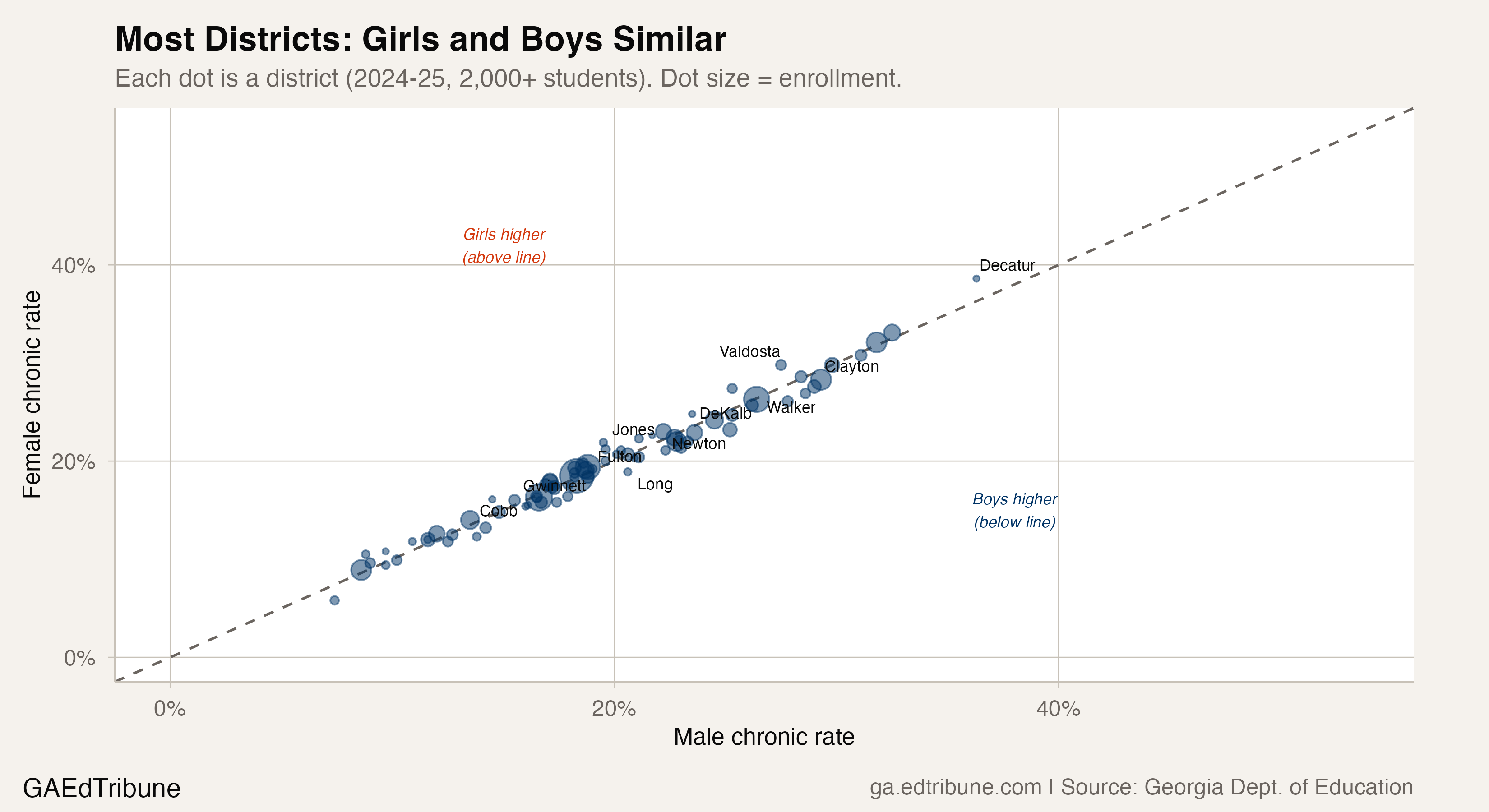
The scatter plot tells the story visually: most districts cluster tightly around the diagonal line where boys and girls have equal rates. This is not a story about a few extreme districts driving a statewide statistic. The flip is diffuse, a small shift replicated across Georgia's school systems.
What could be driving it
The most prominent hypothesis nationally is the youth mental health crisis, which has hit adolescent girls disproportionately hard. The CDC's 2023 Youth Risk Behavior Survey found that 53% of female high school students reported persistent feelings of sadness or hopelessness, compared to 28% of males. That gap, nearly two-to-one, has widened steadily over the past decade.
Research from the University of Southern California has found that mental health struggles are "closely connected" to absenteeism, with teenage girls showing especially strong links between emotional symptoms and missed school days. USC professor Morgan Polikoff described the relationship directly:
"Our findings show how the three main crises in schools post-COVID — absenteeism, student learning difficulties, and mental health — are closely connected." — Whiteboard Advisors, 2024
Georgia's infrastructure for responding to this crisis is thin. The state ranks among the bottom five nationally for youth mental health access, with 151 of 159 counties designated as mental health provider shortage areas. The ratio of school psychologists to students is 1:6,390, nearly 13 times the recommended 1:500. Children seeking an appointment with a behavioral health specialist face waits of six to eight months.
Children's Healthcare of Atlanta has reported a doubling of emergency department visits for behavioral crises since 2015, now exceeding 4,000 visits annually. Black youth in Georgia face an additional dimension: the fastest rising rates of suicide among any racial or ethnic group.
An analysis by the Agenda Alliance in England found a parallel pattern: severe absenteeism among girls rose 257% between 2017-18 and 2023-24, compared to 188% for boys. The organization pointed to "uniquely gendered impacts of poverty, abuse and trauma" including higher rates of sexual violence in schools and mental health challenges, as factors affecting girls' attendance.
This evidence is suggestive but not conclusive for Georgia specifically. The state's absence data does not include the reason a student missed school. The mental health crisis is real. Its connection to the gender flip in chronic absenteeism is plausible. But alternative explanations exist: transportation barriers that differentially affect girls in rural districts, caregiving responsibilities falling on older sisters, or period poverty and lack of menstrual products in schools. Georgia's data cannot distinguish among these.
Counting the cost
In raw numbers, boys still account for more chronically absent students than girls: 191,861 versus 184,677 in 2024-25. That is because boys make up a slightly larger share of total enrollment (945,126 to 905,278). The rate reversal has not yet produced a reversal in absolute headcount.
But the trajectory tells a different story. Since 2018-19, the number of chronically absent girls grew by 66,565, a 56.4% increase. Chronically absent boys grew by 64,136, a 50.2% increase. Girls are adding to the chronically absent population faster, even from a smaller base.
Georgia's legislature has begun to respond to the broader attendance crisis, though not specifically to the gender dimension. SB 123, signed by Governor Kemp in April 2025, prohibits schools from expelling students solely for absences and requires attendance review teams in districts with chronic rates above 10%. A Senate study committee chaired by Sen. John F. Kennedy recommended expanding mental health services into elementary schools, a move that would cost an estimated $34 million.
Neither measure addresses the gendered pattern directly. The data raises a question that Georgia's policy apparatus has not yet engaged: if the crisis is disproportionately affecting girls, are the interventions designed with that in mind?
The gap is 0.1 percentage points. It would be easy to dismiss. But a 0.1-point gap that has held for four consecutive years, reversing every prior year on record, is a signal worth investigating before it becomes something larger.
Detailed code that reproduces the analysis and figures in this article is available exclusively to EdTribune subscribers.
Discussion
Sign in to join the discussion.
Loading comments...