Correction (July 21, 2026): The original article incorrectly said students with disabilities made the smallest subgroup improvement; the current package shows smaller changes for white students and several smaller subgroups. It also attributed district and attendance-band changes to interventions and family circumstances that the aggregate file cannot test, while its analysis wrote charts to obsolete March paths. This version corrects those issues and rebuilds all five published charts and the claim ledger from fresh state-package output.
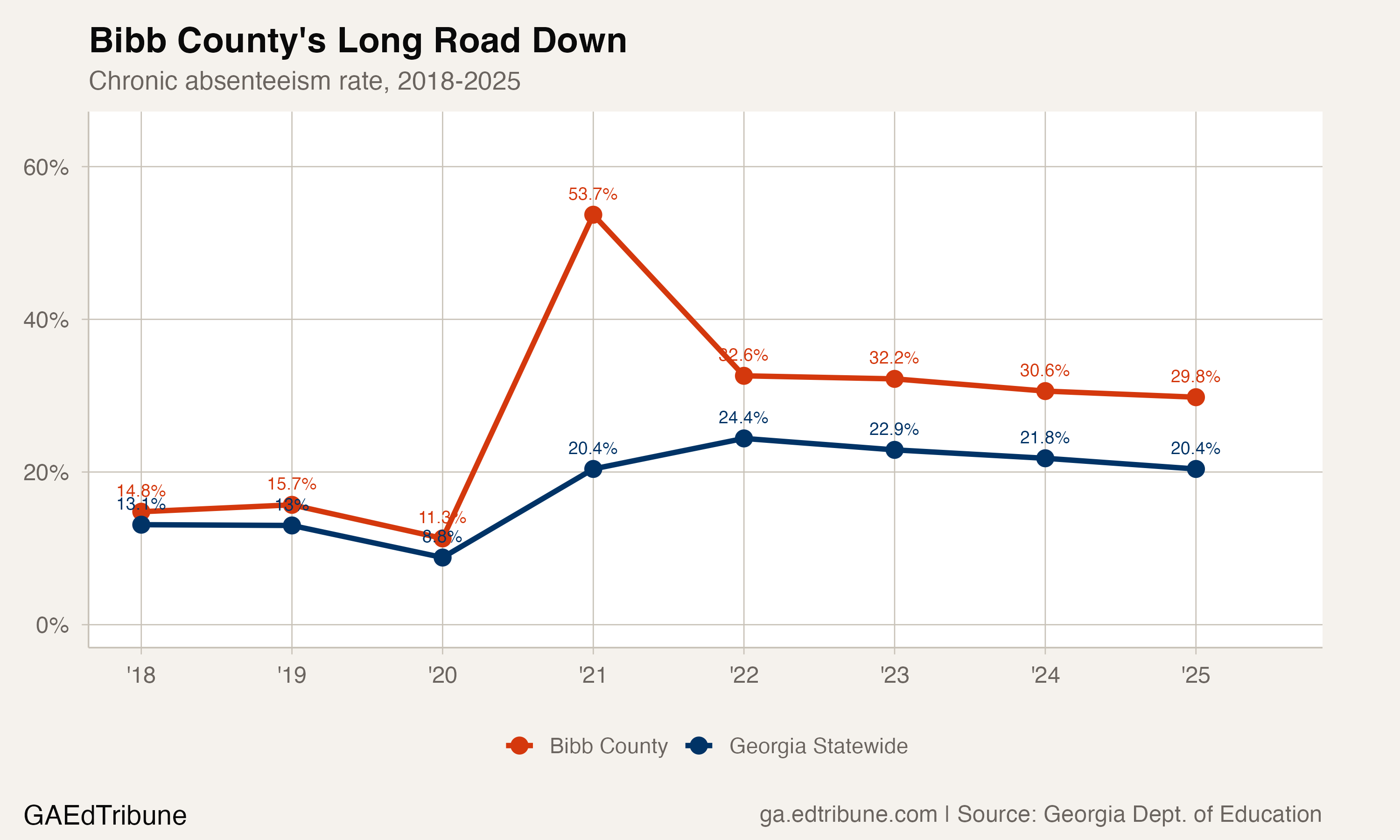
Bibb County↗ET's chronic absenteeism rate fell from 53.7% in 2021 to 29.8% in 2025, a 23.9 percentage-point improvement. That was the largest peak-to-2025 decline among Georgia's 68 districts that enrolled at least 5,000 students in 2025.
Barrow County↗ET ranked next in that panel. Its rate fell from a 39.4% peak in 2021 to 18.6% in 2025, a 20.8-point improvement. Bibb's recovery was 3.1 points larger.
The current Bibb rate still represents 6,943 chronically absent students among 23,297 enrolled. It remained 9.4 points above Georgia's 20.4% statewide rate and 14.1 points above Bibb's 15.7% rate in 2019.
Most of the Decline Came at Once
Bibb's rate rose from 15.7% in 2019 to 53.7% in 2021. Over the same endpoints, Georgia's statewide rate moved from 13.0% to 20.4%. Bibb's gap to the state widened from 2.7 points to 33.3 points.
The largest reversal came in 2022, when Bibb's rate fell 21.1 points to 32.6%. The next three changes were smaller: a 0.4-point decline in 2023, a 1.6-point decline in 2024 and a 0.8-point decline in 2025.
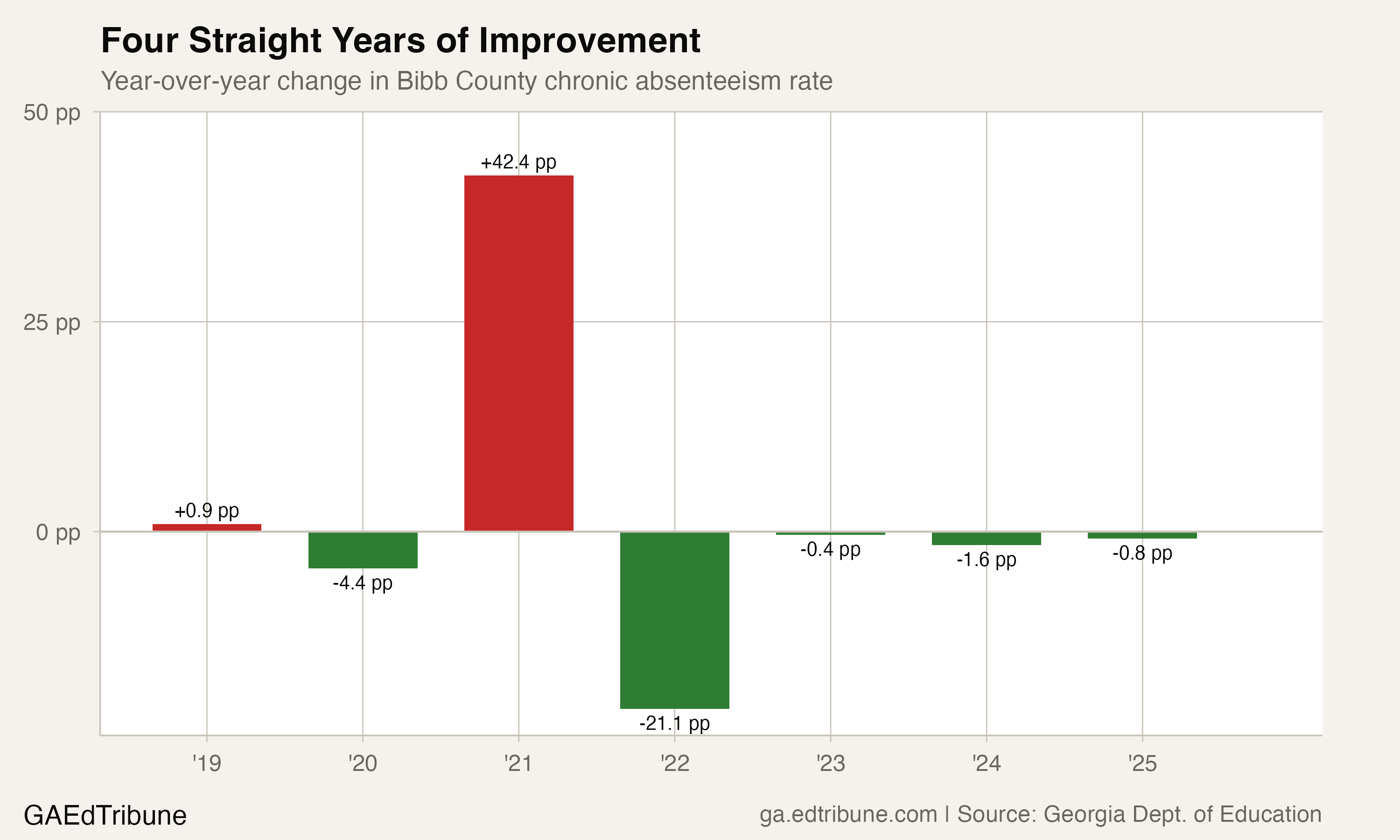
Those four annual declines establish a sustained direction. The attendance file does not identify how much of the change came from district practice, student composition, reporting, family circumstances or other mechanisms.
Only 12 of 194 Georgia districts with reported 2019 and 2025 rates returned to or below their 2019 level. Bibb was not among them despite its large decline from the peak.
Subgroup Rates Also Fell
Black students in Bibb had a 57.1% rate in 2021 and a 30.7% rate in 2025, a 26.4-point improvement across 17,824 students in the latest year. Hispanic students moved from 50.1% to 28.3%, a 21.8-point decline. English learners moved from 41.9% to 21.6%, a 20.3-point decline.
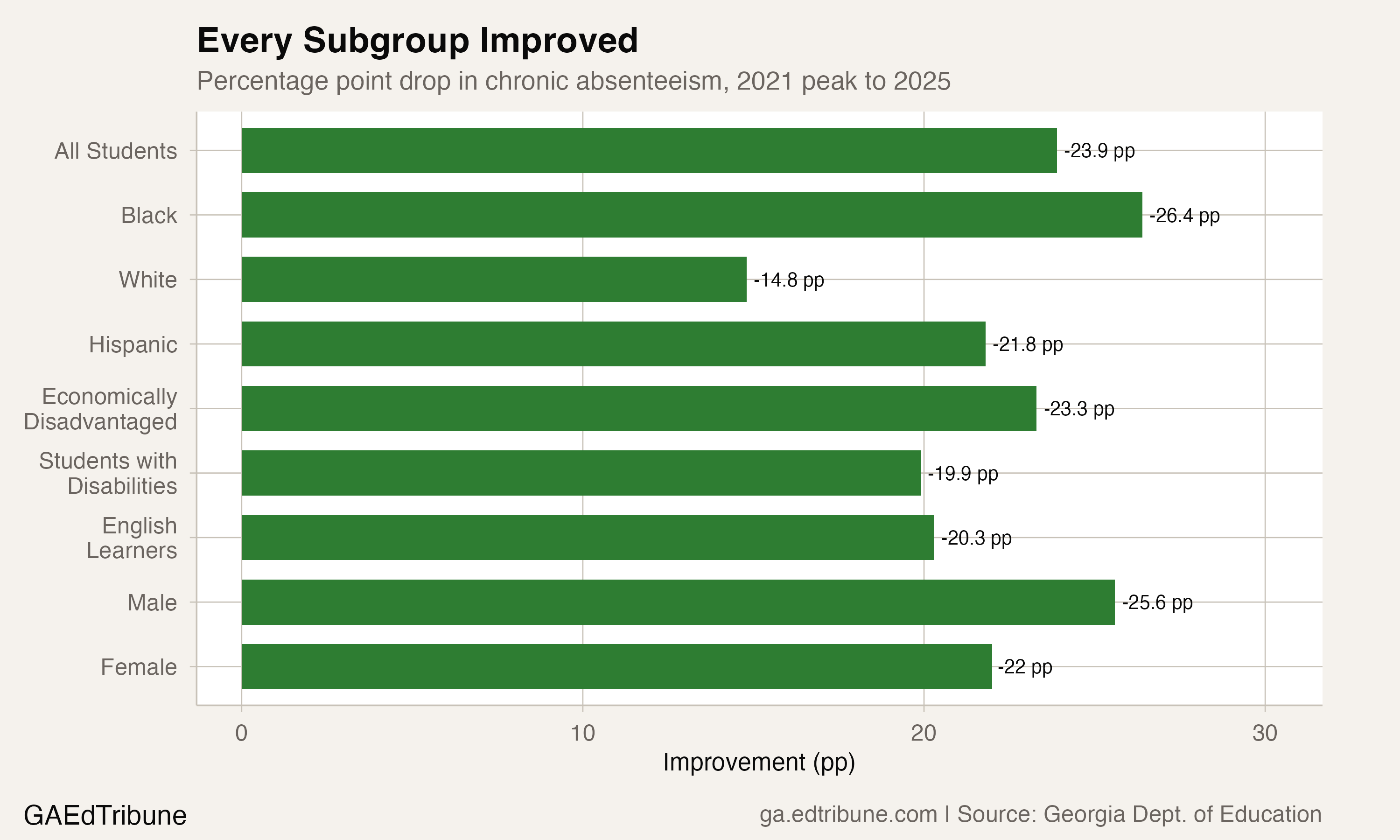
Students with disabilities moved from 54.3% to 34.4%, a 19.9-point decline across 3,022 students. White students moved from 39.7% to 24.9%, a smaller 14.8-point decline across 2,205 students. The original article's smallest-improvement claim was therefore incorrect.
These subgroup categories overlap. Their counts and changes cannot be added together or treated as a decomposition of Bibb's overall result.
Comparison With Selected Georgia Districts
Among the selected comparison districts in the chart, Fulton County↗ET had the next-largest peak-to-2025 improvement at 19.0 points, from 38.1% in 2021 to 19.1% in 2025.
Richmond County↗ET improved 2.1 points from its 34.9% peak in 2022 to 32.8% in 2025. Muscogee County↗ET improved 3.3 points from 25.8% in 2022 to 22.5%. DeKalb County↗ET improved 3.9 points from 30.3% in 2023 to 26.4%, and Clayton County↗ET improved 1.9 points from 30.7% in 2022 to 28.8%.
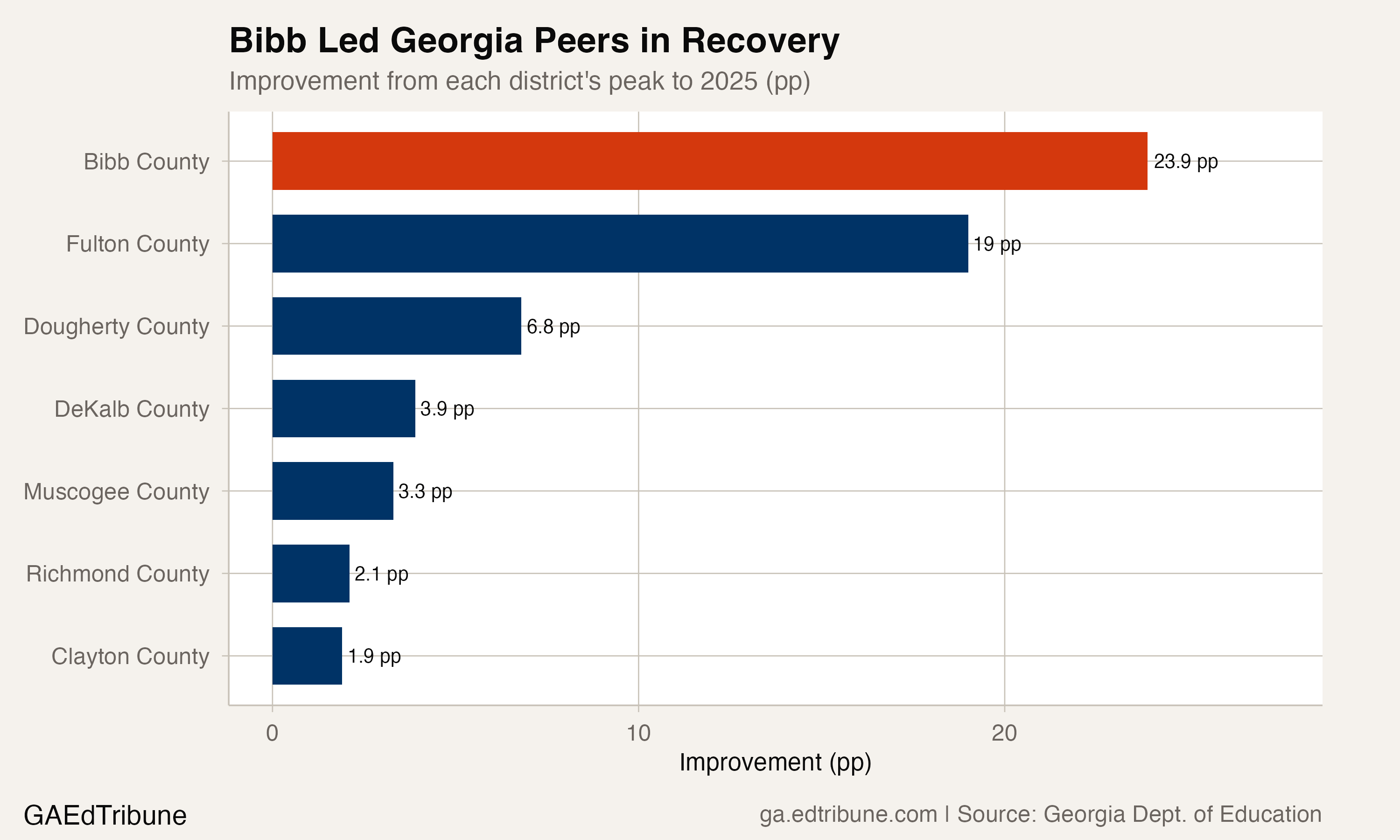
The comparison shows different trajectories. It does not establish that intervention strategies caused the differences, because the package does not measure implementation or create matched district comparisons.
The Attendance-Band Distribution
In 2019, 51.0% of Bibb students missed five or fewer days, 35.3% missed six to 15 days and 13.8% missed more than 15 days. In 2021, those shares were 22.4%, 26.8% and 50.8%, respectively.
By 2025, the five-or-fewer-days share had risen to 33.5%, the middle band was 39.3% and the more-than-15-days band was 27.2%. The severe band was 23.6 points below its 2021 peak but remained 13.4 points above 2019.
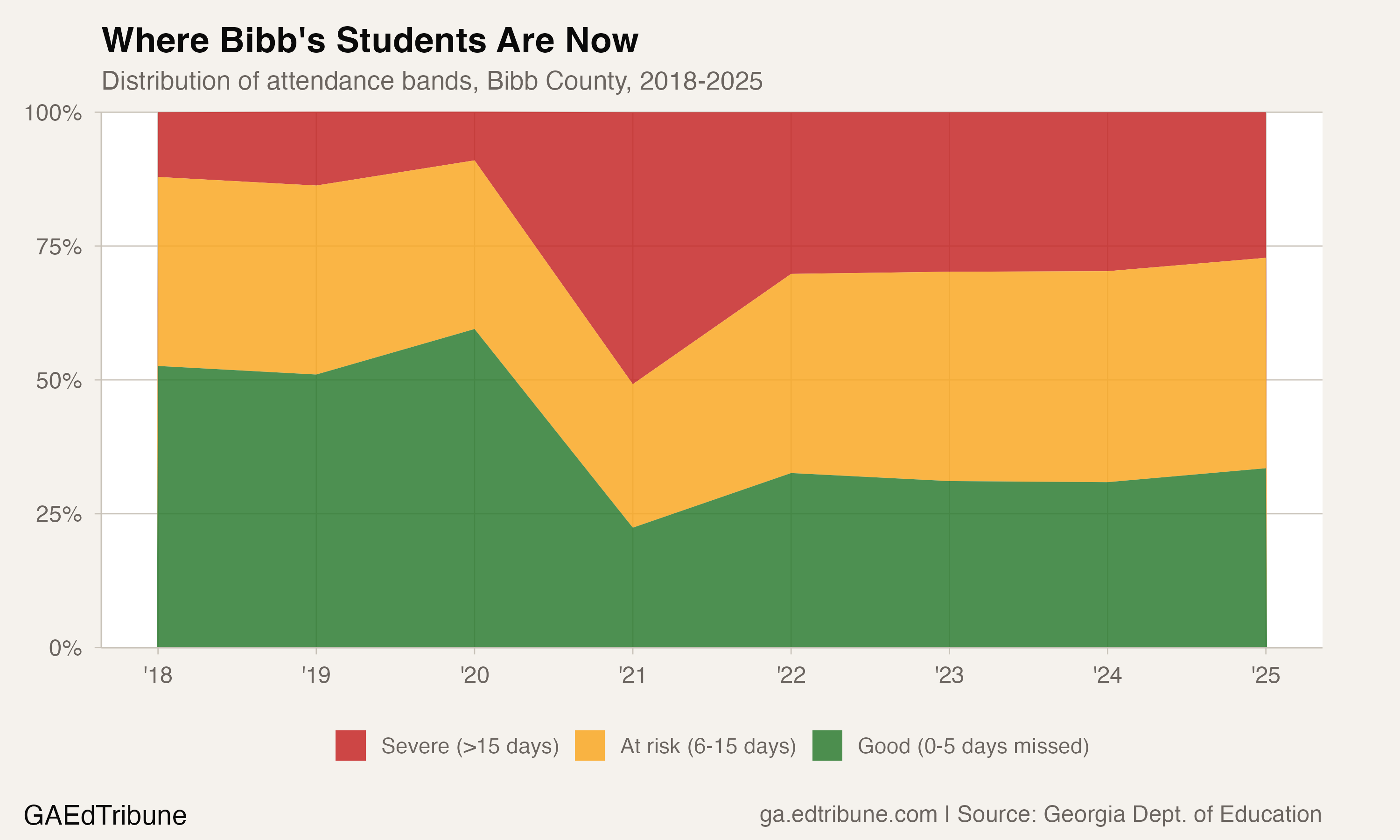
Those are annual distributions, not a record of individual students moving from one band to another. The package supports the change in the shares but not a claim about which students changed categories or why.
Detailed code that reproduces the analysis and figures in this article is available exclusively to EdTribune subscribers.
Discussion
Sign in to join the discussion.
Loading comments...