In Muscogee County↗ET, six of nine high schools posted their highest graduation rates on record this year. Columbus High and Rainey-McCullers School of the Arts graduated every single senior. The district's overall rate, 96.1%, beat the state average by nearly nine points.
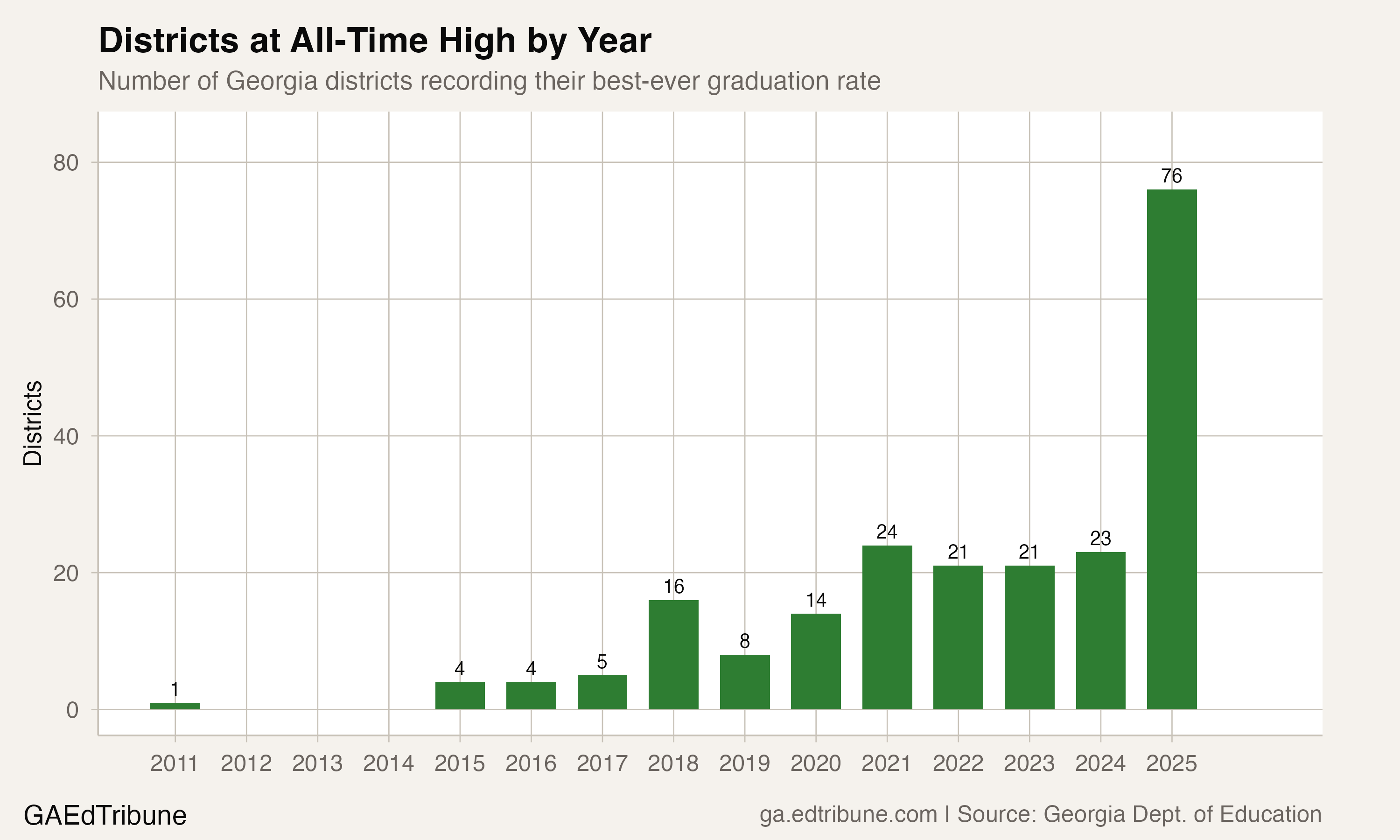
Muscogee County is not an outlier. It is one of 76 Georgia districts that recorded their best-ever four-year graduation rate in 2025, according to data from the Georgia Department of Education. Zero districts hit all-time lows. In a state with 191 districts carrying at least three years of data, that ratio, 76 to zero, has no precedent in the 15 years Georgia has tracked adjusted cohort graduation rates.
The shape of the surge
Georgia's statewide rate climbed to 87.2%, up 1.8 percentage points from 85.4% in 2024. The only comparable post-2015 jumps came in 2012 (2.3 points) and 2020 (1.8 points), and the 6.2-point leap in 2015 itself reflected a methodology change in cohort calculation that inflated the numbers. The 2025 gain has no such asterisk.
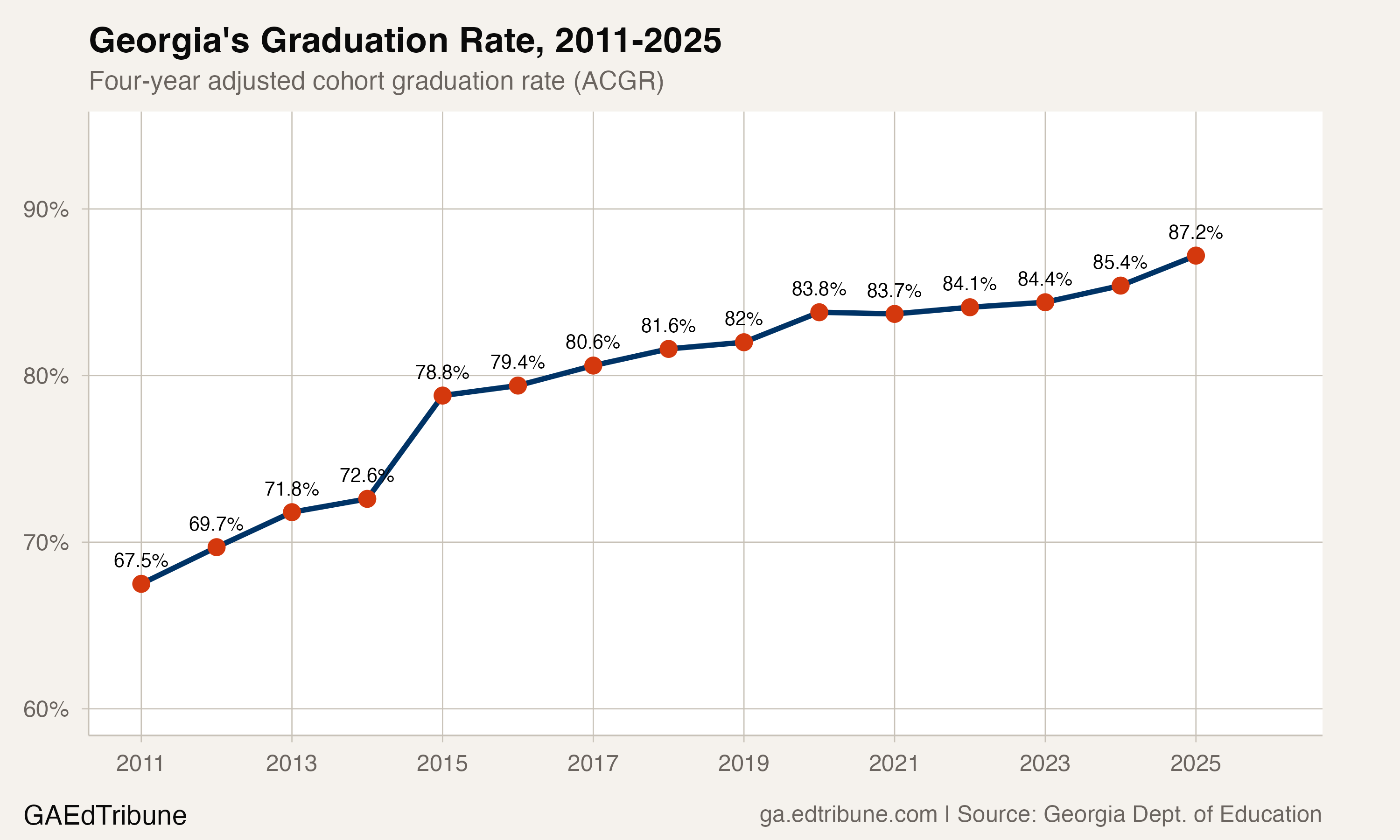
The trajectory since 2011 tells two stories. From 2011 to 2015, the rate rose 11.3 points, but much of that reflected the methodology shift. From 2015 to 2025, the climb has been steadier: 8.4 points over a decade, roughly 0.8 points per year. The 2025 jump of 1.8 points more than doubled that pace.
What makes 2025 unusual is not just the state average but the breadth. The previous record for districts at all-time highs in a single year was 24, set in 2021. This year tripled it.
Among the 192 districts reporting 2025 data, 124 improved year over year. Only 62 declined. The median district gained 0.9 percentage points.
From 81 below 70% to five
The distribution shift since 2011 is stark. In the first year of adjusted cohort reporting, 81 Georgia districts graduated fewer than 70% of their students. In 2025, that number is five, and all five are state charter or virtual schools: Foothills Charter High School (11.4%), Mountain Education Center (13.5%), Coastal Plains Charter High School (18.4%), State Schools (48.6%), and Georgia Connections Academy (65.4%).
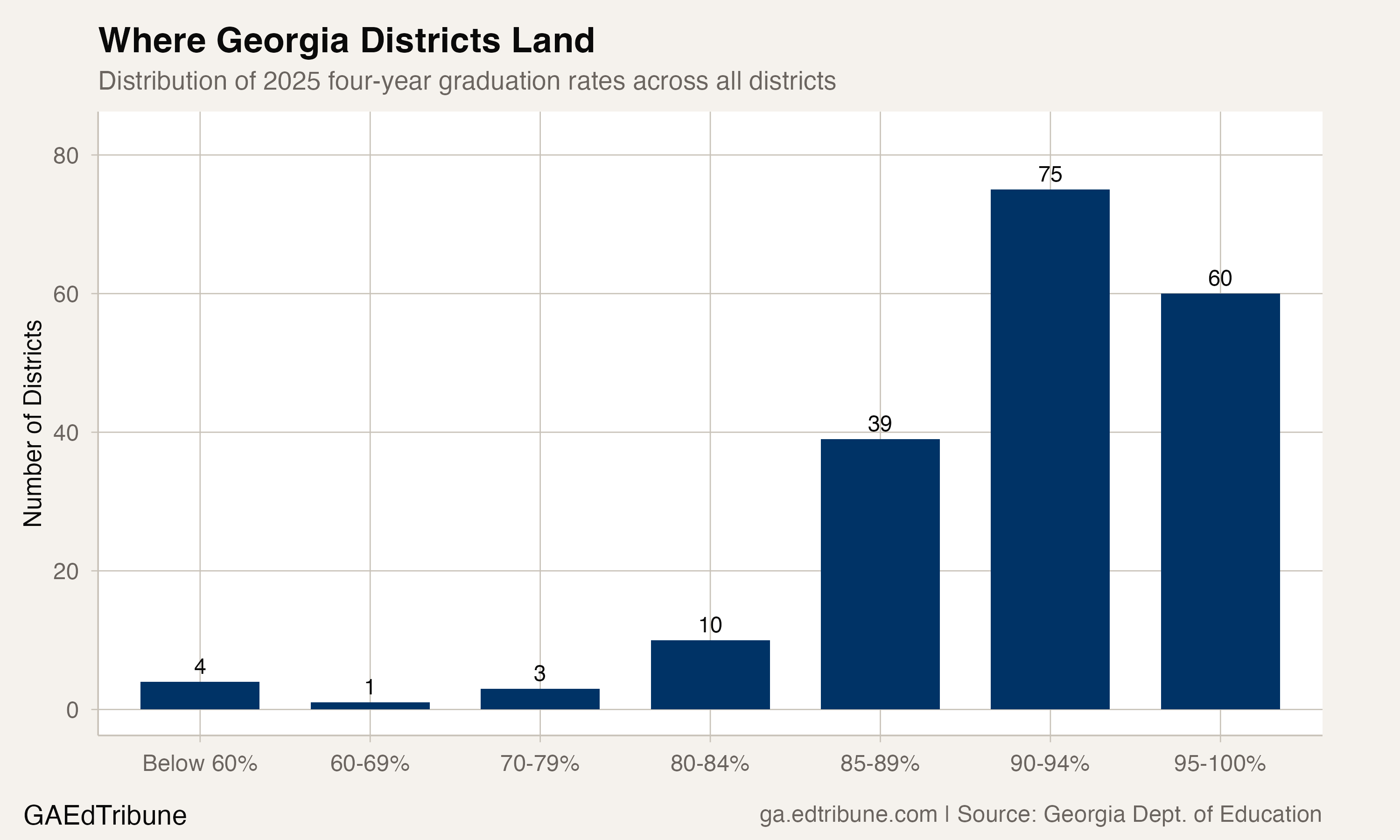
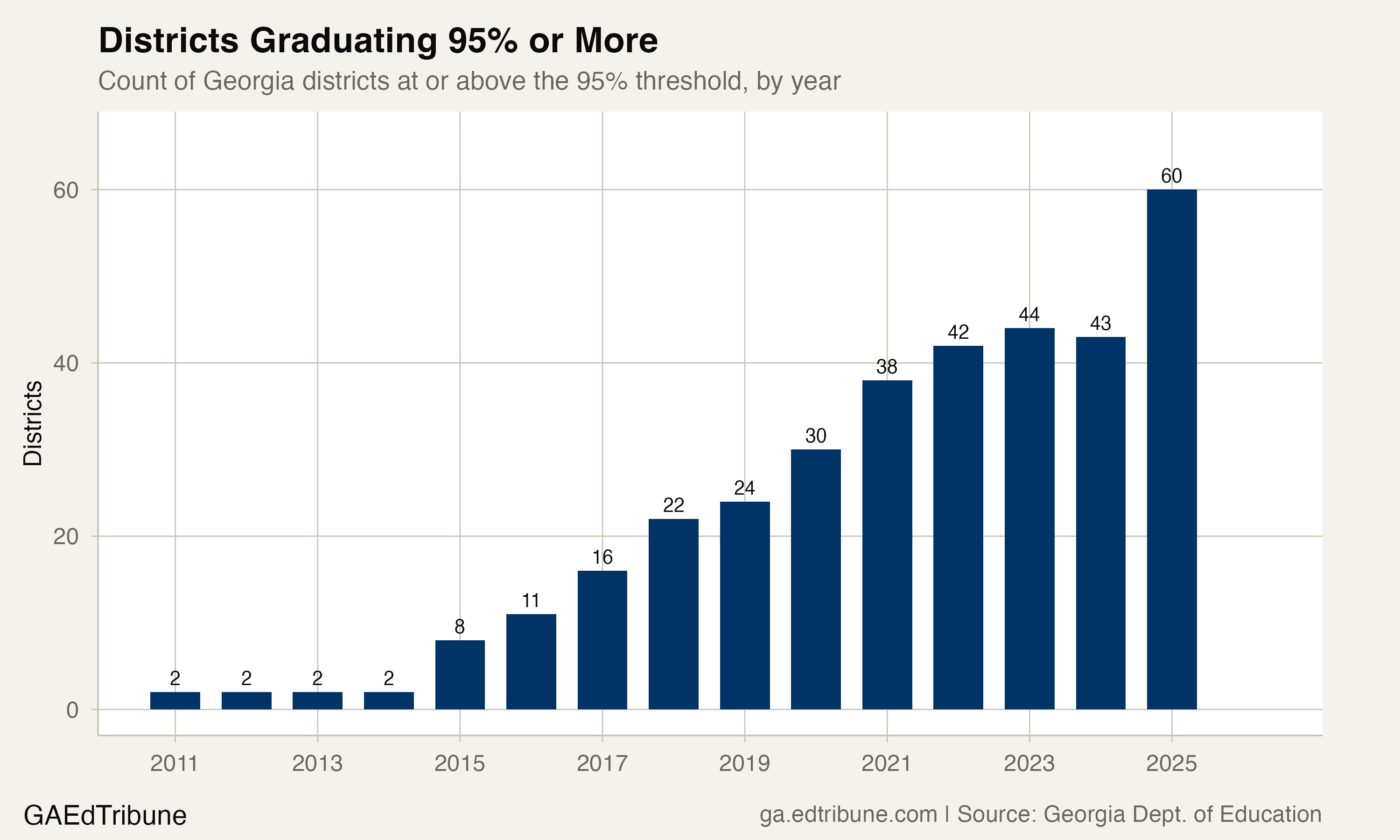
The median district graduation rate rose from 71.7% in 2011 to 92.8% in 2025, a 21-point shift. Nearly all traditional districts now sit above the 80% mark: 184 of 192 districts, or 95.8%, graduated at least four in five students. The number at or above 95% jumped from two in 2011 to 60, a 30-fold increase.
The 50-point districts
The biggest transformation stories belong to small, rural districts. Baker County↗ET, with a cohort under 20 seniors in 2025, climbed from 41.4% in 2011 to 94.4%, a gain of 53.1 percentage points. Crawford County gained 50.7 points. Talbot County gained 49.8.
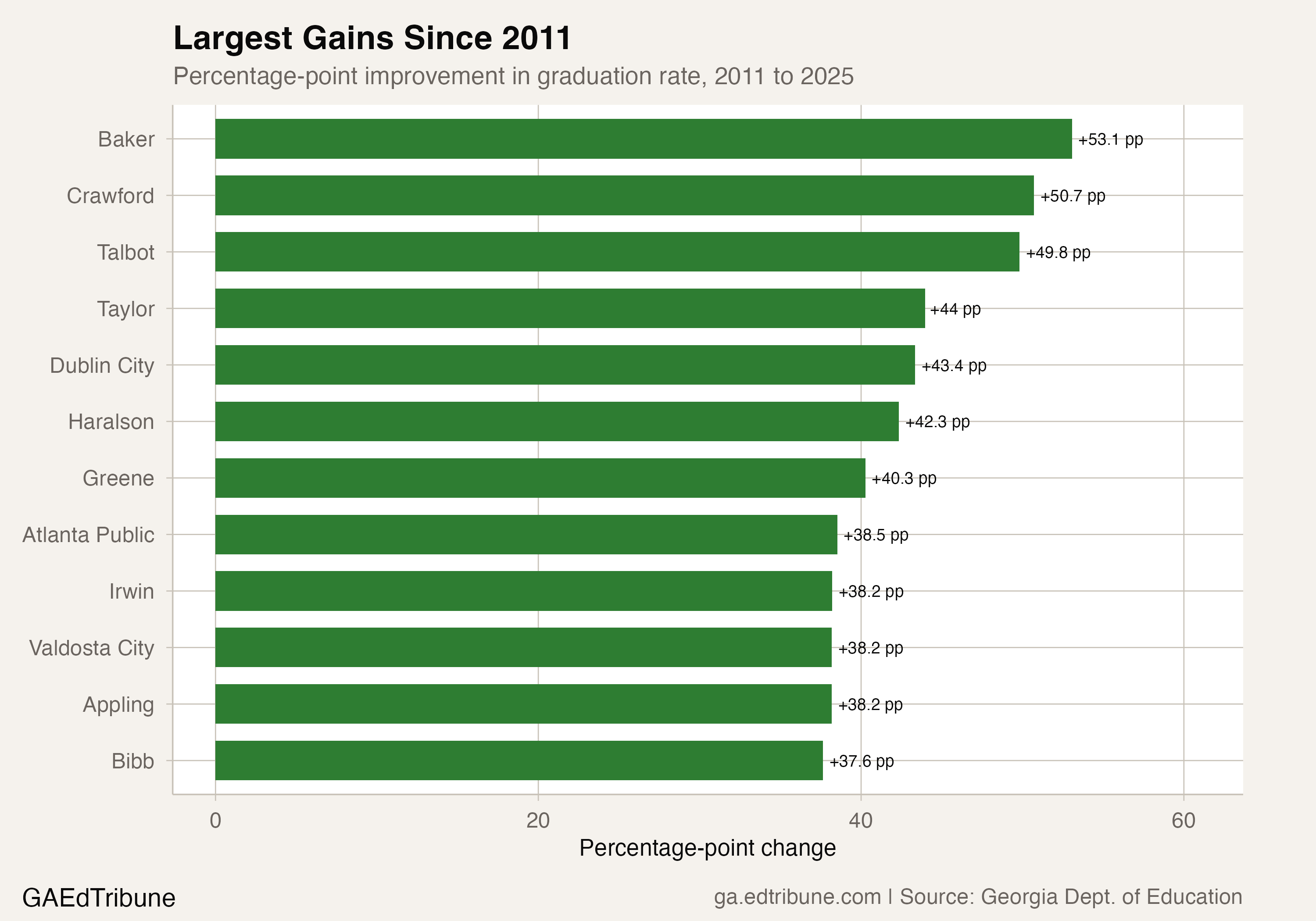
These are districts where a single dropout moves the rate by several points. But the gains are not confined to small cohorts. Atlanta Public Schools↗ET, with more than 3,000 seniors, rose from 52.0% to 90.5%, a 38.5-point gain and its first time above 90%. Bibb County↗ET gained 37.6 points to reach 89.0%. Marietta City, which graduated 92.2% of its class, hit its highest rate since the state adopted adjusted cohort calculation.
Bartow County↗ET stands out for consistency. The district has not posted a year-over-year decline since 2013, climbing from 66.2% in 2011 to 95.4% today.
What the numbers do not capture
The 1.8-point jump statewide produced 123,911 graduates from a cohort of 142,070 in 2025, compared to 117,661 graduates from 137,710 in 2024. That is 6,250 more diplomas in a single year, a function of both the higher rate and a larger cohort.
State Superintendent Richard Woods credited district-level engagement strategies for the breadth of the gains.
Districts point to a mix of approaches. Clayton County↗ET, which jumped 3.3 points to 86.3%, pointed to wraparound supports, credit recovery programs, and career pathway expansion. Fulton County↗ET, up to 91.9%, highlighted one-on-one goal-setting sessions between teachers and students at Skyview High School, which gained 8.4 points in a single year. Cobb County↗ET set a district record at 89.2%, with board chair David Chastain calling it "something the whole community can celebrate."
Whether these interventions explain the statewide breadth of the gains is harder to say. Credit recovery programs, which allow students to make up failed courses through alternative pathways, can inflate graduation rates without corresponding gains in academic proficiency. Georgia's CCRPI accountability system does track proficiency alongside graduation, and 2025 scores showed improvement in content mastery and readiness, though the relationship between proficiency gains and graduation gains is indirect.
The virtual floor
The five districts below 70% are all state charter or virtual operations, not traditional brick-and-mortar school systems. Their combined cohort of roughly 3,989 students represents 2.8% of Georgia's graduating class but accounts for all of the state's low-performing outliers.
Virtual charter schools across the country consistently graduate students at lower rates than traditional districts. Georgia Connections Academy, the largest of the five at 988 cohort students, posted a 65.4% rate. Mountain Education Center, with 1,133 cohort students, graduated 13.5%. These are credit-recovery and alternative programs that serve students who have already left traditional schools, so their low rates partly reflect the population they enroll rather than instructional failure.
Exclude the virtual and charter outliers, and Georgia's traditional district floor sits at 78.4%, held by Treutlen County, the only traditional district below 80%.
The biggest district, the smallest gain
Gwinnett County↗ET, Georgia's largest district with 13,604 graduates, improved from 84.1% to 85.4%. That 1.3-point gain falls short of the state's 1.8-point improvement and still leaves Gwinnett below the state rate. Twelve Gwinnett schools reached 90% or above, but the district's size means even modest improvement translates into hundreds of additional graduates.
DeKalb County↗ET, at 81.6%, remains one of the metro Atlanta districts furthest from the state average. Four DeKalb schools did reach 100%, including DeKalb Early College Academy, but the district-wide number reflects persistent gaps in its larger comprehensive high schools.
What to watch
The all-time-high count has drifted in the low 20s since 2021. In 2025, it tripled. The 2021 pandemic cohort produced 24 all-time highs, then the count dipped to 21 in both 2022 and 2023 before climbing to 23 in 2024 and reaching 76. Something changed in 2025 beyond statistical noise. A rising state rate, expanding credit recovery, and a large cohort pushed dozens of districts past their previous ceilings at once.
The cohort entering ninth grade in 2022 was Georgia's largest in a decade. Their graduation in 2026 will test whether this was a one-year concentration of good fortune or the beginning of a new normal where three-quarters of Georgia districts are at their best mark and climbing.
Detailed code that reproduces the analysis and figures in this article is available exclusively to EdTribune subscribers.
Discussion
Sign in to join the discussion.
Loading comments...