In 2022, Frederick Douglass High School in southwest Atlanta graduated 62.1% of its seniors. The school had cycled through 11 principals in 10 years. Its freshmen failed courses at a 52.7% clip. That spring, administrators relocated the entire ninth grade class to a converted elementary school two miles away, spending $2.8 million in CARES Act funds to turn the old Margaret Fain building into a STEAM academy where freshmen would study without the distractions, fights, and gang pressures that surveys showed over 70% of Douglass students worried about.
Three years later, Frederick Douglass posted an 89.4% graduation rate. The school that was the district's worst performer gained 27.3 percentage points in three cohorts.
Douglass is not the headline. It is the proof of concept for one.
The 90% threshold
Atlanta Public Schools↗ET graduated 90.5% of the Class of 2025, the first time in district history the four-year rate has crossed 90%. In 2011, the rate was 52.0%. The 38.5 percentage point gain over 14 years transforms a district where a coin flip determined whether a senior earned a diploma into one where nine in 10 do.
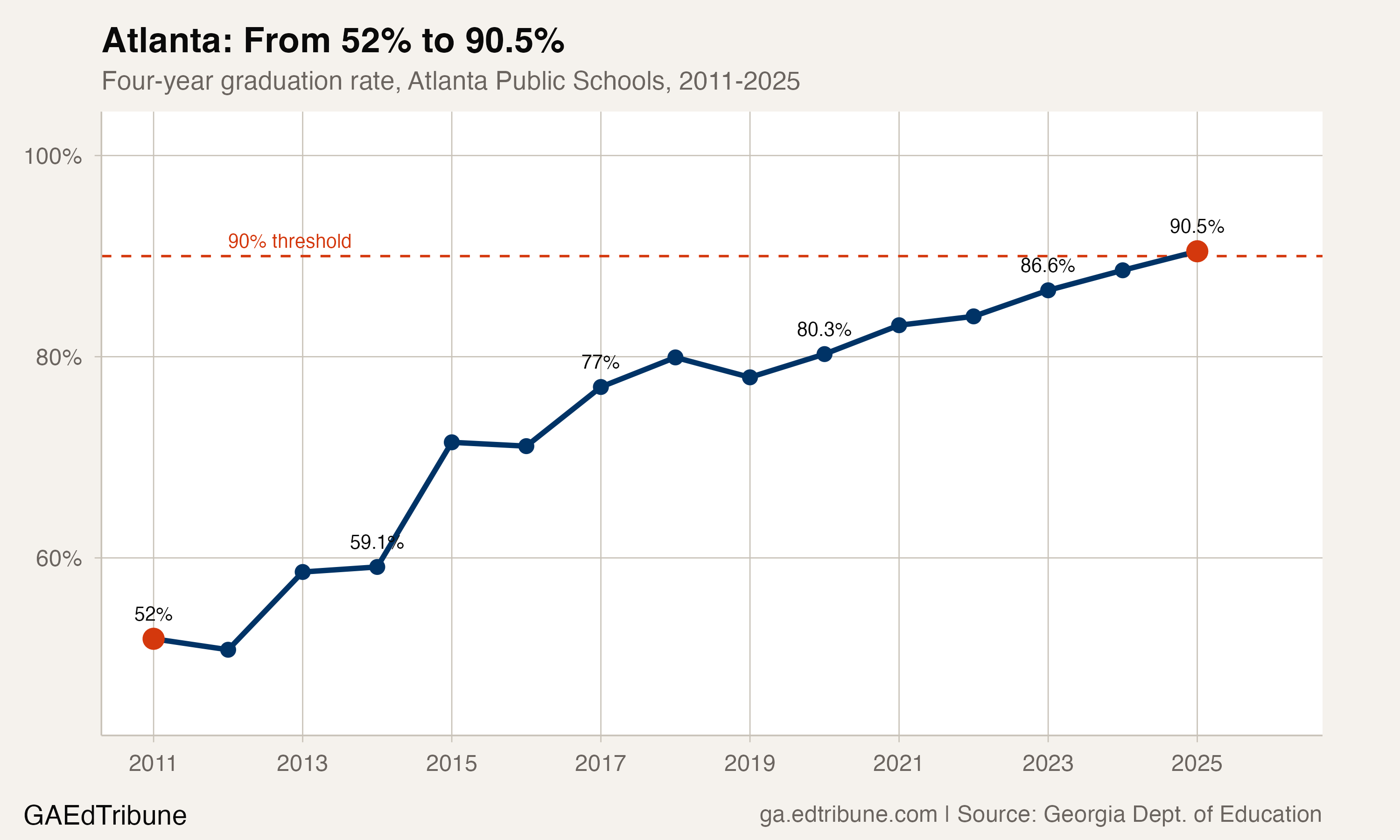
The milestone carries extra weight because of what preceded it. In 2009, a state investigation found that educators at 44 of 56 APS schools had systematically altered student answers on standardized tests. Thirty-five educators were indicted, and 11 of 12 who went to trial were convicted on racketeering charges. By 2012, the graduation rate had fallen to 50.9%, nearly 19 points below the state average of 69.7%.
The Class of 2025 produced 3,097 on-time graduates from a cohort of 3,423 students. In 2011, 2,083 students graduated from a larger cohort of 4,009. Fewer students entered the pipeline. Far more came out with diplomas.
Closing the state gap, then passing it
For most of the past 14 years, APS was playing catch-up. The district trailed the statewide graduation rate by 18.9 points as recently as 2012. The gap narrowed steadily through the mid-2010s, collapsed to near-zero by 2021, and flipped in 2023 when APS exceeded the state rate for the first time.
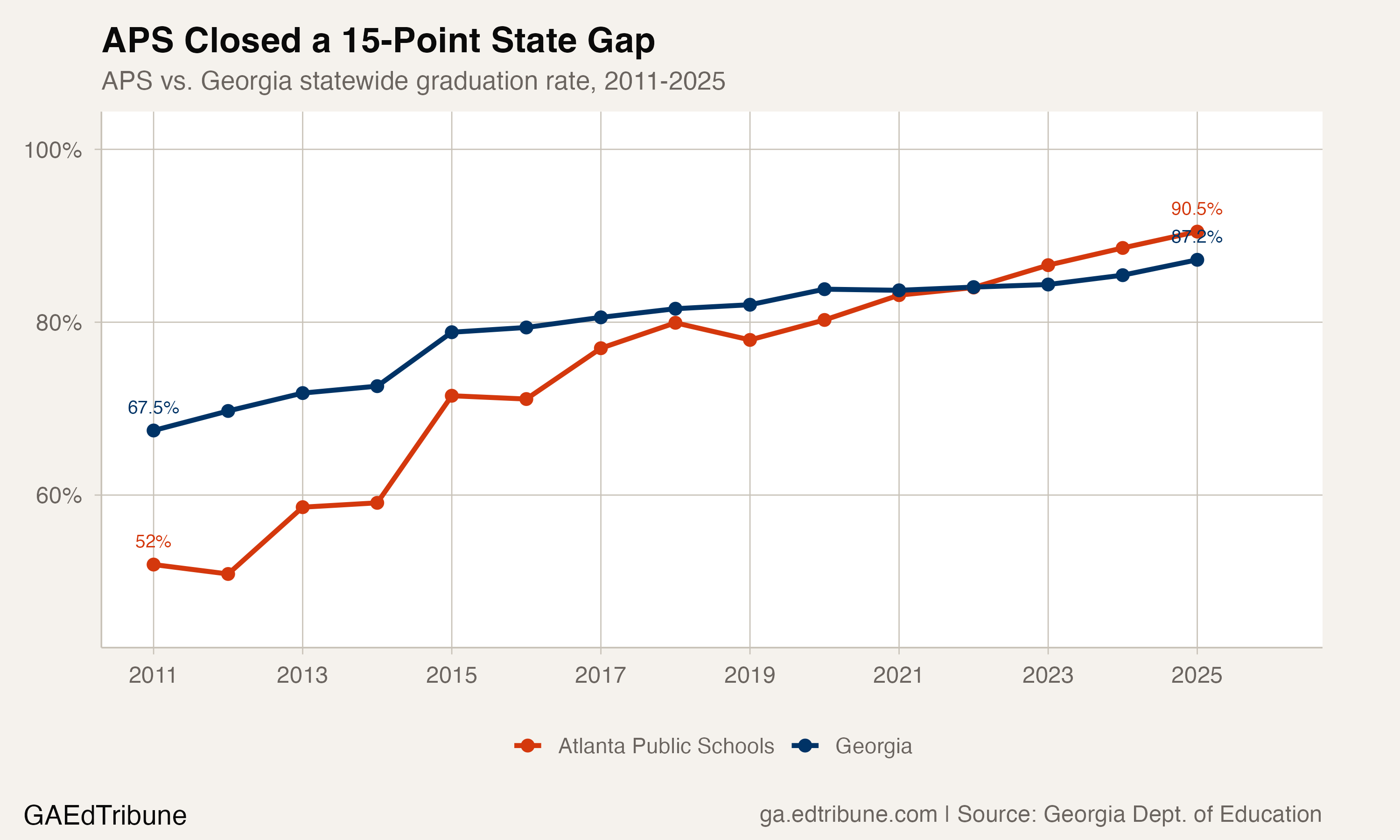
In 2025, APS outpaced Georgia's 87.2% rate by 3.3 percentage points, the third consecutive year above the state average and the largest margin yet. That reversal, from 18.9 points behind to 3.3 points ahead, is a 22.2-point swing in 13 years.
Atlanta Board of Education Chair Erika Y. Mitchell called the Class of 2025 a benchmark: "The Class of 2025 continues to raise the bar for Atlanta Public Schools, achieving a record graduation rate of 90.48 percent."
1,600 fewer students without diplomas
The percentage tells one story. The count tells a harder one.
In 2011, 1,926 students in the APS senior cohort did not graduate on time. In 2025, that number was 326. The reduction of 1,600 non-graduates per year happened even as the cohort shrank by 586 students. The rate did most of the work: a district that used to lose nearly half its seniors now loses fewer than one in 10.
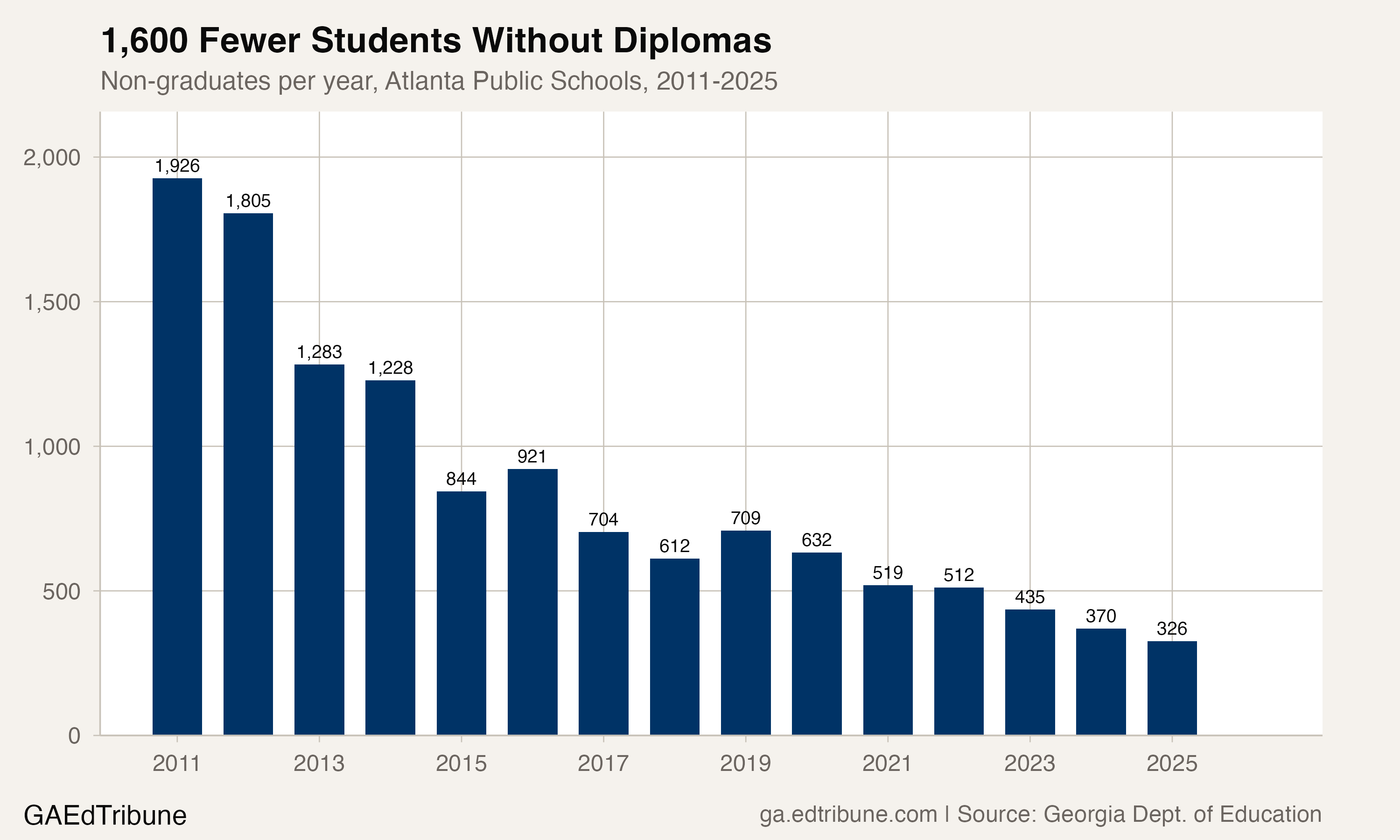
The sharpest compression came early. Between 2014 and 2017, non-graduates fell from 1,228 to 704. That period coincided with a statewide methodology change in 2015 that boosted rates across Georgia by roughly six points, but APS outpaced the statewide bump: the district gained 12.4 points in 2015 alone versus the state's 6.2.
What happened inside Douglass
The Douglass turnaround is the most concrete illustration of how APS reached 90%. In 2022, interim Principal Forrestella Taylor presented data to the board showing that fewer than 20% of students who fail ninth grade ever graduate. The school's freshmen were failing at 52.7%.
The Ninth Grade STEAM Academy physically separated freshmen from upperclassmen, placed them in a smaller building with dedicated counselors, and wrapped them in monitoring structures. Under Principal Shermaine Jennings, the school instituted graduation monitoring meetings where counselors, tutors, teachers, and social workers review each student individually.
"It's not one size fits all. We focus on what's best for them." -- Principal Shermaine Jennings, FOX 5 Atlanta
The results: 62.1% in 2022, 69.3% in 2023, 82.0% in 2024, 89.4% in 2025. Adonis McCrary, a recent Douglass graduate and valedictorian, now attends Georgia Tech. Joshua Tucker, a senior, described the persistence: "Since my freshman year they have been on us constantly about our grades."
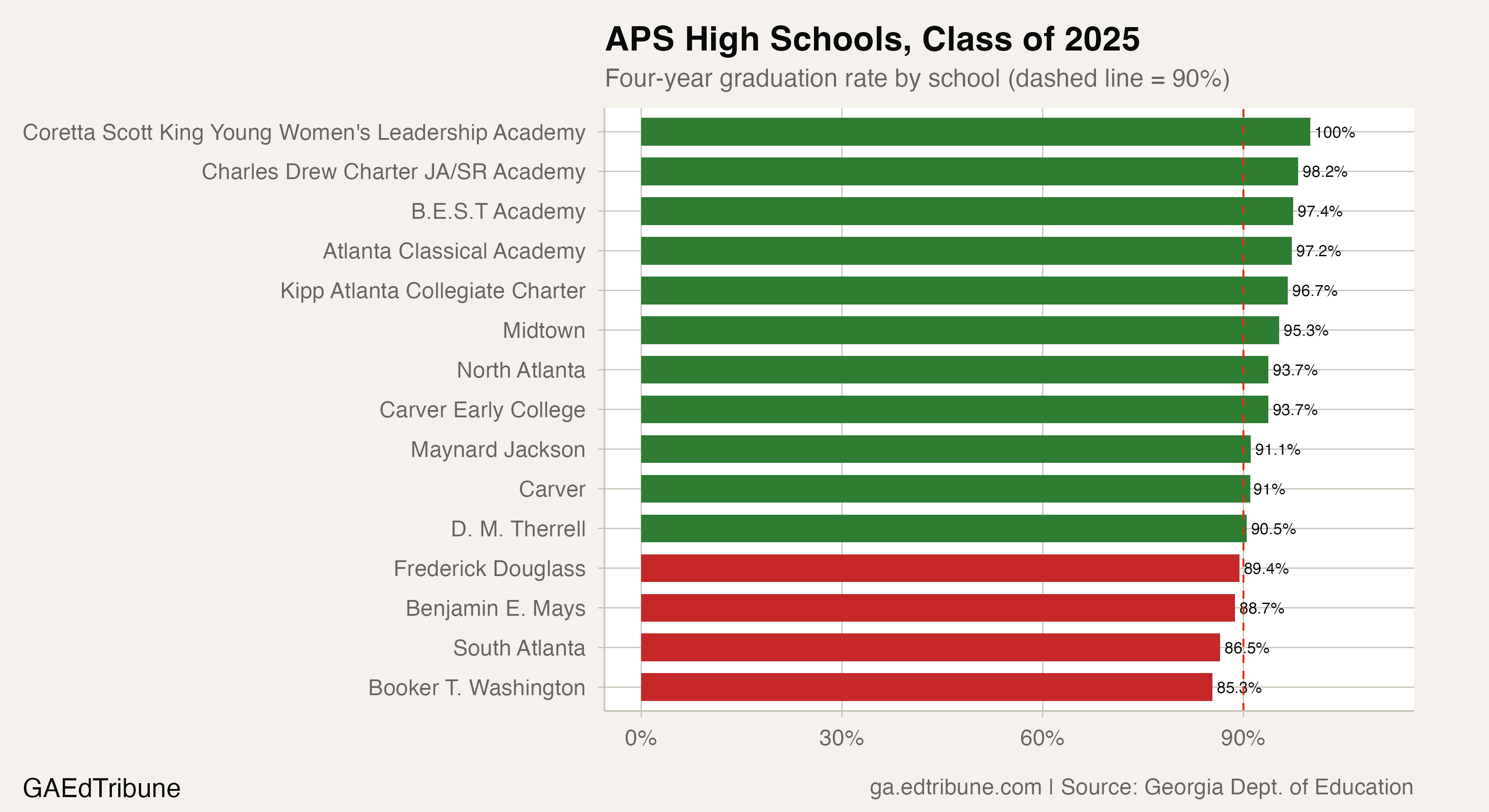
Douglass was not the only school to surge. Carver STEAM Academy gained 12.4 points in a single year, from 78.6% to 91.0%. Booker T. Washington rose 5.7 points to 85.4%. Of 15 APS high schools with reportable data, 10 improved year over year.
The equity story inside the numbers
The district-level gains are striking. The subgroup-level gains are more so.
Special education students in APS went from a 12.9% graduation rate in 2011 to 83.1% in 2025, a 70.2 percentage point gain. English learners rose from 34.6% in 2011 to 82.5% in 2024 (the most recent year with a reported APS ELL rate; Georgia did not publish a 2025 ELL breakdown). Hispanic students gained 39.4 points, from 49.6% to 89.0%. Black students, who make up the large majority of APS enrollment, gained 37.8 points, from 51.3% to 89.1%.
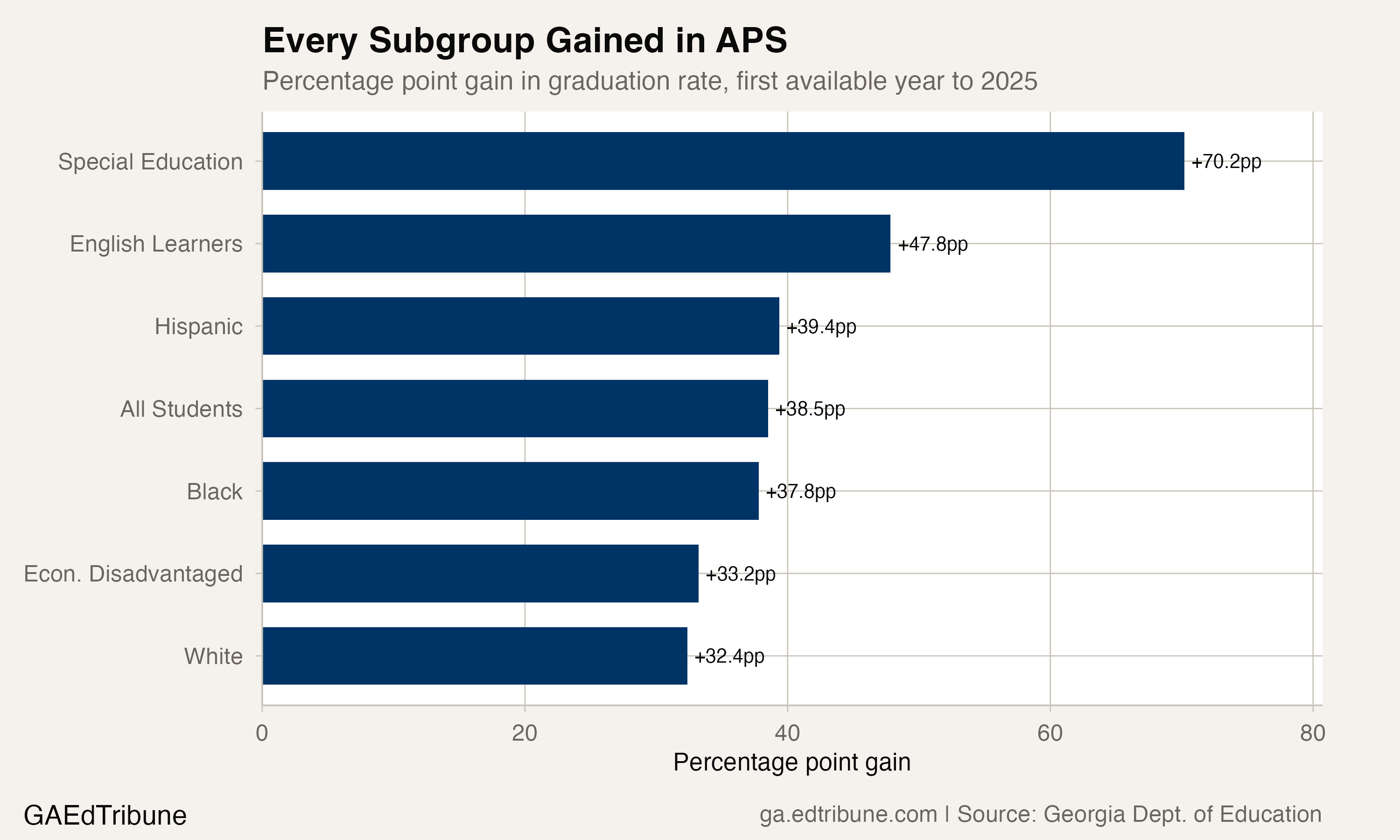
The white-Black graduation gap in APS narrowed from 13.6 points in 2011 to 8.2 points in 2025. That gap has been closing at the state level too, but APS closed it faster: Black students in Atlanta now graduate at 89.1%, compared to 86.7% statewide for Black students. APS Black students surpassed the statewide Black average in 2022 and have stayed above it since.
Economically disadvantaged students in APS graduated at 88.9%, up 33.2 points from 55.7% in 2011. That rate is 2.9 points above the statewide economically disadvantaged rate of 86.0%.
Where the 90% milestone lands APS among its peers
The 90.5% rate places Atlanta 12th among Georgia's 20 largest districts by cohort size. Forsyth County leads at 97.0%, and suburban systems like Cherokee (91.8%) and Paulding (91.6%) sit just above APS. But the comparison is misleading in one direction: APS serves a student population that is overwhelmingly Black and majority economically disadvantaged. The districts above it on the list are predominantly suburban and far wealthier. DeKalb County, which shares Atlanta's demographic profile, graduates 81.6%. Richmond County posts 81.7%. Clayton County, another majority-Black neighbor, sits at 86.3%.
Statewide, only five other districts crossed 90% for the first time in 2025: Douglas County (90.7%), Troup County (93.4%), Gainesville City (91.4%), Crawford County (93.0%), and Macon County (91.6%). APS is the largest in that group, with a cohort of 3,423 compared to the next largest, Douglas County, at 2,312.
The questions the data cannot answer
A graduation rate is a completion metric, not a quality metric. A 90.5% four-year rate says that nine of 10 APS seniors earned enough credits to walk across a stage. It does not say what those students learned, how prepared they are for college-level work, or whether the credits they accumulated reflect genuine academic mastery. Georgia's 2024 College and Career Ready Performance Index includes content mastery data that tells a more complicated story about APS, one where proficiency rates in math and ELA lag behind the graduation trajectory.
The 2015 methodology change, which shifted Georgia from a four-year rate to a broader adjusted cohort formula, inflated rates statewide. APS jumped 12.4 points that year. Some portion of the 38.5-point gain since 2011 reflects how the state counts, not only how the district teaches.
Credit recovery programs, which allow students to retake failed courses through accelerated online modules, are widespread in Georgia and nationally. Research on whether these programs produce equivalent learning outcomes is mixed. APS does not publish the share of its graduates who completed courses through credit recovery.
What comes next
Superintendent Bryan Johnson, who took the helm in 2024, framed the target beyond the rate: "The work continues to ensure that every APS graduate not only completes high school, but finishes ready to enroll, enlist, be employed, or pursue entrepreneurship."
The four schools still below 90%, South Atlanta (86.5%), Booker T. Washington (85.4%), Frederick Douglass (89.4%), and Benjamin E. Mays (88.7%), are all within six points. If the 2024-2025 gain pace holds, the question shifts from whether APS can sustain 90% to whether it can push its remaining outliers above that line. Frederick Douglass, the school that spent $2.8 million on an old elementary building and a bet on ninth graders, is 0.6 points away.
Detailed code that reproduces the analysis and figures in this article is available exclusively to EdTribune subscribers.
Discussion
Sign in to join the discussion.
Loading comments...